13

As I was doing my reverse engineering of the lighting for this question, I wondered whether there's any discernable difference between a large light modifier far away versus a small light modifier close up. (This is outside the obvious things like required flash power.)

Previously, my understanding was that, all other things being equal, the factors that produce the same apparent size & light intensity were completely interchangeable. I'm wondering now if that's actually the case.

I'm thinking specifically about light falloff, due to the inverse square law. I wondered if the light from a close source might fall off faster (ie: go from bright to dark in a shorter distance) because the distance to the source itself is closer. Given a certain distance lit (such as the model's face), the ratio between it and the distance to the light source is going to be much higher for a close source than a far one... so it might make the falloff more pronounced. But I'm not sure of this by any means.

Is this correct? Are there other factors to that change based on apparent size?

Craig Walker
  • 11,025
  • 8
  • 55
  • 82

4 Answers4

12

Yes, a closer light will fall off faster due to the inverse square law. For a very close light, one cheek of your subject will be relatively much closer than the other. With a larger light further away, the distances will be much more similar, so less fall off. This will make a difference to the apparent softness of the light.

MikeW
  • 33,408
  • 10
  • 88
  • 123
  • I am not sure... the assumption is that the closer light is weaker, so in total the fall off is the same (as rfusca mentions). However, I am not convinced myself yet :-) – ysap Aug 09 '11 at 02:16
  • 3
    No, the light falloff is not the same. The closer light source will have more falloff. Let's say you set up two lights, one close and one far, so that the amount of light hitting the near cheek of your subject's face is the same. With the far off light, the brightness of the light hitting the far cheeck will be almost the same, but with the closer light, there will be more falloff. This is why if you want a dark background, you move the light close to the subject (more falloff) and try to move the subject away from the background. – MikeW Aug 09 '11 at 03:22
  • OK, you convinced me. – ysap Aug 09 '11 at 05:54
  • +1 for a simple explanation without formulas! It's well known that a distant lightsource will give a more even light than a close one, even if the apparent sizes are the same – Matt Grum Aug 09 '11 at 09:56
5

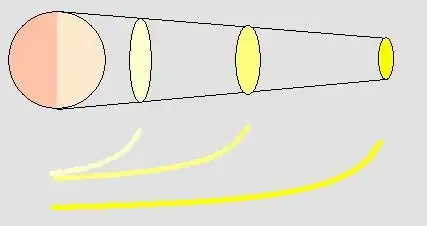
They say a picture paints a thousand words, so I'll augment the existing answers with a basic MS Paint representation.

The falloff is depicted by the yellow curves below the light paths. It's very rough, but given an 1/r² falloff, you can see how the falloff is much more gradual from the light source furthest from the subject.

enter image description here

Nick Bedford
  • 9,762
  • 3
  • 29
  • 40
3

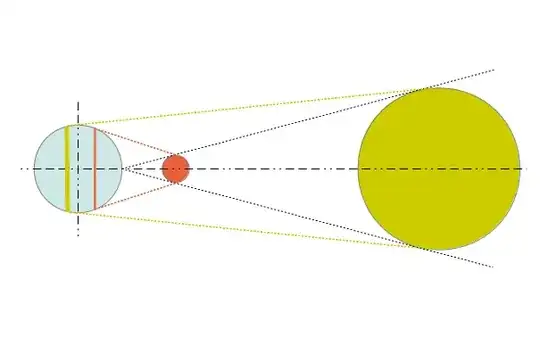
To be very precise, I think that if two sources have the same apparent size, then the farthest source will cast softer light. The apparent size is determined by the angle of view of the object (the source).

Imagine two light sources, at distance D and size H and at distance 2xD and size 2xH. Also, imagine the subject's head is of size 1.5xH. It is easy to see that although to the subject's eye the two sources appear the same size, the light falling from the far source "wraps" around the subject's head, while the light from the near source does not.

UPDATE: here's a sketch to show what mean by "wrapping". The bigger light source illuminates the subject beyond its equator, while the smaller does not:

UPDATE 2: updated the diagram to make it more geometrically precise.

enter image description here

ysap
  • 11,208
  • 3
  • 37
  • 56
  • I'm not sure I really buy this. By this definition, the sun should sufficiently wrap around everything - being a very, very far point light source. – rfusca Aug 09 '11 at 02:29
  • @rfusca - The sun indeed wraps around all spherical objects which are smaller than itself. However, the further away the object, the less this wrapping will be beyond the day-night "equator". Also note that due to the atmosphere, this effect is somewhat eliminated by the scattering of light by in the atmosphere (which is why we have light before sunrise and after sunset). – ysap Aug 09 '11 at 02:43
  • I'm confused about your argument then, you seem to be saying that distance plays increases 'wrap around'. – rfusca Aug 09 '11 at 02:56
  • If the light surfaces have the same apparent size, the wrap around should be about the same. However, the nearer light, having more fall off, might appear softer - the transition from light to shadow would be softer due to the fall off. – MikeW Aug 09 '11 at 03:25
  • @rfusca - not the distance - the size. I'm adding a quick drawing to exemplify this point. – ysap Aug 09 '11 at 06:03
  • The size does not matter. It's the apparent size, measured as an angle (10 degrees at 10 meters is going to be larger physically than 10 degrees at 5 meters, but given the power to reach the same exposure at 0 meters), the difference is only in how quickly the light diminishes as it carries on past it's subject. – Nick Bedford Nov 03 '11 at 05:06
  • @NickBedford - No, you are wrong. The diagram I added shows that no matter how far the larger source is, it still illuminates areas which are shaded with the small source. In this case, the large light illuminate areas past the body's equator. It is true, though, that the area past the equator gets smaller as the light gets farther away. – ysap Nov 03 '11 at 05:15
  • @ysap the question is talking about the difference between light sources that are visibly the same size to the subject, being physically different in size depending on distance. Your example doesn't show this, instead showing the difference between apparently different sized light sources. – Nick Bedford Nov 03 '11 at 05:18
  • @NickBedford - Admittedly, I did not draw the sketch with a precise engineering package, but you can imagine that the two sources are tangent to a cone whose head point is at the object's "eye", thus making them look the same size while having different lighting effect. – ysap Nov 03 '11 at 05:28
  • 1
    @ysap they wouldn't look the same size. The lines going from the sources to the subject are different angular sizes. I'm not arguing that the diagram is incorrect. It isn't. But the question isn't the same as what that diagram is depicting. – Nick Bedford Nov 03 '11 at 05:41
  • 1
    @NickBedford - You actually made me go and update the diagram. Hopefully it is clear now that the apparent size of the two sources is the same (from a cyclop's point of view...), while the lighting effect is different. – ysap Nov 03 '11 at 06:14
  • @ysap: Well, in this diagram you show that two sources might have the same apparent size from a small point, but different apparent size for much larger object. It does not mean there is any lighting difference for the small point. – che Nov 29 '11 at 09:53
  • @che - think of the lit object as the person's head. The "point" is the person's (cyclop) eye. For the subject, the two sources look exactly the same (sizewise). However, the lighting effect they cast on his head are different, as can be seen in the diagram. – ysap Nov 29 '11 at 14:53
  • @ysap: So, how do you judge apparent light size when you're shooting a sofa? – che Nov 29 '11 at 20:35
  • @che - There is no "apparent" light to a sofa. The whole concept of apparent light is ho one sees the light sources. A sofa doesn't see them. Then, the same conclusion that you had with a person's head applies to a sofa - sources with different sizes can cast different lighting patterns on a sofa, even if, when you sit on the sofa and view the sources as if they were the same size. – ysap Nov 30 '11 at 00:01
2

If the apparent size of the light is the same, then the light will appear the same, with a few exceptions.

  1. The close light source might be close enough where the angles are different to different areas.
  2. The closer light source might allow for some reflection off of other surfaces, which would have different effects.
  3. The angle at which the light spreads might cause some different shadows to appear. Think a small light right on a person's nose, vs a huge light far away. The far away light will have parallel rays, the close light will give different shadows.
  4. If the subject is large, say, a room or landscape, then the further away light source will more evenly light the subject than a close light source.

But in general, it shouldn't make much of a difference.

PearsonArtPhoto
  • 10,941
  • 10
  • 60
  • 93