1

I have been reading some things about photography and most make sense, with some exceptions.

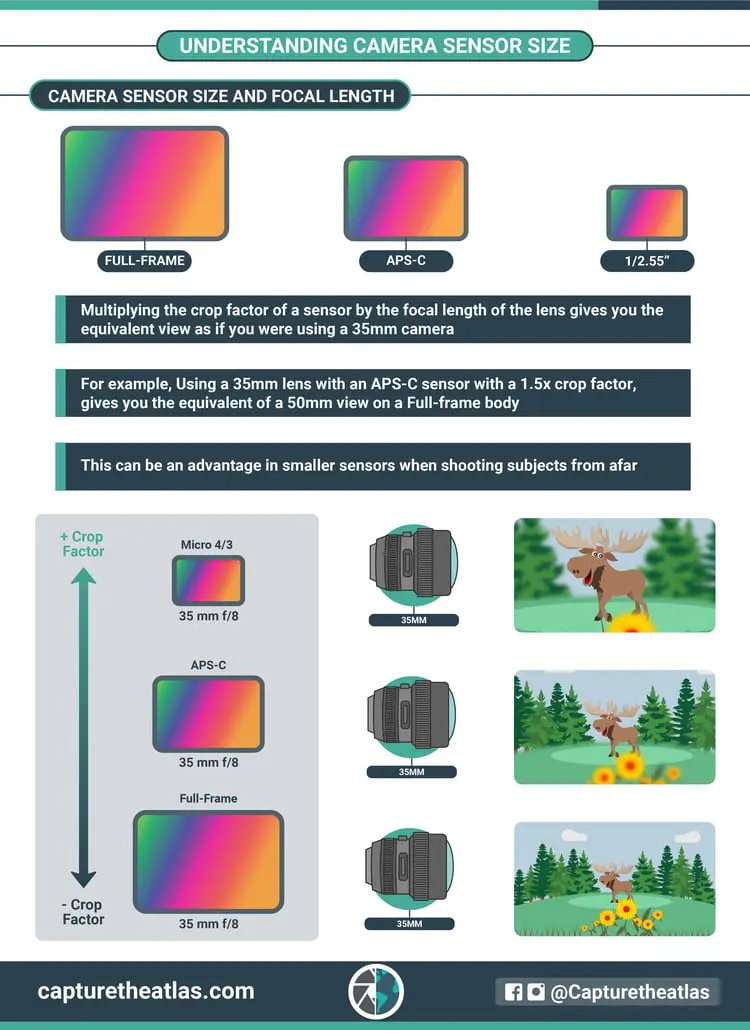
About sensor sizes, I was reading this nice article where at some point, scrolling down, it says that with the same lens, as the sensor size gets smaller, we get a cropped version of the picture. And it summarizes it with this nice image.

What I don't get is this: with my current understanding, shouldn't the deer in the picture appear the same size in the micro 4/3 sensor size as with the full frame size? Why does the dear appears larger as we go to a smaller sensor size? All other things being equal (sensor pixel/photosite density), shouldn't the image in a smaller sensor be just cropped but the object appear the same size?

Or put it differently, will the deer appear bigger, because smaller sensors also usually have higher pixel density? Or am I missing something?

Michael C
  • 175,039
  • 10
  • 209
  • 561
MirrorMirror
  • 113
  • 3
  • The image circle created by a lens will be the same, no matter the size of the sensor. The smaller the sensor is, the smaller the part of the image circle it will fill out. When it fills out a smaller portion, the part of the image circle that is hitting the sensor will appear to be bigger (or more zoomed in) when compared to the part filled out by a larger sensor. You can see more here: https://photo.stackexchange.com/questions/139/what-is-crop-factor-and-how-does-it-relate-to-focal-length – John Sørensen Nov 17 '22 at 12:44
  • The image of the circle with a red and a blue square in this links illustrates it perfectly: https://en.wikipedia.org/wiki/Crop_factor – John Sørensen Nov 17 '22 at 12:46
  • ok so, if the smaller sensor has the same photosite/pixel density (meaning less pixels in total), the object should appear at the same size. The reason it appears bigger is because pixels are more dense. So the object appears bigger IF both sensors have the same number of pixels, or put it differently the smaller sensor has higher pixel density, right? – MirrorMirror Nov 17 '22 at 13:00
  • No. This doesn't have anything to do with pixel density. Not directly at least. Regardless of the amount of pixels within each of the squares, the object will fill out more of the total square, if the square is smaller. With a higher pixel density you will be able to crop further after the photo has been taken, to make the object appear even closer (until you have so little pixels that the image quality is too poor) – John Sørensen Nov 17 '22 at 13:34
  • 1
    @JohnSørensen - well, it does have a lot to do with pixel density. If a full frame & APS are both 24MP, then the picture of the deer will literally be larger in the APS. It will take up more of that 6000x4000 image. I know what you're saying, but the OP is seeing it this way & it is, in effect, true [even if the quality of image in each will not necessarily be equal.] – Tetsujin Nov 17 '22 at 14:24
  • Don't forget that after the crop, the image is essentially 'blown up' so that the final image size is the same. So, say a 5x7 print, you wouldn't want an image that only fills 30% of the print, you will take that image edge to edge. So in the images referred, remember, those are being taken edge to edge after the crop. – cmason Nov 17 '22 at 18:02
  • 1
    @Tetsujin I disagree. It has nothing to do with pixel density. Even if you had 10 times as many pixels within the smaller sensor square the maginfication by crop would be the same. But having far more pixels within the smaller sensor square allows you to have the option of cropping far more while still, in theory, keeping enough pixels on the subject and thereby gaining further magnification. But the OP asked "with my current understanding, shouldn't the deer in the picture appear the same size in the micro 4/3 sensor size as with the full frame size?" Not "how much can I crop an image?" – John Sørensen Nov 18 '22 at 06:55
  • 1
    It has everything to do with pixel density. If I'm shooting wildlife on a FF, my lens doesn't reach as far so I have to crop from 24mp to something smaller, with fewer pixels. If I shoot APS, then I can reach further & not crop. My resulting image therefore has more pixels at the same frame size. Should the deer in the picture be 'the same size?' - only if you have the same pixel density. If you have the same pixel count then it wil be 'bigger'. – Tetsujin Nov 18 '22 at 08:09
  • Again. What you are adressing is the capability to crop in post-production. The lens does not receive magic magnification abilities because you have more pixels within a smaller area. It just means that you can magnify more while keeping as many pixels as with a bigger sensor with lower pixel density. – John Sørensen Nov 18 '22 at 09:10
  • 1
    We've only got 587 versions of this same question already existing here. – Michael C Nov 19 '22 at 00:05

3 Answers3

4

It all about the various levels/forms of magnification/resolution...

There is the lens' magnification/resolution... that determines how large the subject is projected onto the sensor, and how much detail/resolution the sensor might record.

There is the sensor magnification/resolution (pixel density)... that determines the size the subject is displayed at when enlarged to a certain degree (e.g. 100%), and the maximum amount of the available (lens) resolution recorded.

And then there is the print/display magnification; which when combined with the viewing distance determines the relative magnification, visible details/resolution, and the depth of field (relative sharpness of details).

The reason the smaller sensor resulted in a larger subject in that example is because they were output at the same print/display size/physical dimensions; which in-itself is independent of the pixel density... but the pixel density will/can still have a significant impact on the visible detail.

Steven Kersting
  • 17,087
  • 1
  • 11
  • 33
  • 1
    Ok so one factor is pixel density, the other is print/display size. I think I get what you mean: even if the pixel density is the same, if printed on the same paper size, the object will be larger because less pixels will be printed larger to achieve the same print dimensions. However if displayed on the same monitor (with same sensor pixel density), the object would be the same size if displayed at 100% , but would be larger if we tried to have the same monitor "dimensions" (same effect as printing) – MirrorMirror Nov 17 '22 at 15:04
  • 1
    @MirrorMirror, Yes, that's it... another way of saying it is that enlarging to the same physical dimensions is different amounts/percentages of enlargement. – Steven Kersting Nov 17 '22 at 16:34
3

Yes, assuming if using the same lens and focal length is possible, the lens does the same thing on all sensors, and then objects would all be the same size in all crop factor sensors. The cropped sensor simply makes the frame of the image smaller, the image frame around the same size deer (assuming the same lens). Cameras with small sensors routinely use a proportionally shorter lens focal length (wide angle) to compensate for the crop, to still show the same full field of view in the smaller sensors. The sensors are as shown in the left column (which don't contain the deer).

In the link you give (of the deer image), your question is because the right column shows all sizes of sensors enlarged so that all view at the same size. The smaller sensors must always simply be enlarged more for viewing, which does have the illusion of the object (the deer) being shown larger, merely because the small sensors must be enlarged more to be the same viewing size.

This is why some users think using a cropped sensor zooms more as if a longer lens were used, but that illusion is simply the greater viewing enlargement. They think of it as zoomed, but instead the image is simply enlarged more later. They can see exactly the same effect by simply cropping and zooming any existing image in their photo editor. There is no zoom magic with cropped sensors. It is just simple enlargement of the same pixels (with no additional detail), and IS NOT comparable what zooming the lens zoom does (which actually increases object size on the sensor, magnification as like with binoculars).

A cropped sensor is of course always a smaller image that must always be enlarged more to view it at any given size, like to print an 8x10 inch print.

WayneF
  • 12,879
  • 1
  • 16
  • 30
3

All other things being equal [...], shouldn't the image in a smaller sensor be just cropped but the object appear the same size?

Yes. That's exactly what's being shown. Just, the "cropped" image is being displayed at the same size as the uncropped one. The deer (surely it's a moose) appears larger in the "final" image only because that cropped image is being enlarged more, so that its width/height matches the uncropped image.

osullic
  • 12,093
  • 1
  • 23
  • 47
  • oh deer... it probably is a moose :-) I had no idea such a thing existed, looked like a deer to me, apparently they belong to the same family – MirrorMirror Nov 21 '22 at 09:32