2

Assume for a moment that I wanted to take photographs with my SRL with no lens attached. Suppose that I wanted to get extremely blurry, mostly solid color photographs. How would I set the camera's shutter speed to achieve a "proper exposure" of my blurry field of average tones. What Fstop is no lens?

Don't worry about my sensor, in this thought experiment it's a 35mm film camera.

WillD
  • 153
  • 10
  • 1
    Related: https://photo.stackexchange.com/questions/20968/can-i-shoot-a-photo-with-my-dslr-without-the-lens-on/37867 and https://photo.stackexchange.com/questions/8513/what-is-freelensing – Orbit Aug 20 '21 at 09:15

3 Answers3

3

You can use pinhole camera calculations. It doesn't really matter that it is a terribly made/designed pinhole camera.

The distance that the lens mount opening (pinhole lens) is in front of the image/film plane is the camera's focal length. And the opening's diameter in relation to the focal length is it's f-ratio/f#. For the Nikon F mount SLR/DSLR's w/o a lens it is 46.5mm flange distance ÷ 44mm lens mount opening = f/1.06

Of course, you still need a measure of the light intensity, and know the film's sensitivity, in order to determine an appropriate SS (at least approximately).

Steven Kersting
  • 17,087
  • 1
  • 11
  • 33
2

Imagine the point of view of one of the center-most point of the film or sensor plane, looking out of the camera box: your viewport of the world is the angle of view that is limited by the camera's flange. As it turns out, there's a fundamental concept in optics called the numerical aperture, a dimensionless number that characterizes that acceptance angle:

N.A. = n sin(),

where n is the index of refraction of the material, and is the half-angle of the acceptance angle (it makes things easier for most of optics to measure from the optical axis, rather than the total acceptance angle). Since there is no lens, and the sensor is in air, then we can assume n = 1, so the N.A. is simply sin().

Rather than measuring with a protractor, we can just calculate it from basic trigonometry, since we know the diameter of the camera's flange (D) and its distance from the sensor (f):

= atan(D / 2 f)

Putting it all together,

N.A. = sin(atan(D / 2 f)) (again, assuming n = 1)

Note that in the case of no lens attached, there isn't really a "focal length", because it's completely afocal. In this case, f is still the distance to the aperture though.

When talking about refractive optics, and also with pinhole cameras without refractive optics, we often define the f-number as N = f / D. But understand that definition only holds within the paraxial approximation, wherein sin() ≈ tan() ≈ . That is, it only holds for small . For pinhole cameras, D is usually very small (hence the name 'pinhole'), so sine and arctangent essentially become inverse functions of each other, and thus sin(atan(D / 2 f)) = D / 2 f = N.A.

But that just means that the f-number N = 1 / (2 N.A.). As it turns out, that's actually the definition of f-number.

So let's calculate some "f-numbers" for various camera without lenses attached:

Camera mount flange diameter D flange distance f N.A. N
Nikon F 44 mm 46.5 0.428 1.17
Pentax K 44 mm 45.46 mm 0.436 1.15
Canon EF 54 mm 44 mm 0.523 0.96
Sony E 43.6 mm 18 mm 0.771 0.65
Canon RF 50.6 mm 20 mm 0.784 0.64
Nikon Z 52 mm 16 mm 0.852 0.59
naked sensor, no body 0 1 0.5

Take note of that last line in the table: for a "camera" with no body (i.e., no throat limiting the angle of view of the sensor), sort of the "degenerate case" of the system, the half acceptance angle is 90º (the result of atan(∞/0)), which is the argument angle for which the sine function produces its maximum value, 1.

Thus, the maximum N.A. for an optical system in air (n = 1) is 1, and the corresponding fastest/widest theoretical f-number for any photographic system in air is f = 0.5.

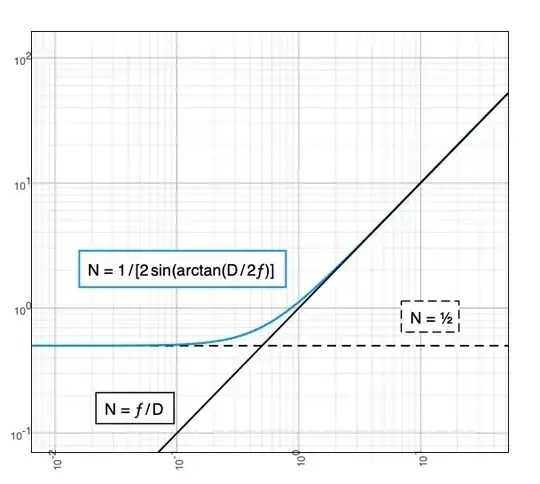
In the log-log graph below, the horizontal axis x is the ratio f / D. The 3 functions are:

  1. N = f / D (i.e., y = x) {solid black line}
  2. N = 1/2 {dashed line}
  3. N = 1 / 2 [sin(atan(D / 2 f)] (i.e., y = 1/2(sin(atan(1/(2 x)))) {solid blue line}

The solid blue line clearly aysmptotes to 0.5 as its argument gets small (that is, as D / f gets large, either because of a short focal length, or arbitrarily large throat diameter). enter image description here
scottbb
  • 32,685
  • 12
  • 104
  • 188
  • A comprehensive answer! Bottom line for the OP, absent camera specifics, short of a mirrorless camera the effective F-stop to use is *around* f/1.0 . – user10216038 Aug 24 '21 at 03:20
  • The definition of f-stop is N=f/D. And there are some differences in the N.A. formulas/results. Using the Canon EF/RF mount and the base N.A.=sinØ=.52; whereas using the formula for a lens focused at infinity I get N.A.=D/2f=.61. And applying those to N=1/(2N.A.) I get f=.96 vs f=.82; while N=f/D gives f=.81. I think there must be some difference for general optics/microscopes (sinØ) vs lenses at infinity, but IDK what they are or why. – Steven Kersting Aug 24 '21 at 15:46
  • @StevenKersting The definition of f-stop is N=f/D... until it isn't. You can't use f/D to help determine working f-number for close focusing; you need to go to first principles. And that's where N.A., as a first principle, always works. Honestly, the problem is linearly extending something that applies in the paraxial approximation beyond the point where the approximation is valid, in a domain it isn't meant for. But for exposure purposes only, N.A. Is the correct approach. And that's where "you can't get a lens faster than f/.5, ever" (in air) comes from. – scottbb Aug 24 '21 at 15:56
  • correction: I meant to say: for exposure purposes only, you can use f-number (when derived from N.A., not f/D) to get the equivalent exposure of a lens-less camera body. – scottbb Aug 24 '21 at 16:06
  • @StevenKersting you are correct, calculating a lens focused at infinity using N=f/D, works because a lens focused at infinity is in the domain of where the linear approximation of N=f/D is valid. In fact, that's pretty much the only case, because we're talking refractive optics. Anything less than infinity focus is a deviation from the approximation. It just turns out that the deviation doesn't matter much for non-negligible magnifications (say, 1:20 or so, and lower) (that is, focusing at or beyond appreciable distances, even including close portraiture). – scottbb Aug 24 '21 at 16:12
  • When f is derived from N.A.≈(D/2f) the result is f.82 where f/D gives f.81... near enough identical. I can see where N.A.=sinØ resulting in f/.96 is more accurate at very short distances where the relevant rays are not all parallel (do not reach all points on the objective). But that's not the working f/# either; and I'm not sure it is necessarily more appropriate for a body w/o a lens. Still, the formulas you provide for cameras with optics and for pinhole cameras results in f/.82. – Steven Kersting Aug 24 '21 at 17:20
  • I think I understand now... the paragraph showing the formula resulting in N.A.=D/2f applicable to narrow angles/pinhole cameras (and well corrected lenses) should be clarified as probably/possibly not being applicable to a camera without a lens (short distance to large opening/large angle) and therefore was not used... or leave all of that out? And maybe clarify that f# is 1/(2N.A.) because N.A. is based on the half angle of view? Assuming I've gotten it clear now... :>) – Steven Kersting Aug 24 '21 at 17:32
  • @StevenKersting I think you got it now. And to bring it all home, the handwavy "well corrected lenses" bit at Wikipedia is correct, but there's no need for the handwaviness. For a refractive optic, the focal length is approximated as the perpendicular distance to the entrance or exit pupil. But for N.A. purposes, a marginal ray travels a focal length to get to the optical axis after being refracted. That is, when drawing the D/2f triangle to calculate the half-angle , rather than f being the cosine distance (along the optical axis), the optical axis should be the hypotenuse, and f is the ... – scottbb Aug 25 '21 at 18:38
0

Another way to think of F-stop is in terms of Light Reduction. A fast f/1.4 lens is 1-stop down or half the light (1/(1.4)^2) of an f/1.0. An f/0.9 lens would be (1/(0.9)^2)) or 1.23 times more light.

No lens would be zero effect on light levels, corresponding to f/1.0.

Many years ago I did take some pictures with No Lens. I was using a Minolta SRT-303 (European number for a U.S. 102). I believe, but am no longer sure, that the camera builtin metering defaulted to its maximum aperture of F/1.0 (There was an f/1.2 lens available so it had to handle at least that). Setting the shutter for correct exposure seemed to work.

So why would anyone want to take pictures without a lens?

I had some early attempts at astro-photograpy, specifically Saturn and Jupiter on Kodachrome-64. I didn't have access to an enlarger capable of doing the kind of massive blowup I wanted to try. In lieu of a super-enlarger, I put the original in a slide projector and projected directly onto the Minolta with no lens.

It worked! Getting the film plane aligned with the projector focus was ... painful ... but the end result was a super enlargement, along with horrid grain and crazy contrast, but it worked.

My suggestion is try F/1.0 and bracket.

user10216038
  • 2,241
  • 8
  • 10
  • No affect on light levels is f/0, which is impossible. If f/1 had no affect, then faster lenses would have to be increasing the available light intensity... and it is impossible to get more than was generated. An opening with no lens still reduces the light intensity at the image plane; because the light at the opening (lens) has to continue to travel to the image plane which causes it to spread out and loose intensity (the inverse square law). – Steven Kersting Aug 22 '21 at 23:28
  • 1
    @Steven Kersting - It's interesting that your edited answer treating the lens mount opening as a large pinhole computed to f/1.06, essentially f/1.0. Yet you are arguing against the very f/1.0 you computed. Yes, an f/0.9 would bring in more light than the mount opening (by your own calculation) because it would have a lens aperture larger than the mount opening, not because it's creating energy. – user10216038 Aug 23 '21 at 04:04
  • yes f/.9 is more light than f/1; but it is still less light intensity at the image plane than is available to the lens at that point/distance. Take Canon lens mounts for example... the EF and RF lens mounts both have an opening of 54mm; the EF mount has an flange distance of 44mm and the RF is only 20mm. That gives the EF lens mount an aperture of f/0.81 and the RF an aperture of f/0.37. Not that the effect on aperture is linear with the distance. Both are less than f/1, but neither is "no effect." – Steven Kersting Aug 23 '21 at 14:16
  • If the lens mount diameter is the smallest restriction, then it will be the maximum aperture for the optical system/path. E.g. the aperture restriction/blades can be after all of the optical elements, or somewhere in between. – Steven Kersting Aug 23 '21 at 14:21
  • @Steven Kersting - We're drifting away from the OP question, of which I think we both agree the answer to his question is f/1.0. I just couldn't ignore your comment of, "If the lens mount diameter is the smallest restriction, then it will be the maximum aperture for the optical system/path." Even a casual observation of nearly any long lens ever made will disprove that. A really good example of this concept is a "Speed Booster", which will re-channel large optical image areas to smaller areas. A short youtube video (there are many) reference is https://www.youtube.com/watch?v=uirMiOZ6ePQ – user10216038 Aug 23 '21 at 15:58
  • The lens mount is not the smallest physical restriction in any typical camera/lens, it is always the aperture diaphragm. One might think that the aperture of my Nikon 400/2.8 is 143mm and thus much larger than the 44mm lens mount, but it isn't... the aperture only appears to be 143mm to the optical path due to the magnification by the objective lens (the entrance pupil is 143mm). And a speed booster is not overcoming an aperture restriction; it is concentrating a larger image circle into a smaller image/sensor area. – Steven Kersting Aug 23 '21 at 17:07
  • @Steven Kersting - "One might think that the aperture of my Nikon 400/2.8 is 143mm and thus much larger than the 44mm lens mount, but it isn't...." At the maximum F-stop of your lens (2.8), working backward to compute the aperture: 400/2.8 = 143mm. So yes I do think it's 143 mm because it is! – user10216038 Aug 24 '21 at 03:07
  • No, the f/# is based on the entrance pupil diameter; not on the physical size of the aperture diaphragm opening. As I said, the aperture appears to be 143mm, and that's what matters. – Steven Kersting Aug 24 '21 at 12:22