41

It has been mentioned at a few places that a larger sensor results in images with a shallower depth of field. Example image:

APS-C Canon 30D left, FF Canon 5D right, same lens, same composition, both f/2.8

APS-C Canon 30D left, FF Canon 5D right, same lens¹, same composition, both f/2.8

I understand how sensor size would relate to, for example, field of view, but the relationship with depth of field does not seem straightforward.

It actually seems contradictory - I have more wells on my sensor, and I am able to focus on less number of points.

What is the reason for this effect?

1 Same lens zoomed to a different focal length using the same f-number. This changes the entrance pupil diameter by the same factor as the change in focal length.

Michael C
  • 175,039
  • 10
  • 209
  • 561
Lazer
  • 4,029
  • 6
  • 37
  • 45
  • See this question and its answers http://photo.stackexchange.com/questions/10079/. The relationship is actually pretty direct. – mattdm May 16 '11 at 13:36
  • agreed with Matt. Looks duplicate to me. – epoon May 25 '13 at 02:59
  • 3
    It's not correct to say that the same lens has been used here. In your example the lens has been zoomed in (focal length has been changed). This is very important when we talk about DOF. – Sunny Reborn Pony Aug 19 '14 at 08:50

6 Answers6

41

Firstly, the number of wells on the sensor has no bearing on where you can focus or 'how much' you can focus on. Out of focus light is still light hitting the sensor.

Simply put, you have shallower depth of field with a full-frame sensor because you have to get closer to the subject (or zoom in) in order to fill the frame. Note that in your example it says same composition: the camera has been moved or the focal length changed in order to fill the frame with the bottle.

To put it another way, if you fix a tripod in place and take a shot with an APS-C camera with the bottle filling the frame, then take the same shot in exactly the same position with a full-frame camera, you will have more space around the bottle. So you will either need to zoom in or move the camera closer to achieve the same shot where the bottle fills the frame, either of which will alter the depth of field,

See this excellent summary of sensor sizes and their effects.

ElendilTheTall
  • 17,891
  • 2
  • 46
  • 78
  • @ElendilTheTail Well said. @Lazer, it is because the person who took the picture moved the position of the camera. – Dave Nelson May 16 '11 at 13:28
  • 2
    -1 full frame sensors do inherently have less depth of field, it's not to do with getting closer, in that example the camera was not moved in order to fill the frame with the bottle - I know 'cos I shot it! – Matt Grum May 16 '11 at 13:33
  • Edited for accuracy; if you didn't move the camera, you changed the focal length, nes pas? – ElendilTheTall May 16 '11 at 13:39
  • I've rescinded my hasty downvote as I think I misread, from "Simply put, you have shallower depth of field with a full-frame sensor because you have to get closer to the subject in order to fill the frame" it sounded like you were suggesting that you must move the camera physically closer to get shallower depth of field. If by "get closer" you mean zoom in, then you are correct. – Matt Grum May 16 '11 at 13:41
  • 4
    Right. I don't mean you have to move the camera closer (or zoom in) in order to get a shallower DoF, I mean you have to move closer (or zoom in) to fill the frame which results in shallower DoF. – ElendilTheTall May 16 '11 at 13:52
  • 1
    Yeah I changed focal length, as far as I'm concerned zooming counts as using the same lens (others seem to disagree) – Matt Grum May 16 '11 at 18:09
  • 8
    When you are zooming you are changing the focal length - and it is focal length that is the critical aspect here. Whether you do it by swapping one prime lens for another or by zooming a zoom lens is irrelevant. – Staale S May 18 '11 at 08:21
  • 1
    This is wrong answer. DOF changes because the circle of confusion changes. – epoon May 25 '13 at 10:39
  • 1
    Read this:http://www.cambridgeincolour.com/tutorials/digital-camera-sensor-size.htm – ElendilTheTall May 25 '13 at 19:28
  • @epoon The CoC changes because the enlargement ratio for the smaller sensor changes to view images from different sensors at the same display size. – Michael C Jun 27 '18 at 08:03
15

Without moving the camera you will get shallower depth of field when using a larger sensor whilst maintaining aperture ratio and field of view (whilst maintaining the same final output size). I.e. if you keep the same settings but zoom the FF camera to match the angle of view (yielding an equivalent composition).

Depth of field is a function of the physical size of the aperture. A 75mm f/4.0 lens on a full frame camera has a physical aperture that is 75/4 i.e. 18.75mm, whereas a 50mm f/4.0 lens on a 1.5x crop camera has a physical aperture that is 50/4, 12.5mm

From this it is easy to work out what equivalent aperture you'd need to get the same depth of field with both cameras/lenses, to get a physical aperture of 18.75mm with a 50mm lens it would have to be f/2.6 (50/18.75) which is more than a whole stop faster!

Matt Grum
  • 118,892
  • 5
  • 274
  • 436
  • well, I thought same composition meant same aperture.. – Lazer May 16 '11 at 13:43
  • 1
    @Lazer composition usually refers to the position/orientation of objects in the frame, not to camera settings such as aperture or shutter speed. – Matt Grum May 16 '11 at 13:46
  • 4
    @MattGrum - "physical size of the aperture"! That is exactly the variable influencing the DoF, and not the f#, which is a relative figure. +1. – ysap May 16 '11 at 17:16
  • Might want to change "without moving the camera". To achieve the same framing when changing from a smaller to a larger sensor but maintaining lens and aperture (as stated in the quote in the question), you would indeed need to move the camera closer since you now have a wider FoV...and thats ultimately what changes DoF. – jrista May 16 '11 at 17:57
  • @jrista you can zoom without changing the lens! I never said the focal length was maintained, only the optic that was used. As far as I'm concerned moving the camera results in a different image (as the relative positions of objects and their appearance can change), making the comparison invalid. – Matt Grum May 16 '11 at 18:14
  • 1
    Depth of field can certainly be included under the broad umbrella of composition. And arguably shutter speed can as well, or at least can be a tool in composition when there's motion in the scene. – mattdm May 16 '11 at 18:57
  • 1
    @Matt: I would be curious what the actual subject distances were for your two shots, then. You obviously had to change the camera you were using. Was the subject distance identical between both shots, or did it change as you recomposed the shot to maintain framing and composition with the first shot? What was the focal length of the first shot, and what was the focal length of the second shot? In all the demonstrations of why FF has shallower depth of field than APS-C, the same lens (and focal length+aperture) were used, and only the subject distance changed to maintain framing/composition. – jrista May 16 '11 at 19:25
  • 1
    The moment you throw a dynamic focal length into the mix, I think it is harder to demonstrate the REAL reason why full-frame cameras have shallower DOF (given that focal length is a function of lens, while subject distance is a function of camera.) The question that then arises is...is the difference in DoF purely due to sensor size differences...and therefor subject distance, or is it also partially because of a different focal length? The formula for DOF involves focal length and subject distance, however sensor size itself is not an intrinsic component of the formula. – jrista May 16 '11 at 19:30
  • @jrista I can't remember the exact subject distance but I kept it as constant as possible between shots. Likewise I don't know the focal length (I'll see if I can look it up from the EXIF) but the length used with the 5D was about 1.6 times as long. I've seen plenty of sensor size DOF comparisons that vary focal length rather than subject distance, in fact I regard this as the correct way! – Matt Grum May 16 '11 at 19:58
  • @jrista cont. Imagine you are comparing the depth of field between a compact and FF DSLR, the crop factor is about 7, using the same focal length so you'd have to be seven times closer with the DSLR, which would yield a totally different looking image, and may even have problems focussing on the subject without a macro lens! I don't get what you mean by "dynamic focal length" masking the real reason FF DOF is shallower... the reason is simple, with FF you have a larger aperture for the same f stop & field of view. Finally sensor size does factor in DOF equations as it has to do with CoC size. – Matt Grum May 16 '11 at 20:09
  • @Matt: Regarding CoC size, that only matters if you are disproportionately scaling images between formats (i.e. you scale an APS-C image more to achieve the same print size as a FF image), and I don't think that necessarily applies to comparisons of DoF (you could make the argument, but eliminating it as a factor simplifies things.) Regarding changing focal length, yes, you can make the comparison that way, but more factors are in play (changing focal length changes physical aperture), and its harder to understand. When you change subject distance, ONLY distance changes, all else is static. – jrista May 16 '11 at 21:03
  • Were probably just talking semantics now, as either approach produces the same result. Its not that changing focal length between cameras is incorrect...but I do think it complicates the problem in the general case and makes the point harder to understand. (Comparing DOF between a P&S and a FF DSLR is one thing...and perhaps changing focal length is your only option there, but I think the normal comparison is between APS-C, FF, and maybe MF.) I tend to opt for the simplest approach where the fewest variables possible change...but its certainly not the only viable approach. – jrista May 16 '11 at 21:06
  • 1
    @jrista Of course you have to have to scale to the same output size when comparing sensors, otherwise if you compare a P&S with a DSLR you wind up comparing a 6"x4" to a postage stamp. It just doesn't make sense! There is exactly the same number of factors in play when comparing sensors and changing focal length and when comparing sensors by changing focal length: one. But changing focal length yields images that look roughly the same and have the same perspective, so that's clearly the right choice to me. – Matt Grum May 16 '11 at 21:22
  • Why use a different approach when comparing a 2/3" sensor to a 36mm sensor than you'd use to compare a 23mm sensor to a 36mm sensor? And again I fail to see why moving the camera closer means fewer variables change than if you zoom in. Exactly one variable changes in either case! – Matt Grum May 16 '11 at 22:21
  • The relevant measurement in terms of how lens aperture affects depth of field is not the absolute physical diameter of the aperture diaphragm, it is the diameter of the entrance pupil. – Michael C Jun 27 '18 at 08:02
13

Why does a bigger sensor lead to a shallower depth of field?

In simple terms: It doesn't.

If you used exactly the same lens, and only changed the sensor size, you would not get a shallower depth of field with the larger sensor.

It's only when you change other variables to compensate for the different sensor size that you may get a change in depth of field.

In the case of the example images you posted, the photographer actually moved the camera! He presumably did this to compensate for the change in sensor size, so that the main subject filled approximately the same portion of the frame. However, clearly when you move the camera, it changes the perspective and relative distances between objects - in this case, with the camera further from the subjects it will have more depth of field.

Of course, if he hadn't either moved the camera, or changed the focal length (via zooming or changing lenses), then the shot taken from the smaller sensor would look "cropped", only showing a portion of the image the larger sensor shows. But in all other respects the technical aspects of the photo would be the same, only cropped.

So the reason a lot of things change according to sensor size is not actually due to the sensor size, but due to what you do to compensate for the sensor size, whether that be by choosing a different camera location, lens, or zoom level. In the case of this example, it was choosing a different camera locations - specifically, changing the camera to subject distance.

thomasrutter
  • 13,600
  • 2
  • 40
  • 53
  • 1
    It's a pity that most people won't read as far as this answer. In my opinion, it's the one with the clearest description of the actual explanation. – osullic Jun 26 '18 at 23:09
5

maybe the clearest way to explain this is: if you compare it to a cropped (aps-c) sensor, shooting the same thing from the same point, to get the same result (framing) on full frame you need a longer focal length; as a matter of fact, longer lenses give a shallower depth of field.

edit(more accurate, more annoying): so it's uncorrect and misleading to say a bigger sensor leads to a shallower depth of field, at least directly, no way this could actually happen.

Depth of field really depends on focal lenght and f-number ONLY; on every possible sensor (or film) the same lens (same settings) will give the same depth of field. If we assume every camera we put this given lens on has the right mount to fit it and the same distance between the lens and the focal plane to get focus right, all we get comparing all possible sensor/film formats is different cropped parts of the same projected image circle.

UPDATE: Here's an update to tell my commenters (and everybody interested) why I didn't account for CoC in relation to sensor size in my answer above. Most people who may read this already know probably more than me about this subject and may find stupid to read something they already know; keep in mind I'm just trying to put this in perspective.

For those who don't know, a Circle of Confusion is one among infinite dots of light a lens projects on its focal plane, in our case the part of a camera where a sensor or some film is. The closest this dot gets to a point (which has no size, but our dot is never a point because lenses are not perfect), the sharper the image (in that area), and vice versa. (A rough definition just to introduce newcomers to the subject, experts please don't waste time criticizing this).

I think we can agree the maximum permissible CoC is a value used to determine with mathematical certainty what is in focus and what is not; it serves the purpose of "drawing a line" (as actually there is a smooth transition between in focus and not in focus), and it may well be adjusted according to the print size you want to achieve, as a larger print would make this transition more evident and, at some level, one would notice that some areas, appearing to be in focus looking at a smaller print of the same image, are actually out of focus.

Applying formulas in which one element is the CoC to determine DOF is an analytic process, so it's a way to understand what's going on, not changing things (i.e. the image a lens is projecting on a focal plane). The fact that CoCs exist and that one needs to decide what's the right CoC size to produce a sharp image of a given size is not changing the way a lens works across different sensors/film formats.

If you want to get a large print, I understand it may be needed to consider a different acceptable sharpness. In my answer above I assume (and I declared I do) the focal plane is always the same, that's what's happening in modern DSLRs we're talking about: the different rendition of a lens on different bodies is just a matter of cropping.

an ugly oversimplified drawing sometimes helps that's it
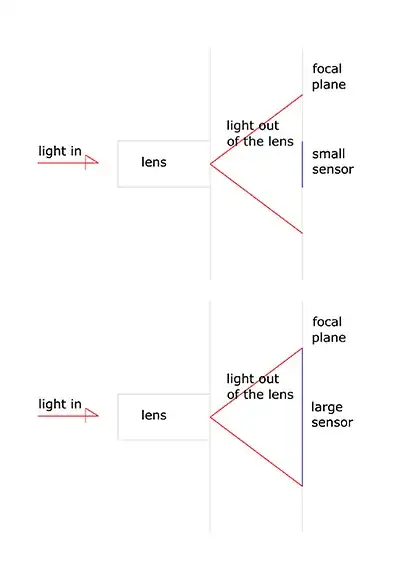
making two print of the same size from the two different sensors will give varying results depending on the resolution of the two sensors.

if we assume pixel density is the same for both sensors and we print at a fixed resolution, the prints from the smaller sensor will look exactly like the larger ones, just cropped.

if again we assume pixel density is the same and we print at a fixed size, the prints from the smaller sensor will look like enlarged crops of the larger ones, at a lower quality.

if we simply and more correctly to the purpose of our analysis assume both have enough pixels to print a fixed size we want without noticeable loss in quality, what we get in prints from the smaller sensor is like a cropped enlargement of the print from the bigger sensor, so we can indeed see a difference in depth of field, that is, we see more detail so it's easier to spot slightly out-of-focus areas. This we could have accounted for if we decided to put a larger CoC in the formula when, while shooting, we calculated the DOF. Who's so rough a photographer not to do so? ;-)

However, I'm not really mocking anyone. I'm just saying, long story short: if you do big prints you might want to squeeze a bit more DOF out of your aperture selecting a higher f-number, so some part of the image around the line separating out of focus and in focus will be sharp enough to be considered fully in focus also in enlargements. That's it.

The same lens with the same aperture settings (at the same focal length if it's a zoom) will always give the same result. CoC is not a physical variable like those I just mentioned which really changes light coming out of the lens and into you camera, it's a parameter used to determine mathematically if something is in focus.

You can't say DOF is a function of sensor size (among others) because larger sensors are used for large prints and in large prints you see out of focus areas that in small prints you don't see. First because to call this an indirect relation is an euphemisms, then because this is accounting for detail at the expenses of sheer exactness. Maybe I'm missing on... more than something.

MattiaG
  • 1,178
  • 1
  • 8
  • 12
  • 7
    Quantitatively, the depth of field formulas depend on a "maximum allowable circle of confusion," which basically depends on what you consider to be "acceptably sharp." Some people impose the same allowable CoC in all circumstances (sort of a quality metric for lenses), in which case this answer is correct. Others, including myself, believe this "acceptable sharpness" criterion only makes sense in the context of a finished work, e.g. a print. In that case, the maximum allowable CoC depends on the degree of enlargement, which in turn depends on sensor size. – coneslayer May 16 '11 at 16:23
  • @coneslayer - thank you, at last someone states the one fact that so many overlook. DoF is not only a function of f# and FL, but also of the output format and sensor size. It is a combination of them all! – ysap May 16 '11 at 17:14
  • 2
    I always assume the same final output size (in which you do get shallower DOF with the larger sensor) as it's not like people print images from P&S cameras a tenth of the size as those from DSLRs, no people tend to print/view images the same size regardless of how large the sensor is! – Matt Grum May 16 '11 at 18:26
  • 1
    @Matt: Me too, and I thought that was pretty well accepted, but see http://photo.stackexchange.com/questions/11291/why-invest-in-high-end-large-and-medium-format-digital-cameras/11311#comment-17087 for a dissenting opinion. – coneslayer May 16 '11 at 18:59
  • @coneslayer - see the update in my answer. Thanks for your interesting comment which prompted me to think more about this stuff. – MattiaG May 17 '11 at 14:44
  • 1
    +1 for "If we simply and more correctly to the purpose of our analysis assume both have enough pixels to print a fixed size we want without noticeable loss in quality, what we get in prints from the smaller sensor is like a cropped enlargement of the print from the bigger sensor, so we can indeed see a difference in depth of field, that is, we see more detail so it's easier to spot slightly out-of-focus areas." A smaller sensor or a crop from the large sensor have exactly the same effect of increasing apparent DoF when enlarged. – mattdm May 17 '11 at 15:12
  • @mattdm - thanks, it's good to hear some confirmation. I was a bit afraid of messing everything up in such an involuted analysis. – MattiaG May 17 '11 at 15:47
  • @mattdm A smaller sensor or a crop from the larger sensor have exactly the same effect of decreasing apparent DoF when enlarged. – Michael C Dec 26 '23 at 16:19
1

Depth of Field is a function of many variables, one of them being the distance to subject. In the example shot you posted, the left-hand side was taken with a Canon 30D, which has an APS-C cropped sensor (24mm), while the right-hand side was taken with a Canon 5D, which has a Full Frame sensor (35mm). Both photographs were taken with the same lens at the same aperture.

The reason DoF changed between the 30D and 5D is because to maintain framing, or the size of the subject relative to the size of the image, you have to get the 5D closer. This is because the 5D has a wider Field of View for any given lens than the 30D. The closer you focus to a subject, the thinner your Depth of Field will be.

jrista
  • 70,728
  • 15
  • 163
  • 313
  • Actually, the photographer who produced those images says the camera position did not change. He also said he used a zoom lens and maintains that even though he changed the focal length, since he used the same f-number (which also changed the size of the entrance pupil to maintain the same f-number since the focal length changed), it's the same lens with the same aperture. It's more accurately the same lens using the same f-number, but it's the same lens with a different focal length/different aperture (entrance pupil size) to get the same f-number ratio. – Michael C Dec 26 '23 at 16:24
0

Depth of field is determined by only two factors. They are magnification ratio and fstop. By magnification i mean final prit size versus object size. larger sensors require less magnification to get to a particular print size thus appear to have greater depth of field, but if magnified to the same ratio as the smaller sensor, will prove that that the circle of confusion is based ONLY on the fstop.

carl
  • 19
  • 1
  • 1
    Your answer does not add new insights and this question was already answered with great details. You should avoid these king of answers. – Itay Gal May 24 '13 at 18:10