14

Prusik knots are useful in emergency situations as they can be used for both climbing up a rope (out of a canyon) or down a rope (rappelling) without someone else providing a fireman's belay.

How would I go about properly tying a Prusik knot?

Charlie Brumbaugh
  • 69,253
  • 35
  • 217
  • 423
Reverend Gonzo
  • 8,218
  • 11
  • 49
  • 77

1 Answers1

23

A Picture is worth a thousand words:
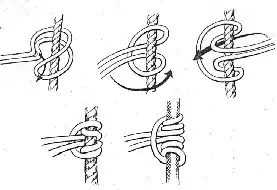
Illustration of a prussik knot

Ricketyship
  • 7,785
  • 3
  • 33
  • 69
  • I've used the first two steps a number of times. Is there much benefit to the additional loops? – Timothy Strimple Jan 25 '12 at 17:20
  • 2
    Friction I could see, but the weight is still being put entirely on the two ends coming away from the knot. Thanks! – Timothy Strimple Jan 25 '12 at 17:30
  • @TimothyStrimple More wraps = more friction. You test it and see if it stops your descent with no hands. If it slips, you add more wraps. – endolith May 28 '18 at 23:25
  • @TimothyStrimple in my experience, it depends on what kind of activity you are doing. If it is merely a safety measure for self-belay, one or two wraps should be sufficient because a fall would cinch the prusik very quickly. However, when I am using a pair of prusiks to ascend a rope, I usually want at least 3 wraps because I need the prusik to bite into the rope immediately so I don't lose any effort through sliding. – BlackThorn Jun 07 '18 at 19:56
  • Rope thickness also matters. The bigger the difference between your ropes, the more likely you are to need a double or triple (the one in the picture) prusik knot. – Monster Jun 11 '18 at 08:35