Turntables come in many flavors. One of the main decisions to make when buying one is choosing between a direct drive and a belt driven mechanism.
What are the differences between them? Which are the pros and cons?
Turntables come in many flavors. One of the main decisions to make when buying one is choosing between a direct drive and a belt driven mechanism.
What are the differences between them? Which are the pros and cons?

Pros
The belt acts as a shock-absorber, preventing vibration transmitted from the motor reaching the platter
Isolating the motor from the platter results in less noise transmission to the tone-arm
It is generally considered that belt drive turntables produce better sound quality dues to less interference from the motor
Cons
Belt drives have lower torque & can have less accurate playback speed unless well-maintained
The belt will eventually wear & need to be replaced.
Belt drive turntables tend to be primarily used by audiophiles.
Significantly, very expensive systems all tend to be belt drive
Example: Linn Sondek LP 12 [base configuration] or just to show how silly the prices can get, the top configuration as advertised by one randomly Googled vendor - Linn Klimax LP 12
Pros
Higher torque & highly consistent speeds. Higher torque means the platter is less vulnerable to outside forces such as the stylus or your hand
Higher torque also means the platter will reach playback speed more quickly
Because there is no physical connection between platter & motor, it is possible to stop or even reverse the platter by hand.
Cons
Direct drive systems are exclusively preferred by DJs, for the fast start-up at cue, vari-speed controls for beat-matching & the ability to manipulate the platter by hand without causing damage; for scratching, etc.
Example: the almost ubiquitous Technics SL 1200, now unfortunately discontinued
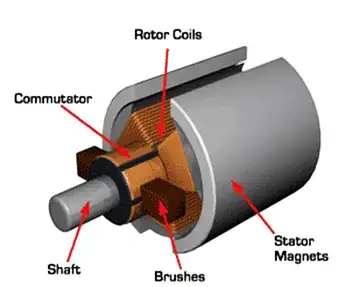
Simplified description of 'standard' vs direct drive motor.
In a standard electric motor configuration, permanent magnets are held in a fixed position surrounding a wire coil on a central spindle which is free to rotate. The rotating spindle extends outside the enclosing magnets & is then available to do the 'work' of turning an attached device - in a turntable, this would be a rubber pulley belt connected to the platter.
Stopping this with your hand would lead to the belt slipping, detaching or breaking.
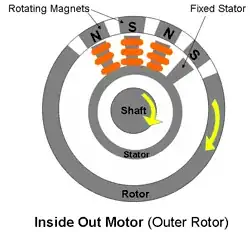
In a direct drive motor, this relationship is reversed.
The coil is held stationary, fixed to the body of the player. The magnets are attached to the underside of the platter itself. The spindle of the platter is the spindle of the motor.
As the two are not physically connected, stopping the platter with your hand causes no issues.
There is the possibility it could overheat if held long enough, but presumably direct drive turntables, especially those intended for DJ use are designed with sufficient cooling as to make this improbable.

There is so much misinformation when it comes to direct drive vs. belt drive turntables. Yes, much of what you hear about the two is pretty much correct, except..... Direct drive turntables have been around for a while now, and the technology has improved so much that you cannot compare the way a belt drive works and how a direct drive works and say that one is definitely better than the other. First, there are different designs of direct drive like the one described above, which is very much like the Technics design.
The motor circuitry and sound delivery circuitry is COMPLETELY separate from each other. DD motors are designed SPECIFICALLY to rotate smoothly, simply BECAUSE of the wow and flutter issue, which is what is actually being discussed as to VIBRATION and speed up and slow down. THAT is what wow and flutter is. When there is virtually no wow and flutter being produced(extremely low on a good DD TT), what is there for the cartridge to pick up????? All you have to do is research the wow and flutter specs of similarly priced turntables from the same era, say late 70's and you can READ the difference. The reason, is that DD TT are VERY stable, and GOOD ones have a heavy platter which helps keep wow and flutter at bay. My Pioneer PL-540 platter weighs about 5lbs!! It starts up very quickly, yes, but there is NO spurious sounds coming through! You have to compare APPLES TO APPLES and unfortunately, many people don't and keep repeating what all the so called experts say. Yes the belt helps absorb the flutter part of the equation, but NOT so much the wow part. Wow is the variations in speed that occur that only a DD TT is VERY successful in curtailing. Here is the link to my turntable specs, which at the time was about $500 and it has amazing specs: https://www.vinylengine.com/library/pioneer/pl-540.shtml Here is a similarly priced Dual belt drive from the same time period... https://www.vinylengine.com/library/dual/cs-1257.shtml You see the specs are much better on the Pioneer. It is all about design and technology. The late 70's, early 80's saw a huge increase in the refinement of DD TTs, and they are every bit as good or better than similarly priced belt drives. Today, belt drives are used almost exclusively for one major reason....COST! Yes DDs need a very techy motor with much supporting electronics AND that is why they are pricey, and the companies that make belt drive turntables want you to buy their product. I have 2 DD, and one is a Dual 606 which is as stable and maybe a bit quieter than my Pioneer, but the torque sucks! lol!!
