If there is no leak? So how does the coolant level decreases as time passes? Does it get pressurized so it's level decreases? Or what happens? Since it keeps circulating to the engine and coming back so why do we have to add some coolant every year or something, even if it evaporates inside it will again condensate after the engine is off and cooled
Asked
Active
Viewed 8.1k times
2

-
possible duplicate of Reasons for loss of radiator fluid – Zaid Sep 26 '15 at 15:56
-
@Zaid - I think there is some overlap here, but the gist of this question is different than is your question ... I'm not willing to vote to close at this point, but definitely see your point. – Pᴀᴜʟsᴛᴇʀ2 Sep 26 '15 at 16:00
-
good question!! – Shobin P Sep 26 '15 at 18:40
-
Water evaporates it's nearly impossible it will drop overtime . This is why after service or coolant change keep remainder in trunk to top off. And I would only measure overflow tank as vehicle reaches operational temperature. Cold level is bogus especially if there is a air pocket in system – Johnathan Cox Apr 20 '20 at 18:37
1 Answers
8
There are only four places (in general) coolant can go missing:
- Out an external leak and onto the ground
- Out through the tail pipe getting burnt (turned into steam) because of an internal leak
- Into the oil through an internal leak
- A very small amount may evaporate from the system if it's not a closed system (ie: no overflow reservoir) ... this really isn't a big deal, just add a small amount to make up the difference. (note: this fourth one was added as an edit)
Since coolant is a liquid, it does not compress, even if pressurized.
The first is pretty obvious as you can find it on the ground, usually. A leak may not occur until the system is fully pressurized, though (ie: after the entire system is fully heated). You would usually see this going on due to steam escaping the system.
The second is not as easy to tell, especially if it's a small leak. You could have a very small leak in the head gasket, which would go out through the exhaust. You would probably not see this going on, as when gasoline is burned, it creates a large amount of steam as well. You may be able to smell a sweet smell from the exhaust.
The third way you may or may not see as well, depending on the amount of coolant loss. If it is just a very small amount, it will mix in with the oil and get evaporated. If it's a larger amount, it will turn the oil to look like chocolate milk.
If you have just a small amount of coolant missing over time, a radiator stop leak (if used correctly) will find and stop the leak without issue.

Pᴀᴜʟsᴛᴇʀ2
- 156,290
- 29
- 252
- 491
-
So it shouldn't be decreasing at all? Even not adding some coolant every year, because that what i was taught, if it decreases a very small amount over time, is there a leak as well? – user3407319 Sep 26 '15 at 16:12
-
I think what they are telling is is it's not a big deal if you lose a little bit over time. You will lose a very small amount due to evaporation unless the entire system is sealed (no overflow tank). My opinion is, unless it's an obvious amount (ie: like having to add a quart per week - and that's an arbitrary number on my part), it's really not a big deal. – Pᴀᴜʟsᴛᴇʀ2 Sep 26 '15 at 16:24
-
Yeah I know it is not a big deal I am just wondering where it goes – user3407319 Sep 26 '15 at 16:29
-
I guess I should add in a "fourth" way you can lose coolant in my answer, eh? :D – Pᴀᴜʟsᴛᴇʀ2 Sep 26 '15 at 16:31
-
If you have a system with an overflow tank, it is still "sealed" unless the whole cooling system is unpressurized. But when you top up the system, it's quite likely the pipe between the main system and the expansion tank gets full or air not coolant, so the first time you run the engine the coolant level apparently goes down a bit as that air ends up in the expansion tank and the pipe stays full of liquid. The only times I've had a significant amount of coolant loss, in 30+ years motoring, has been caused by a leak somewhere. Usually the filler cap doesn't get opened for years on end. – alephzero Sep 26 '15 at 18:17
-
@alephzero - How do you account for inflow and outflow of fluid with an overflow tank? You have to push the air out somehow. An overflow tank is vented. This is the type of system you'd see in older cars (and some newer ones as well). Most newer ones have a sealed system. These usually have a reservoir which you can see the level from, but are still sealed and will have a pressure cap associated with them. These are not what I'm talking about, but maybe you are? – Pᴀᴜʟsᴛᴇʀ2 Sep 26 '15 at 19:18
-
Well, my memory of my first car (1960s vintage) was that it didn't have a header tank at all. There was just a pressurized cap on the top of the radiator, and you filled it to the level of the top of the radiator fins, so there was enough air space left for the water to expand. (10 pints of coolant expands by about 1/5 of a pint, going from 0 to 100C.) I don't know of any designs with an unpressurized overflow tank. There would have to be a pressure valve somewhere unless the whole system ran at such a low temperature that there was no chance of the water boiling inside the block. – alephzero Sep 26 '15 at 21:40
-
... and if you over-filled the radiator, the engine compartment got a hot antifreeze jet-wash when the radiator pressure cap valve opened! – alephzero Sep 26 '15 at 21:42
-
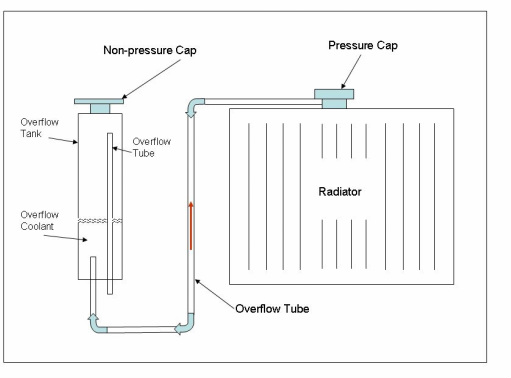
@alephzero - Yah, most had a down tube so you didn't get soaked (and scalded!). Here is a "universal" one from Dorman. Here's a basic image of the system ... believe me when I say, "It's very* common.*" – Pᴀᴜʟsᴛᴇʀ2 Sep 26 '15 at 22:21
-
It might depend which side of the Atlantic (or Pacific) you are on. I've never come across anything like that in the UK. Apart from ebay, the websites selling them shown on Google all seemed to be US based. The commonest system here is the "sealed system" in your earlier comment, with a pressure relief in the filler cap on the expansion chamber, and the bottom of the expansion chamber connected to the rest of the system so the coolant can flow both ways. – alephzero Sep 26 '15 at 23:36