114

EDIT (30 Nov 2012): MoMath is opening in a couple of weeks, so this seems like it might be a good time for any last-minute additions to this question before I vote to close my own question as "no longer relevant".


As some of you may already know, there are plans in the making for a Museum of Mathematics in New York City. Some of you may have already seen the Math Midway, a preview of the coming attractions at MoMath.

I've been involved in a small way, having an account at the Math Factory where I have made some suggestions for exhibits. It occurred to me that it would be a good idea to solicit exhibit ideas from a wider community of mathematicians.

What would you like to see at MoMath?

There are already a lot of suggestions at the above Math Factory site; however, you need an account to view the details. But never mind that; you should not hesitate to suggest something here even if you suspect that it has already been suggested by someone at the Math Factory, because part of the value of MO is that the voting system allows us to estimate the level of enthusiasm for various ideas.

Let me also mention that exhibit ideas showing the connections between mathematics and other fields are particularly welcome, particularly if the connection is not well-known or obvious.


A couple of the answers are announcements which may be better seen if they are included in the question.

Maria Droujkova: We are going to host an open online event with Cindy Lawrence, one of the organizers of MoMath, in the Math Future series. On January 12th 2011, at 9:30pm ET, follow this link to join the live session using Elluminate.

George Hart: ...we at MoMath are looking for all kinds of input. If you’re at the Joint Math Meetings this week, come to our booth in the exhibit hall to meet us, learn more, and give us your ideas.

Timothy Chow
  • 78,129
  • 32
    I'm reminded of the following quote, which perhaps would be good to include in the museum: "Numbers exist only in our minds. There is no physical entity that is the number 1. If there were, 1 would be in a place of honor in some great museum of science, and past it would file a steady stream of mathematicians gazing at 1 in wonder and awe." - Linear Algebra by Fraleigh + Beauregard – Zev Chonoles Dec 25 '10 at 20:38
  • 9
    What an opportunity! Clearly, the fact that many of us mathematicians ourselves don't even know about this project (or related ones mentioned in other responses) means, above all, we need to hire marketing professionals! And designers should build the exhibits. (But as for content, I've always liked the Borromean rings: http://en.wikipedia.org/wiki/Borromean_rings) – Eric Zaslow Dec 26 '10 at 03:09
  • 6
    I'm wary of both marketing professionals and designers. We are interested neither in selling junk people do not really need, nor in trying to beautify something that is ugly by its nature. If anything, we should get a few high level math. people with good taste and some knowledge of the outside world to make decisions about what to do. But I doubt it'll be done. I bet Percy Diaconis, say, has been neither invited as a consultant, nor even told of the project. – fedja Dec 26 '10 at 15:34
  • 7
    @fedja : While Diaconis doesn't seem to be involved, the advisory board (listed here : http://momath.org/about/advisory-council/) includes a lot of very good mathematicians, for example Bjorn Poonen. That being said, I'm still pretty skeptical that a "museum of mathematics" is possible... – Andy Putman Dec 26 '10 at 20:34
  • 3
    @Andy: What is the cause of your skepticism? Existing science museums already have sections devoted to mathematics. Perhaps the name "museum" is the problem. While the name "Museum of Mathematics" or "MoMath" might seem bland, it is not for lack of effort to find a better name. Literally hundreds of suggestions were considered carefully. Unfortunately, all the catchier names were either already taken by someone else, or violated someone's sense of taste. – Timothy Chow Dec 26 '10 at 22:32
  • 8
    @Timothy : My skepticism comes precisely from the math sections of a number of science museums I have been too. They've all been pretty lame (and that's not just Andy the math-snob talking -- my wife and kids haven't enjoyed them either). We just don't have cool things like robots or spaceships or dinosaur bones or life-size models of the human heart to show off! – Andy Putman Dec 26 '10 at 23:18
  • @Andy: Did you click on the Math Midway hyperlink? I went to a Math Midway and the exhibits were pretty cool. – Timothy Chow Dec 27 '10 at 00:01
  • 3
    Andy's comment reminds me of the math section at Boston's Museum of Science. I haven't been there in 5-10 years, but their list of "Living Mathematicians" has more and more dead ones on it...and it also has "Bourbaki". I offered to update the list for them for free about 15 years ago but they declined. – Ken Fan Dec 27 '10 at 00:39
  • 1
    @Andy: Also, are you aware of Germany's Mathematikum? – Ken Fan Dec 27 '10 at 00:44
  • 2
    Whenever I go to Munich, I visit the Deutsches Museum and go to the Informatik/Mathematik section. Napiers bones, planimeters, differential analyzers, the first computers, devices from antiquity for trisecting angles, nomographs, and many other examples of mathenatics are nicely arranged. (On the way to the exhibit, I thought I'd spend a few minutes looking at a smaller section devoted to geodesy. This much smaller exhibit took me 2 hours to complete!) Gerhard "Seen a Few Science Museums" Paseman, 2010.12.29 – Gerhard Paseman Dec 30 '10 at 05:19
  • 4
    If I may make a comment on the "we don't have cool things to show kids" statement: I think any kid would be entirely thrilled to walk on a Moebius band (or take a roller-coaster ride on one as technology and legal concerns permit). – stankewicz Dec 30 '10 at 21:41
  • 1
    There are lots of cool exhibits at the Exploratorium (http://www.exploratorium.edu/) -- in my mind the Exploratorium is the canonical model for science museums. I also had a great time at the mathematics and the computing sections of the Science Museum in London (http://www.sciencemuseum.org.uk/visitmuseum/galleries/mathematics.aspx), especially the working model of the Difference Engine. – Sam Nead Dec 31 '10 at 18:53
  • Doesn't the math section in Boston also mention a counter-example to the 4-color theorem? – Thierry Zell Jan 02 '11 at 19:41
  • 2
    @Andy: Really? I invariably enjoy the math sections of science museums. There's tons of cool stuff to show kids (and adults). And the Math Midway was a big hit at the World Science Festival in NY. I think the hardest part is to get people through the front door, because they hear "math" and think "boring." Just make sure not to have a timeline with b/w drawings of dead mathematicians. – Dan Lee Feb 04 '11 at 20:38
  • I agree about the Exploratorium. It's wonderful, and it's the only good Science Museum I've ever seen. Maybe there are others, but all the others I've been to (with the exception of "special-purpose" ones like the Museum of Natural History in NYC) are just embarrassing.

    I'll bet a good Museum of Mathematics could be constructed. But it would take some really good people -- people who were both experts in mathematics and excellent teachers -- to do it. And leave out the marketeers and "let's make math fun" types.

    – Carl Offner May 02 '11 at 01:28
  • 1
    Incidentally, in the history of science museum in Florence you can find the (mummified) middle finger of Galileo's right hand: http://brunelleschi.imss.fi.it/museum/esim.asp?c=404010 --- Definitely a peculiar exhibit. – Federico Poloni Oct 26 '11 at 10:49
  • 2
    I don't see any reason that you should close this suggestion thread or those on other sites when MoMath opens. Presumably, even after the first exhibits go up you'll be changing the exhibits from time to time and occasionally want to design new ones. – Michael Joyce Nov 30 '12 at 22:20
  • 3
    @Michael: The reason I suggest closing this thread is that the most logical way to communicate suggestions to MoMath after it opens is to communicate directly with MoMath, rather than to post something here on MO. While MoMath was still in the planning stages and was a largely unknown entity, it made sense to create a spot on MO for suggestions and discussion. – Timothy Chow Dec 01 '12 at 01:32
  • 3
    I'm voting to close this question for the reasons that Timoth Chow stated in his 2012 comment – Yemon Choi Sep 04 '15 at 01:34
  • 4
    I’m voting to close this question for the reason stated in the edit of 30 Nov 2012 (also explained in Timothy Chow's comment from 1 Dec 2012). – DamienC Apr 09 '21 at 21:10
  • 1
    @YemonChoi It looks like your vote to close expired, so I think you can vote to close again. – Timothy Chow Apr 10 '21 at 01:03

96 Answers96

80

At the science museum in London they have this very cute little gadget used by mapmakers 150 years ago: an axle with a rubber ring around it, and the ring pressing against a cone. The whole lot is attached to a metal stylus; you trace around an area on a map with the stylus and a little reader tells you the area of what you've traced around. I always found that ingenious. The exhibit in London then goes on to show how you can use the same idea to integrate and hence solve differential equations, and finishes with a monster machine that can solve ordinary 4th order ODEs using basically the same trick; you set the coefficients with dials and then the machine draws a graph of the output. I'm afraid I know neither the name of the cute gadget nor the machine :-( but it strikes me as being appropriate for a "math museum"...

Kevin Buzzard
  • 40,559
57

1) A high quality 3D movie (with glasses!) of sphere eversion, like this one

2) A Let's Make a Deal game show room, where people can play the game to death on a computer until they believe that they should switch doors. Offer candy prizes.

3) A scaled down Bridges of Koinsberg room, where you can try to walk across each bridge only once.

4) A large transparent (working!) replica of an Enigma machine.

5) A Velcro covered life-size Mobius strip which you can walk on with Velcro shoes (I hope you have good insurance)

Harry Gindi
  • 19,374
Alex R.
  • 4,902
  • 2
  • 40
  • 66
42

A cool gadget I've seen in a few science museums: There is a vertical board with a lattice of nails in it. You drop balls in from the top, at the center. After dropping enough balls, you always see a Bell curve, "proving" the central limit theorem. Then a catch releases the balls, they are transported back to the top, and you start again. The cooler versions of this have the Gaussian predrawn in the background (which displays a certain level of confidence! And a willingness to replace missing balls).

Edit - This is sometimes called a Galton box.

Denis Serre
  • 51,599
Sam Nead
  • 26,191
  • 7
    For searchability, this device is called a Galton box. – Zsbán Ambrus Dec 25 '10 at 22:54
  • Thanks for letting me know! I'll add a link to the answer. – Sam Nead Dec 26 '10 at 11:36
  • 9
    They have (had?) a Galton box in the math section of the Museum of Science in Boston with an added feature which I found intriguing (and clever): while most of the balls in the box are white, only a handful were black. After operating the machine the balls would overall arrange themeselves in a bell curve, BUT the few black balls would be scattered here and there in a unstructured random way. This shows that the expected distribution is reached only after a large amount of trials (=balls) while the theory is ineffective for a small amount. Unfortunately no panel on the exhibit explained this! – Andrea Mori Dec 31 '10 at 14:01
  • They have one of these at the nearby Queens Hall of Science. I wonder if MoMath can just purchase the Hall of Science's math exhibits. They're nice but completed ignored by most visitors. – Dan Lee Feb 04 '11 at 20:40
29

An exhibit on how cryptography works, and how it keeps online payments and transactions secure. Perhaps a demo or game where kids get to code a message, and other kids have to try to decode it.

29

A knot table, with the knots in it made out of a nice (pretty and pliable) material. It's aesthetic, and people might have fun playing with them.
One might include also the Perko pair! They come with a story, and it's a lovely (terribly difficult, but tremendously fun) challenge to figure out how to change onto into the other.

  • You could also include material on knots conducive to nice visuals, e.g. knotting of molecules and DNA. – Qiaochu Yuan Dec 26 '10 at 05:29
  • 5
    Wire frame knots, that you can dip in a bubble table. Then you can compare your creations to pictures of Seifert surfaces. – Sam Nead Dec 31 '10 at 18:56
29

Tiling and symmetry! You could start with the wallpaper groups, maybe have a station where people learn to recognize and name them (I guess using Conway's orbifold notation or something similar). The great thing about this is that there are beautiful examples throughout history to use. Then move on to the crystallographic groups and explain the application to chemistry; again a lot of nice pictures here. Finally maybe something about hyperbolic tilings, explaining all those Escher drawings.

Related: a guided tour through the proof of the classification of Platonic solids. Conway, Burgiel, and Goodman-Strauss's The Symmetries of Things might be a good place to look for inspiration, as well as Mumford, Series, and Wright's Indra's Pearls for branching out to more exotic groups (although I hesitate to suggest that you do anything about fractals because they already have a disproportionate grip on the public imagination).

Qiaochu Yuan
  • 114,941
  • 2
    Also you could let people play around with different Penrose tilings, as in, you could have a big set of plastic tiles and a big board for people to try and fail to form a periodic pattern. – Dan Petersen Dec 26 '10 at 06:13
  • Ah, right, I was going to mention something about quasiperiodic tilings but forgot. Another good source of historical examples (in Islamic architecture, I think). – Qiaochu Yuan Dec 26 '10 at 06:17
  • 1
    The Math Midway actually already has Penrose's kite and dart tiles on magnets. (As well as interlocking money tiles.) – Dan Lee Feb 04 '11 at 20:50
29

"The Forbidden Forest"

Mathematical objects, the existence of which was once forbidden:

More than one parallel to a given line

Square roots of 2, -1

etc etc [so many examples from different fields]

To show how mathematical development has required real courage against the status quo

27

Sculptures of surfaces would be lovely.

  • 6
    Do you know about http://bathsheba.com/ . The items there are really great. Also look up George Hart and Carlo Sequin. – Dick Palais Dec 25 '10 at 16:59
  • 6
    As many of these (http://www.nytimes.com/slideshow/2004/12/02/magazine/20041205_PORTFOLIO_SLIDESHOW_1.html) as you can find. They are beyond beautiful. – Sam Nead Dec 25 '10 at 19:19
  • Speaking of Bathsheba Grossman, this one's really cool: http://mathworld.wolfram.com/images/gifs/FeigenbaumFunction2.jpg . Helaman Ferguson's stuff is also nice: http://www.helasculpt.com/gallery/index.html – J. M. isn't a mathematician Dec 26 '10 at 00:31
  • @Sam Nead: Indeed! In the Centre Pompidou in Paris, there are photographs by Man Ray of such sculptures... – Kevin H. Lin Dec 26 '10 at 02:29
  • 1
    A related MO question: http://mathoverflow.net/questions/32479/what-are-some-mathematical-sculptures – Timothy Chow Dec 27 '10 at 03:23
  • 4
    John Hempel has a nice sculpture of the pseudosphere in his office, for which he had made a small rubber mould of a patch of it. One can move it around and see that it always fits, demonstrating that it is constant curvature. – Ian Agol Dec 28 '10 at 06:42
  • A bubble table is also a super way to explore surfaces. I've added this as an answer. – Sam Nead Dec 31 '10 at 19:10
26

First, I don't like using the term "Museum", which has too many undesirable implications for me. I have to say I like the word "Factory".

Second, it seems to me that most exhibits give only an impressionistic, usually visual view-from-the-outside of mathematics. For me mathematics is a powerful tool combining deductive logic and abstraction, and I'd like to see exhibits or "labs", where ordinary people are allowed to experience the power of mathematics firsthand by showing them how to use deductive logic and abstraction themselves to gain new knowledge or insight. This, of course, means making the visitor work or think harder than usual, but I think it would be well worth having some exhibits like this, because I think it would create a deeper level of both understanding and excitement about mathematics.

I can't claim to have many concrete examples to offer, but one that comes from my experience teaching precalculus and calculus is to have an exhibit that introduces people to what a function is and then showing them in very concrete terms what a derivative is (i.e., the sensitivity of the output to changes in the input) and also the definite integral (if the function is measuring a rate of change then the definite integral recovers the total or net change). The important here is avoid an exhibit that just shows this visually but to actually make visitors work through a series of exercises (almost as if they were calculus students themselves) where they learn through firsthand experience. The analogy for me is sports or crafts (like, say, knitting). Instead of having visitors just watch someone else do things or look at the finished product, let them actually have the experience of doing the craft of mathematics (I like thinking of math as a craft rather than a science or body of knowledge or whatever) themselves.

Deane Yang
  • 26,941
  • 4
    +1! I strongly agree with this. – Kevin H. Lin Dec 26 '10 at 01:23
  • I'm imagining 3 driving games: the first one gives you a target for where to be at each moment, the second one gives you a target for how fast to go at each moment, and the third one gives...the integral?!?! – Kevin O'Bryant Dec 26 '10 at 03:52
  • I do agree with the handson side ( just google "Mathematics is not a spectator sport"). Yet I hope you did not think that dead science is implicit in the word Museum ( otherwise there is no more painting). – Jérôme JEAN-CHARLES Jan 08 '11 at 23:59
  • 2
    My experience with museums is that it is a passive experience and, even when there is an exception and something for the visitor to do, it is rather superficial and does not convey at all the experience of, say, doing or using mathematics. Certainly, there are very few art museums that allow you to do the painting yourself. And there is a reason why most people view the word "museum" to mean "a rather dull place". – Deane Yang Jan 09 '11 at 00:43
24

I have been involved with an online Mathematical Museum (called unsurprisingly The Virtual Math Museum, and located at http://VirtualMathMuseum.org). There is also an interactive version in the form of an application called 3D-XplorMath that is freely available at http://3D-XplorMath.org. In both you will find many "Galleries" of different types of mathematical objects (curves, surfaces, ODEs, Fractals,...) and in each gallery we have attempted to put all the interesting objects of that type that we could find and that had names. Some years ago I also wrote an article called "The Visualization of Mathematics: Towards a Mathematical Exploratorium" that appeared in the Notices of the AMS and that is now freely available online, and you may find that of interest. By the way, be careful with the use of the word "Exploratorium"... the San Francisco Exploratorium feel they own that word and got very mad at me for using it in the title---even got their lawyers after me to emphasize their displeasure! ! :-)

Dick Palais
  • 15,150
22

https://www.scribd.com/document/479581247/Letter-to-MoMath-Board

Update: many of us got together to take a stand against unethical practices at the museum. See the above open letter to the Board of Trustees which recommends the replacement of the CEO Cindy Lawrence. The concerns raised therein are at the intersection of the problems observed by the cosigners and are not comprehensive.


After serving as Chief of Mathematics at MoMath for the better part of 2 years, I'd like to shed some new light on this.

Firstly, this thread was a beautiful idea, to prompt the community for ideas before the Museum opened. However, at this point, the reality is: the last thing the Museum needs is more math ideas. What they need is proper implementation, and support for education. There is just a huge amount of work that one must do to get from a concept in a mathematician's brain to an interactive exhibit/lesson/activity that will work with kids. That is an ambitious thing to take on even if you don't have any other problems ... which the Museum does (see, for instance, the long history of complaints on Glassdoor -- they are a bit emotional, but having been there, I can say the complaints are well founded). I feel I did some great work there that I'm very proud of, but it was an uphill battle.

So here's what I'd like to see at the Museum:

  1. proper administrative support for the existing ideas to be correctly implemented,
  2. a positive change in leadership so that the employees will be treated with respect, and
  3. for the Board of trustees to take seriously the education standards there should be for a place bearing the name "National Museum of Mathematics."
j0equ1nn
  • 2,438
  • What is "Glassdoor"? – Gerry Myerson Dec 30 '19 at 15:49
  • 5
  • 4
    @GerryMyerson I've added a link to a particularly insightful review. From there you can find a plethora of similar ones. – j0equ1nn Dec 31 '19 at 06:48
  • 3
    It’s about time! Can also personally vouch that these concerns are well-founded. – Noah Snyder Apr 09 '21 at 20:57
  • 3
    I hope I won't upset anyone, but is this the right place to discuss these issues? – DamienC Apr 09 '21 at 21:16
  • 3
    @DamienC: Yeah, probably not the right place, but once it's here it's hard not to chime in. – Noah Snyder Apr 09 '21 at 23:09
  • 4
    I just hate them so much, and it's such a shame that mathematicians don't know how terrible a workplace it is and keep working with them. Maybe the meta thread about news of interest to MO would be more appropriate? Joe have you considered writing a letter to the Notices? – Noah Snyder Apr 10 '21 at 02:31
  • 2
    @DamienC as much as we want mathematics to be a bubble on its own, it is not, so there are situations in which even a space like MO should get involved. I personally believe this is one of those situations. – user347489 Apr 10 '21 at 08:56
  • 3
    @user347489: I'm afraid that you are openning the Pandora box here. Is this OK then if I post on MO about clear misconducts I'm aware about in some math departments, giving names of people etc..? – DamienC Apr 10 '21 at 10:18
  • 1
    @Noah Snyder: if what is described in the letter is true, then I understand why you are upset. But several people here on MO never had any interaction with this institution, are now told only one side of the story, and can't really judge. And suddenly, things like "I just hate them so much", or criticizing an individual ("poor character", in the letter) rather than their attitude, become acceptable. I hope you will understand my concern. – DamienC Apr 10 '21 at 10:46
  • 5
    My wife was their first employee. It’s a Theranos-level disaster of an organization. The linked Glassdoor review is spot-on. The letter barely scratches the surface. It’s been like this for 10+ years and the employees all keep saying the same things. – Noah Snyder Apr 10 '21 at 13:20
  • 2
    An obstacle with this letter is visibility. If the claims made therein were unfounded, there would be a cease-and-desist stopping us from propagating it, but there isn't. Spreading the word is our best strategy for effecting change about these serious problems. I don't mind it taking off this site (I agree this site is for talking math) but for anyone with first-hand experience of the problem, would you please help find a visible and appropriate place to post this? Posting the link helps because Scribd's view count puts a metric on visibility. – j0equ1nn Apr 11 '21 at 02:47
22

A game section for kids with good strategy games where the player can win if they figure out how and makes no mistakes (nim, pursuit on a lattice, etc.) but not otherwise would be nice (with some prizes for really hard games). Some puzzles will be nice too.

Also, look at this. I would really love those to be played in the museum theater.

Greg Martin
  • 12,685
fedja
  • 59,730
  • 8
    Vi Hart's videos are super great! Some of the things in her videos would make cool museum exhibits or activities, as well. – Kevin H. Lin Dec 26 '10 at 04:30
  • 2
    License a copy of xkcd's drawing of winning tic-tac-toe. http://xkcd.com/832/ – user1504 Dec 30 '10 at 16:23
  • Something tells me that the MoMath people are well aware of Vi Hart's amazing doodles... (Their chief of content happens to be a fellow named George Hart.) – Dan Lee Feb 04 '11 at 20:47
21

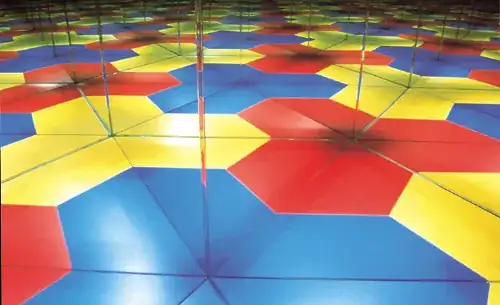
Mirrors exhibiting plane tilings: enter image description here

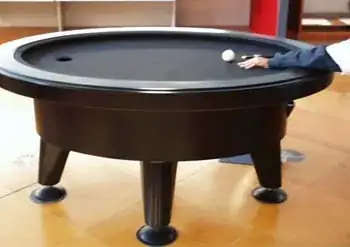
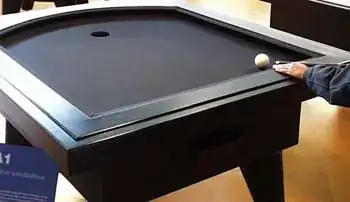
Conic section billiard tables (the reflection properties!): enter image description here enter image description here enter image description here

These are taken from the exhibitions documented at http://atractor.pt

Update: Elliptical pool tables can now be bought from http://loop-the-game.com.

21

Hendrik Lenstra and others worked out the mathematics behind Escher's "Print Gallery" print, and filled in the hole in the center. Their website is here. Since then many people have used the same technique on photographs, a google search shows many examples. What I haven't seen, and would be an excellent exhibit, is a real-time video implementation of this.

Perhaps a good setup would involve a video camera pointed at a picture frame. The inside of the frame would be green or blue, so that green/blue screen technology could be used to detect the inside of the frame and distinguish it from objects or people overlapping it. The rest of the calculations are not mathematically difficult, but it would need a fast processor to get it to be real time.

Henry Segerman
  • 1,886
  • 20
  • 25
21

I just saw this question and its many answers today. As Chief of Content at MoMath, there is much I could tell you about in response. Most important: we at MoMath are looking for all kinds of input. If you’re at the Joint Math Meetings this week, come to our booth in the exhibit hall to meet us, learn more, and give us your ideas. We have many activities scheduled there. With your help, we'll be the coolest museum of any kind anywhere, because mathematics is so rich with engaging concepts.

As to the comment about Persi Diaconis, he certainly is involved. MoMath will be inaugurating a free public lecture series on recreational mathematics in NY City later this year, and Perci is one of the wonderful speakers you can come hear. Check momath.org for an announcement or go there to add yourself to our email list.

Many of the exhibit concepts suggested in these answers are already on our drawing boards, including the walk-on Mobius strip, but this isn’t the place to delve into the details of individual exhibits. A couple of answers mention Vi Hart’s Math Doodles. She is already involved with MoMath and you can meet her at our JMM booth, along with MoMath's executive director, Glen Whitney, our chief of operations, Cindy Lawrence, and me.

Finally, a big thank you to Timothy, for posting this question, and to the many people who contributed interesting answers.

  • Hi George...thanks for posting. I notified Ken Fan and Glen Whitney by email when I first posted this question but I guess the word didn't circulate among the official MoMath people as quickly as I thought it would. – Timothy Chow Jan 04 '11 at 15:48
19

This:

alt text http://dl.dropbox.com/u/5390048/genus_2.gif alt text http://dl.dropbox.com/u/5390048/orange_torus.gif

see this MO post, by Bill Thurston.

18

A piece of conformal fabric. A conformal fabric is some membrane-like material that can stretch and unstretch, yet locally at any given point, only by equal amounts along a direction and a perpendicular to it. Such fabric you could stretch to any planar shape; if you stretch it from a circle to a square, say, you'd have found the Riemann mapping that maps a circle to a square! So holding a piece of conformal fabric and playing with it you'd at last get some "feel" for what the Riemann mapping theorem is all about.

Unfortunately, basic as it is, I could not find where one could get a piece of this valuable material. I'm not quite sure why - I'm not asking for something that depends on the axiom of choice, or that may live only in 4D, or for the moon. I can easily imagine holding a piece of conformal fabric, yet I have no clue how to make one.

[Edit by A. Henriques]: I think that this link might be showing exactly that material: http://www.bbc.co.uk/news/science-environment-35818924

  • Very nice. An interesting engineering challenge to make such a thing. – Dylan Thurston May 02 '11 at 03:01
  • I'm skeptical about easily imagining holding it. What does it feel like to pull on it? When you're stretching it into a new shape, you can't simply pull it by the edges because a Riemann mapping has very rigid boundary behavior. – Tom Goodwillie May 02 '11 at 04:16
  • 1
    Yes, unfortunately conformal fabrics would violate conservation of energy, as a small motion in one place may lead to a huge motion somewhere else. Perhaps I should settle for a crank-powered approximate conformal fabric, that would at least illustrate the difficulty in making the real thing. – Dror Bar-Natan May 11 '11 at 19:28
  • @Dror Bar-Natan: Why do you say "conformal fabrics would violate conservation of energy, as a small motion in one place may lead to a huge motion somewhere else"? When you use a pair of scissors, a small motion in one place leads to a large motion somewhere else---do scissors violate conservation of energy too? – Vectornaut Jan 04 '12 at 20:50
  • @Dylan Thurston: Although it wouldn't be as nice as a physical conformal fabric, you can build almost anything under the glass of a touch screen... – Vectornaut Jan 04 '12 at 20:59
  • @Vectornaut: Imagine wagging a conformal dog (or a 2D cutout of a dog) by its tail. You tickle the tail just a bit, and over at the head side things move dramatically. Potentially, $10^{50}$ times faster. If the fabric at the head side has any weight, you'll need a lot of energy to move it. – Dror Bar-Natan Jan 10 '12 at 14:30
15

There are many interesting films at the site http://www.etudes.ru/ (not in English): curves of constant width, Pick's theorem, geometry of polyhedra, an infinite staircase with the harmonic series, mechanisms of Chebyshev, etc. They can provide some interesting ideas for exhibits, and the people who are putting together the math museum in NY should consider contacting the folks behind this website (click on 6th link on the left, with the envelope icon). I saw a presentation of several of these films by the "main" person on the contact page, Nikolai Andreev, and it was quite impressive.

KConrad
  • 49,546
15

I think graph theory is a good source for nice "labs" (see Deane Yang's post)...

There are nice activities you can do involving:

  • The Königsberg Bridges, Eulerian paths, Hamiltonian paths

  • The non-planarity of $K_5$ and $K_{3,3}$

  • Map coloring and graph coloring, leading up to a discussion of the four color theorem

  • Euler characteristics of graphs, leading up to a discussion of topology

  • Traveling salesman problems (... leading up to a discussion of NP-completeness????)

Kevin H. Lin
  • 20,738
15

The hairy ball theorem demonstrated with a ball with hair on it and a comb.

What happens if we deform the ball a little, so that it is shaped like a banana?

What happens on a torus?

(I'm not so sure that it's a good idea to emphasize the name "hairy ball".)

Euler characteristics of polyhedra and possibly of manifolds.

I would like to see something about manifolds and the shape of the universe. Maybe something about string theory as well.

K.J. Moi
  • 988
14

I think it would be nice to have exhibits (or "labs" -- see Deane Yang's post) on various probability "paradoxes", such as the Monty Hall problem, the false positive paradox, the birthday paradox...

Like the central limit theorem (see Sam Nead's post), many of these "paradoxes" can be experimentally demonstrated. The birthday paradox can be quite impressive when you have a group of around 30 to 40 people -- assuming it works out, that is ;-)

The Monty Hall problem can also be demonstrated experimentally. Once, at a party with non-mathematicians, I played 20 instances of "the Monty Hall game", and already one could see that the "switch doors" strategy was usually more successful. Happily, my audience was actually rather unsatisfied with my experimental demonstration, and wanted a more conceptual explanation. (I actually found this to be somewhat curious -- for me personally at least, the experimental demonstration is very satisfying!) This lead into a long and fun discussion.

I like the following quote by Israel Gelfand:

Mathematics is a way of thinking in everyday life. It is important not to separate mathematics from life. You can explain fractions even to heavy drinkers. If you ask them, ‘Which is larger, 2/3 or 3/5?’ it is likely they will not know. But if you ask, ‘Which is better, two bottles of vodka for three people, or three bottles of vodka for five people?’ they will answer you immediately. They will say two for three, of course.

I think it can be difficult for many people to appreciate math "for its own sake". We mathematicians usually find, for example, the infinitude of primes, and the proof thereof, to be pretty awesome. But I don't think that you can expect most people to react to such things the same way that we do. I think the reason is because, as in the Gelfand quote, it is often not apparent how these things connect to "the real world", and it is often not apparent that these kinds of considerations can arise very naturally. So to get people excited about math, I think that it can be useful to first get them to care about a problem or arouse their curiosity in something, and then demonstrate that math can be used to solve that problem. This nice TED talk also argues for this point.

Sorry for rambling...

Kevin H. Lin
  • 20,738
  • 8
    "they will answer you immediately" They must still be on the first couple of drinks. – Dan Piponi Dec 26 '10 at 16:31
  • 5
    Gelfand's example reminds me of the difference between the following two questions. Question 1: Shown 4 cards on a table, displaying respectively "25," "16," "B," and "C," what is the minimum number of cards you need to turn over to verify the statement, "every card with a B on it has a number > 20 on the reverse side"? Question 2: There are 4 people at a bar; the first is 25 years old, the second is 16 years old, the third has a beer, and the fourth has a coke. What is the minimum number of people you need more information about to verify that there is no underage drinking going on? – Timothy Chow Dec 27 '10 at 17:33
14

The Antikythera Mechanism, a stone encrusted mechanical computer from 150-100 BCE designed to calculate astronomical positions. It has a degree of mechanical sophistication is comparable to a 19th century Swiss clock. Nothing as complex is known for the next thousand years.

In addition it'd be nice to have an explanation of its workings along with a modern functional copy that one can directly manipulate.

Kelly Davis
  • 1,897
14

If a Museum is a place where mathematics meets people of every kind, it is important to let them think that our discipline is useful, and is not just a game. I advocate to display applications of good mathematics in the everyday life. Cryptography has been evoqued before and I voted +1 for this answer. Let me add a few others :

  • Radon transform, with application to tomography, and therefore to medical diagnosis.
  • QR algorithm, with application to searching on the web (Google page rank algorithm).
  • Dynamical systems, saddle points and their application to the launch of spacecrafts away from the ecliptic.

I have not been involved in the elaboration of any mathematical exhibition, but I am convinced that if these topics have been successfully used by non-mathematician, they can be explained to a non-scientific audience. I except that they contribute to a positive judgement of mathematics by the population.

Denis Serre
  • 51,599
  • 1
  • I'm not too sure the elegance of QR can be done justice in an exhibit that will be glanced at for at most a minute or two. 2. A (heavily modified) power method is used, not QR proper: http://www.mathworks.com/moler/exm/chapters/pagerank.pdf
  • – J. M. isn't a mathematician Dec 28 '10 at 00:39
  • Can the Radon transform be talked about without mentioning integrals too much? This would be great if so; it would be great to show how these machines "slice" bodies.
  • – J. M. isn't a mathematician Dec 28 '10 at 00:40
  • 2
    @J. M.: the museum does not have to explain the math, just mention that it's there, and point out that we wouldn't know how to solve the same problem without that specific tool. Remember, it's easy for us to be jaded about applications of mathematics, but many (even educated) people don't even begin to suspect how much mathematics is involved in the devices they're so fond of. Not to mention that many people who should know better (e.g. Claude Allegre) seem to think that "we'll just let the computer do it" is an answer and an end to a problem rather than the beginning of it. – Thierry Zell Jan 02 '11 at 20:35