24

Sometimes (perhaps often?) vague or even outright incorrect arguments can sometimes be fruitful and eventually lead to important new ideas and correct arguments.

I'm looking for explicit examples of this phenomenon in mathematics.

Of course, most proof ideas start out vague and eventually crystallize. So I think the more incorrect/vague the original argument or idea, and the more important the final fruit, the better, as long as there is still a pretty direct connection from the vague idea to the final fruit.

Note: Many "paradoxes" sort-of are like this, but I think aren't what I'm looking for. (William Byers's book "How Mathematicians Think" has several examples and lots of discussion of the important role of paradox in mathematical research.) For example, the relationship between Russell's paradox, Godel's Incompleteness Theorem, and the undecidability of the halting problem (Church; Turing). But I think, unless the paradox has some other aspects of the vague-idea-as-fertilizer phenomenon, that I'm not looking for examples of paradoxes, though I am willing to be convinced otherwise.

Edit: It's been suggested that this a duplicate of this other question, but I really think it is not. I am more interested in examples of outright incorrect (or nearly so) original statements that nonetheless lead to fruitful mathematics, whereas the other question seems to essentially be asking about ideas that start out intuitive, non-rigorous, or ill-defined and then are turned into rigorous arguments but along the same intuitive lines. (And, as I said above, I think I agree with one of the answers there that that is simply much of mathematics.) By comparing the answers to the other question to the three great answers already on this question (knot theory rising because Kelvin thought atoms were knotted strings; Lame's erroneous proof of FLT leading Kummer to develop algebraic integers; Lebesgue's incorrect proof that projections of Borel sets are Borel leading to Suslin's development of analytic sets), one can get a sense of the difference.

  • 3
    I would say that physics (mathematical and theoretical) is full of such examples. Just for starters, Heisenberg, Dirac and Schrödinger on wave mechanics fertilising von Neumann on the spectral theory of unbounded self-adjoint operators on Hilbert space (and much more). And of course, the prehistory of distributions (e.g., Heaviside and Dirac, again) paving the way for Sobolev, Schwartz and many others. – user131781 Feb 05 '20 at 19:41
  • 2
    @LSpice: What if I just remove "BS" from the title & question body? – Joshua Grochow Feb 05 '20 at 19:55
  • 4
    Since my initials are BS, perhaps I have some personal examples.... (if you remove the parenthetical interpretation). – Benjamin Steinberg Feb 05 '20 at 20:27
  • 2
    I think many such examples are things which didn't initially have a proper formalization but gave right answers that eventually found a formalization. Like Leibniz didn't seem to have a proper formalization of infinitesimals but reasoned with them anyway and produced valid math. Then Abraham Robinson gave a formalization of them that led to good mathematics. On the other hand, Weierstrass's approach via epsilon-delta also captured what infinitesimal did non rigorously in a rigorous way. – Benjamin Steinberg Feb 05 '20 at 20:35
  • 2
    My understanding is the the Italian school of algebraic geometry made effective use of generic points without precisely making sense of them, but sense of course was made later on in the more modern approaches of Weil, Zariski and eventually Grothendieck. – Benjamin Steinberg Feb 05 '20 at 20:38
  • @BenjaminSteinberg, I guess Euler (although maybe some modern math historians disagree?) and Ramanujan are also examples of this? – LSpice Feb 05 '20 at 20:52
  • 1
    Statistical mechanics contains quite some examples: physicists have non-rigorous methods to make predictions about complicated stochastic systems (such as assuming some function to be a polynomial and then computing some limit behaviour from values at integers, often also obtained in a not quite kosher way) which in practice, at least when done by sufficiently expert physicists, give seemingly correct answers. We're just recently beginning to figure out how to explain in rigorous terms why these methods work and prove the physicists' conjectures (to them, of course, they are theorems). – user36212 Feb 05 '20 at 20:56
  • @FrancoisZiegler: Maybe, but those are more along the lines of vague-but-essentially-correct intuitions that then became more formalized (which I think is how most math goes), whereas I'm interested in more extreme examples of vague-but-more-incorrect ideas that still led to good math in the end. – Joshua Grochow Feb 05 '20 at 22:53
  • @NeilHoffman: Not quite. That was actually Francois Ziegler's original suggestion, which my comment 2 above was in response to. – Joshua Grochow Feb 06 '20 at 04:55
  • 2
    Does this answer your question? Most interesting mathematics mistake? Two of the answers here repeat those there, and the third one is not about mathematical mistake/argument. – Kostya_I Feb 06 '20 at 09:07
  • Does attempting to prove the Parallel Postulate & inventing nonEuclidean Geometry count? – Carl Witthoft Feb 06 '20 at 13:30
  • I agree with @Kostya_I that this is essentially a duplicate of the question he cites. – Benjamin Steinberg Feb 06 '20 at 14:43
  • @Kostya_I: I don't think so, although there is obviously some overlap and some answers would work for both. For example, some highly upvoted answers there include the Grothendieck prime and the fact that Cayley didn't realize $C_2 \times C_3 \cong C_6$, but those aren't relevant to my question. – Joshua Grochow Feb 06 '20 at 16:27
  • @JoshuaGrochow, in my opinon, all mistakes that fertilize good mathematics are by definition interesting, therefore, any answer to your question is also a valid answer to that older thread (but converse is indeed not true). Also closely related is https://mathoverflow.net/q/168917/56624 where, e. g., the "knots and atoms" story is mentioned. – Kostya_I Feb 06 '20 at 16:49
  • @Kostya_I: I agree these are all closely related. If one question's answers could all be included as answers to another question - but the converse is not true - is it standard for the "sub-question" to be marked as duplicate? – Joshua Grochow Feb 06 '20 at 20:09

5 Answers5

35

In 1905 Lebesgue "proved" an incorrect fact that a projection of a planar Borel set onto a line is Borel. Then years later Suslin found a mistake in Lebesgue's paper and he constructed a Borel set whose projection is not Borel. This led to the important theory of Suslin sets, aka analytic sets, that are projections of Borel sets. Such sets are not necessarily Borel, but they are Lebesgue measurable.

LSpice
  • 11,423
Piotr Hajlasz
  • 27,279
23

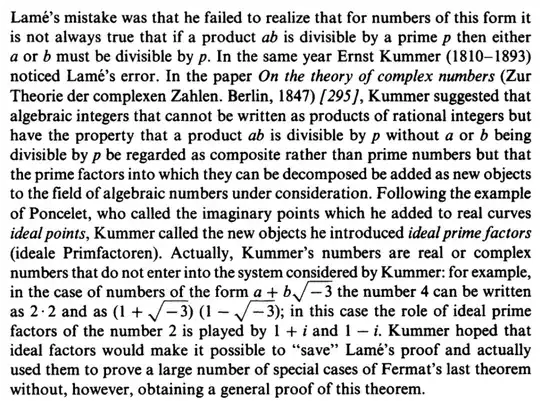
Kummer developed the theory of algebraic integers in an attempt to save a flawed proof of Fermat's last theorem by Lamé, as explained here:

Carlo Beenakker
  • 177,695
  • 2
    Is this true? I thought that Kummer was independently studying factorizations of algebraic integers and so when he saw Lame's argument, he spotted the issue right away. – Kimball Feb 06 '20 at 15:50
20

The field of knot theory became much more (legitimate ?) actively researched area in math because the physicists (i.e., Lord Kelvin) thought that atoms were knots in aether. Of course that idea is now proven `BS'. From AMS.org (http://www.ams.org/publicoutreach/feature-column/fcarc-knots-dna):

The study of knots began in earnest in the 1860's when William Thompson (Lord Kelvin) proposed his vortex model of the atom. Simply said, this theory postulated that atoms were formed by knots in the ether and that different chemical elements were formed by different knots.

5

Obviously König's theorem should appear on this page. König suggested a proof by which the real numbers cannot be well-ordered. Unfortunately, he misunderstood some of the work he relied on, and thence we have this wonderful theorem known as König's theorem or Zermelo–König's theorem:

If $I$ is any set, and for each $i\in I$, $|A_i|<|B_i|$, then $\left|\bigcup_{i\in I}A_i\right|<\left|\prod_{i\in I}B_i\right|$.

Asaf Karagila
  • 38,140
2

Another example: S. Smale wrote a paper with a conjecture that rules out the phenomenon of chaos in dynamical systems (i.e., claiming that chaos does not exist in dynamical systems at all). But a counterexample from a colleague led him to actually discover the `horseshoe', an important geometrical object which is now understood to be the hallmark of chaos, and has led to much greater understanding of chaotic phenomena.

The whole story is here, by Smale himself: 'Finding a horseshoe on the beaches of Rio': http://www.cityu.edu.hk/ma/doc/people/smales/pap107.pdf

  • 5
    That sounds more like an incorrect conjecture, of which there are surely too many examples to enumerate. – LSpice Feb 06 '20 at 14:48