Let me get the skeleton of an answer down here and then I can edit in more details if you want later.
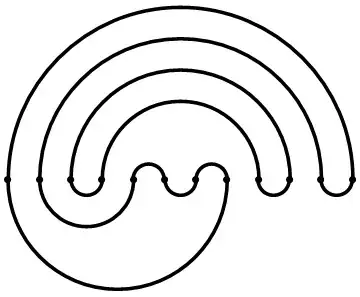
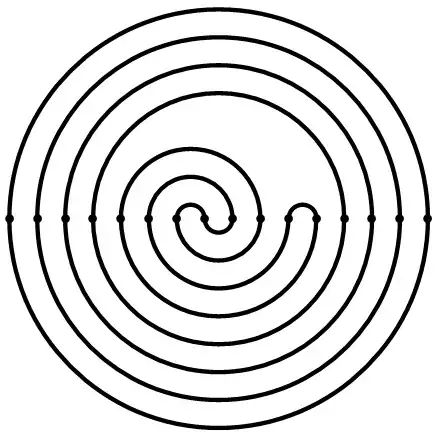
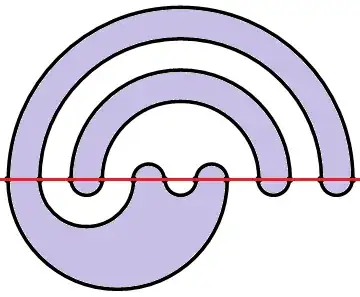
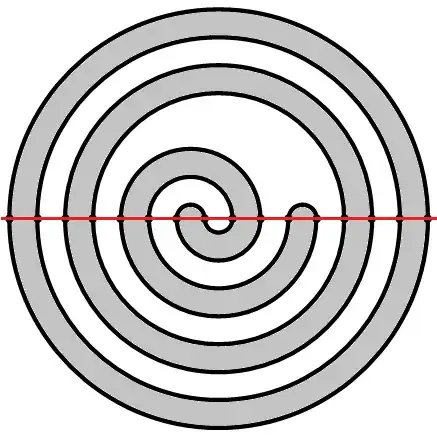
An arch system can be represented as a set of ordered pairs; for example, in the first example the upper arch system is
$$\{(1,12),(2,11),(3,10),(4,9),(5,6),(7,8)\}$$
and the lower arch system is $$\{(1,8),(2,5),(3,4),(6,7),(9,10),(11,12)\}.$$ The numbers in each pair are always of opposite parity.
Define the parity of an arch system as
$$
\prod_{\text{pairs }(a,b)}(-1)^{\frac{b-a-1}{2}}
$$
so the parity of the upper arch system is $-1$ and the parity of the lower arch system is $+1$.
It is not hard to see that the parity of a meander $m$ (where odd is identified with $-1$ and even with $+1$) is equal to the product of the parities of its constituent arch systems and $(-1)^{\text{order}(m)}.$
EDIT:
Consider a meander where the upper arch system contains two pairs of the form $(a, b)$ and $(a+1,a+2)$. Compare this to the meander where we replace these two arches with $(a,a+1)$ and $(b,a+2)$. It is evident that this swaps the parity of the meander and of the arch system. Any arch system can be reduced to $\{(1,2),\ldots,(2n-1,2n)\}$ by a finite number of these moves.
(end edit)
Next, let's count odd and even arch systems. Let $A_{-1}(n)$ and $A_{+1}(n)$ be the number of $-1$ and $+1$ parity arch systems respectively (formally set $A_{+1}(0)=1$ and $A_{-1}(0)=0$). Then by looking at whatever is paired with $1$ we get the recursions
\begin{align*}
A_{-1}(n)&=\sum_{i=0,2,\ldots} \big(A_{-1}(i)A_{+1}(n-i-1) + A_{+1}(i)A_{-1}(n-i-1)\big)\\
&+\sum_{i=1,3,\ldots}\big(A_{-1}(i)A_{-1}(n-i-1) + A_{+1}(i)A_{+1}(n-i-1)\big)
\end{align*}
and
\begin{align*}
A_{+1}(n)&=\sum_{i=1,3,\ldots} \big(A_{-1}(i)A_{+1}(n-i-1) + A_{+1}(i)A_{-1}(n-i-1)\big)\\
&+\sum_{i=0,2,\ldots}\big(A_{-1}(i)A_{-1}(n-i-1) + A_{+1}(i)A_{+1}(n-i-1)\big)
\end{align*}
Simple rearrangement of the sums shows that $A_{+1}(2k)=A_{-1}(2k)$, which implies that both are $\frac{C_{2k}}{2}$.
EDIT: inductive argument added.
The following inductive argument shows that $A_{\pm 1}(2k+1)=\frac{C_{2k+1}\pm(-1)^k C_k}{2}$.
If $n\equiv1\pmod 4$ then when $i$ is odd, then one of $\{i,n-i-1\}$ is $1\pmod 4$ and one is $3\pmod 4$.
By induction, the sum above, for $A_{-1}(n)$, say, is:
\begin{align*}
A_{-1}(n)&=
\sum_{i=0,2,\ldots} \frac{C_iC_{n-i-1}}{2}\\
&+\sum_{i=1,3,\ldots}\frac{1}{4}\left(
\left(C_i+C_{\frac{i-1}{2}}\right)\left(C_{n-i-1} - C_{\frac{n-i-2}{2}}\right)
+ \left(C_i-C_{\frac{i-1}{2}}\right)\left(C_{n-i-1} + C_{\frac{n-i-2}{2}}\right)\right)
\\
&=\sum_{i=0,1,2,\ldots} \frac{C_iC_{n-i-1}}{2}
-\sum_{i=1,3,\ldots} \frac{C_{\frac{i-1}{2}}C_{\frac{n-i-2}{2}}}{2}
\\
&=\frac{C_n}{2} -\sum_{j=0,1,2,\ldots}\frac{C_{j}C_{\frac{n-1}{2}-j-1}}{2}
=\frac{C_n}{2} - \frac{C_{\frac{n-1}{2}}}{2}.
\end{align*}
The other cases of the induction (for $n\equiv 3\pmod 4$ and/or if one wants an independent induction for $A_{+1}(n)$ are similar.
(end edit)
Then using the relationship between parity of meanders and parity of arch systems the result follows by arithmetic.
I can supply more details about the recursion, the rearrangement, the inductive argument, or the final arithmetic once the $A_{\pm 1}$ have been determined, if desired.