11

In set theory, in particular the context of forcing, if $M$ is a model of $\sf ZFC$ and $P\in M$ is a partial order, we say that $G\subseteq P$ is a generic filter (or $M$-generic or generic over $M$) if:

  1. Whenever $p\in G$, and $p\leq q$ then $q\in G$.
  2. Whenever $p,q\in G$ then there is some $r\in G$ such that $r\leq p,q$.
  3. If $D\subseteq P$ is dense (for all $p\in P$ there is $q\in D$ such that $q\leq p$), and $D\in M$, then $D\cap G\neq\varnothing$.

The first two conditions specify that $G$ is a filter, and the third is the required genericity. So a filter is generic if it meets all the dense sets in the ground model. Since this context allows it, we can replace dense by "open dense", meaning $D$ is dense and if $p\in D$ and $q\leq p$ then $q\in D$.

So being generic means meeting all the dense open sets. And this definition agrees with the definition of genericity in the contexts of topology and algebraic geometry (and perhaps other fields of mathematics as well).

Question. Where did the term "generic" come from originally to mathematics, and how did it trickle into set theory?

It should be noted that Cohen used "generic" in his original paper, but it seems to have a different meaning, and not quite this one.

Asaf Karagila
  • 38,140
  • I wasn't sure about the tags, so feel free to change them if need be. – Asaf Karagila Jun 07 '14 at 00:15
  • 5
    Wbat is a difference between Cohen's usage and this one? – The Masked Avenger Jun 07 '14 at 01:14
  • 1
    Let's interpret the question also as a request to exhibit other precise concepts of genericity in mathematics other than the set-theoretic usage. – Joel David Hamkins Jun 07 '14 at 01:40
  • 2
    The connection between Cohen's notion of genericity and the notion from topology and analysis (based on Baire category) was, as far as I know, first observed by Gaisi Takeuti. – Andreas Blass Jun 07 '14 at 02:24
  • 3
    @JoelDavidHamkins, I imagine "generic" along with "typical", "general", "random" etc. is used throughout mathematics. For example, the generic points in a measure preserving system (ergodic theory) are those where the pointwise ergodic theorem holds on continuous functions. (Even these can be connected to forcing (sort of). Hoyrup and Rojas showed the Schnorr randoms are exactly the generic points of all computable ergodic m.p.s. Also, the Schnorr randoms are known to be the generics in the filter of effectively closed sets of computable measure -- an effective type of Solovay forcing.) – Jason Rute Jun 07 '14 at 06:33
  • @TheMaskedAvenger: See my comments to Timothy Chow's answer. – Asaf Karagila Jun 07 '14 at 12:06
  • @Joel: This is roughly what I wanted to know. I'm particularly interested in how the term entered the set theoretic lingo; but I would also be interested to know its etymological origins in mathematics (i.e. did it begin in topology and trickled through algebraic geometry, or vice versa, or perhaps was a child of both topics at some point or another?) – Asaf Karagila Jun 07 '14 at 12:08
  • I think it just entered by its colloquial usage. You can find an earlier use by Cohen in Asymptotic Decay of Solutions of Differential Inequalities (with M. Lees, 1961) applied to an interval; this is unimportant. His advisor, Zygmund, writes in Some Points in the Theory of Trigonometric and Power Series a footnote: "In the following we use $C$ as a generic notation for an absolute constant..." Surely read by Cohen (as his advisee, and also given Cohen's own thesis topic) but, though the paper is from ~1934, this is not significant for your purpose here. I vote "via natural language use." – Benjamin Dickman Jun 12 '14 at 20:04
  • @Benjamin: Thanks. I should remark that I haven't read my advisor's recent papers, although I wanted to. So I'm not 100% sure that Cohen would have read his advisor's papers. But those are good, even if circumstantial, evidence towards the natural language argument. – Asaf Karagila Jun 12 '14 at 21:38
  • @AsafKaragila The reason I remarked about Cohen's thesis is that his dissertation was entitled Topics in the Theory of Uniqueness of Trigonometric Series. See also the citation for a different piece on trigonometric series by Zygmund at the end of Cohen's On a Conjecture of Littlewood and Idempotent Measures. I think it's a pretty safe bet that he would have read the paper I mentioned above, but insignificant in the sense that a single foot-note with the word "generic" (used colloquially) is unlikely to have left a deep impression. (And I didn't root out other uses Cohen might have seen.) – Benjamin Dickman Jun 12 '14 at 21:52

2 Answers2

9

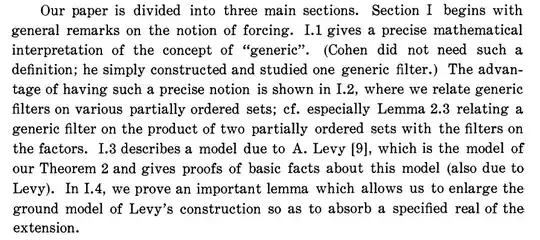
In trying to trace the history of forcing in an earlier MO question, I came across G.H. Moore's The origins of forcing. I think you can find in Moore's piece an answer to your question, too. On p. 164 he writes:

enter image description here

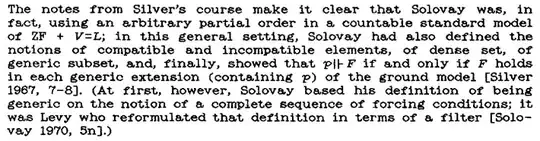
From the corresponding paper of Solovay, A Model of Set-Theory in which Every Set of Reals is Lebesgue Measurable, p. 4:

enter image description here

The next page footnotes:

Our original definition of generic was based on "complete sequences". The present approach is due to Levy [8].

I have found no copies of the Levy papers, but Solovay's citations of 8 and 9, respectively, are:

enter image description here

  • 2
    I actually held in my hands a copy of Levy's second paper a year ago (the one from Notices of AMS). It was exciting. I asked for his permission to scan it and post it online, but he said that since these things have been published and reworked and cleaned up, there's no point in doing that. – Asaf Karagila Jun 07 '14 at 12:03
  • 2
    I just got off the phone with Levy. He didn't really remember who and how it entered the language. But he did say that after Cohen developed forcing, there was a lot of effort to polish the theory into a general form. So it must have been somewhere then. My question was ultimately left unanswered, though. – Asaf Karagila Jun 24 '14 at 17:17
5

As far as the usage in set theory is concerned, Cohen gives the following explanation in his book, Set Theory and the Continuum Hypothesis, after explaining a failed attempt to construct a suitable set $a$:

Rather than describe $a$ directly, it is better to examine the various properties of $a$ and determine which are desirable and which are not. The chief point is that we do not wish $a$ to contain "special" information about $M$, which can only be seen from the outside … The $a$ which we construct will be referred to as a "generic" set relative to $M$. The idea is that all the properties of $a$ must be "forced" to hold merely on the basis that $a$ behaves like a "generic" set in $M$. This concept of deciding when a statement about $a$ is "forced" to hold is the key point of the construction.

Certainly Cohen was partially motivated by the prior use of the term in geometry and topology, and in particular the fact that generic sets should satisfy any condition that is "dense."

Timothy Chow
  • 78,129
  • It seems that it might be the case, but the use of "generic" here can be understood the same way as a natural language use, rather than the specific mathematical use in topology and geometry. – Asaf Karagila Jun 07 '14 at 12:05
  • @AsafKaragila, can't this be said about the use of the term "generic" in topology and geometry as well? The technical and English meanings are not very different, and it is obvious why the term was chosen (unlike, say, the terms "mice" and "creative" which are not so obvious). I think it is very possible (although I have no historical evidence for this), that the informal usage by Cohen slowly became formal and started out independent of topology, and happened to express the same idea. Also see here: http://en.wikipedia.org/wiki/Generic_property – Jason Rute Jun 08 '14 at 05:41
  • @Jason: Yes, it is possible. I have read the Wikipedia pages (that one you mention and for Generic point), but neither gave any hint as to how generic came into set theory. Did it come in all by itself? Was it an influence of topology? Or was algebraic geometers using the terms already and that influenced Cohen? Or maybe whoever developed the modern notion of a generic filter wasn't influenced by Cohen's choice, and rather used the notion of a topology? That's essentially the answer I was hoping to get. – Asaf Karagila Jun 08 '14 at 07:07
  • From Benjamin Dickman's response it seems clear that the later use of the word "generic" in set theory was influenced by Cohen's use of the word. "Generic" was certainly previously used in topology and geometry, as a quick MathSciNet search can confirm. I suppose it is conceivable that Cohen was unaware of that usage, or uninfluenced by it, but that would be very surprising. (Granted that he may not have realized exactly how close the parallel really was.) – Timothy Chow Jun 08 '14 at 20:52