1

Ovidiu Racorean. "Crossing stocks and the positive Grassmannian I: The Geometry behind Stock Market." (arXiv Abstract link)

Anyone care to offer a summary of what's going on here? (The situation is reminiscent of "The amplituhedron minus the physics"...)
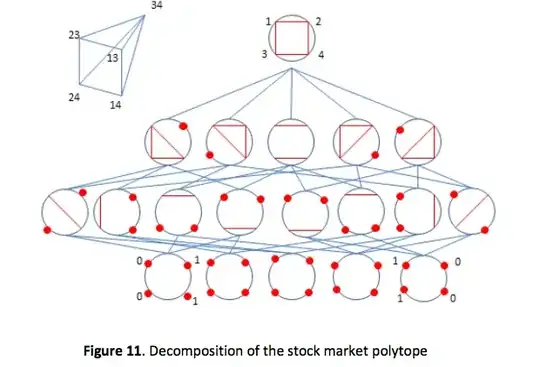

     Fig11

YCor
  • 60,149
Joseph O'Rourke
  • 149,182
  • 34
  • 342
  • 933
  • 24
    Do you believe everything you read on arXiv? – Igor Rivin Mar 16 '14 at 02:39
  • 8
    I don't think that the changes in ordering of the prices in a stock market capture the most important changes. Note that unless there are fixed points (which get decorated with whether the price increases or decreases), every stock price could have gone up, or all could have fallen. Wouldn't this be important? This information isn't present in the permutation. In addition, economists normally say that the nominal prices aren't important, that a split shouldn't change anything, but it would change the permutation. This paper doesn't seem connected to understanding the stock market. – Douglas Zare Mar 16 '14 at 03:08
  • 1
    Of course, it's quite possible that it is related to interesting mathematics, but I would prefer to see that with less hype. – Douglas Zare Mar 16 '14 at 03:09
  • 4
    in the same spirit, by the same author: http://arxiv.org/abs/1305.1559 – Carlo Beenakker Mar 16 '14 at 08:27
  • 9
    I don't believe in stuff not typeset in LaTeX. – Per Alexandersson Mar 16 '14 at 10:57
  • 6
    I don't understand what the paper has to do with finance. I scanned it and I can say that I didn't see anything interesting from a finance point of view. It offers nothing on how this arrangement could be used. I think he could just as easily take temperature readings from different cities for his data points. There may be somebody drinking rum in the tropics based on this idea. However, I have never heard of anyone caring about that particular data point. Some of the authors introductory remarks suggest to me that he is not that familiar with stock trading. – meh Mar 16 '14 at 22:29
  • 4
    "'If there's no meaning in it,' said the King, 'that saves a world of trouble, you know, as we needn't try to find any." - Alice in Wonderland – Michael Greinecker Jun 16 '14 at 22:59
  • I have to admit only my timidity prevents me from casting the first vote to close. – Michael Greinecker Jun 18 '14 at 14:01

1 Answers1

1

May be this will help some of you to better understand

http://www.businessinsider.com/hedge-fund-researcher-is-working-on-a-higher-dimensional-geometric-model-of-the-stock-market-2014-2

But somehow I doubted !

user48434
  • 11
  • 1
  • Thanks for the link. I see the article mentions the amplituhedron. – Joseph O'Rourke Mar 18 '14 at 21:13
  • 3
    "the work has not yet appeared in a peer-reviewed journal, though Racorean has submitted it to several" -- i.e., it's bouncing. – José Figueroa-O'Farrill May 17 '14 at 22:32
  • 9
    It appears that the entire construction is based on identifying the times at which inequalities of the form $P_i>P_j$ are reversed, with $P_i$ the price of the $i$th stock. But the units in which any given price is measured are totally arbitrary, because a company worth (say) $1000 can issue 1, 10, 100 or 1000 shares of stock, making the price per share equal to $1000, $100, $10, or $1. This makes it near-impossible to believe that inequalities of the form $P_i>P_j$ have any significance at all. – Steven Landsburg Jun 17 '14 at 00:53