4

Let $M$ be a 2-dimensional closed Riemmanian manifold diffeomorphic to $S^2$.

S.B.Myers says "the cut-locus of every point $x\in M$ is a finite tree."

  1. How the set of point can be a tree? What are the edges?
  2. Is $p$ an element of $\operatorname{cut-locus}(p)$?

I can not find any paper of Myers in this case. Thanks!

  • Dear azita, I changed the tags and the formatting of your question, I hope you don't mind. Perhaps you could add a reference for the quote? Also, re 2: The answer is surely no, by definition of the cut-locus? – Mark Grant Dec 29 '13 at 08:59
  • Dear @Mark Grant, it is always a good idea to add a top level tag (these are tags with a two letter code, such as 'at.algebraic-topology') whenever possible. See the meta thread http://meta.mathoverflow.net/questions/1075/frequently-asked-questions-about-tagging-on-mathoverflow/ for some more information. – Ricardo Andrade Dec 29 '13 at 18:55
  • Dear Rikardo .thank you. when I was studying paper about algebraic-topology meet this case. – azita lekpour Dec 30 '13 at 07:08

2 Answers2

8

I think Myers only considered analytic metrics, see his papers "Connections between differential geometry and topology I and II", Duke Math. J. 1 (1935), 376-391, and 2 (1936), 95-102.

For arbitrary metrics on $S^2$ the cut locus is indeed a tree. This can be deduced from e.g. in [Shiohama and Tanaka, Cut loci and distance spheres on Alexandrov surfaces] who work in the (more general) settings of Alexandrov spaces homeomorphic to surfaces and prove that the cut locus is a local tree. (This paper is available online, search by title). Specializing to the case when the surface is a Riemannian sphere we observe:

  1. The complement to the cut locus is a 2-disk.

  2. If the cut locus contains an embedded circle, then by Jordan curve theorem the circle separates $S^2$ into two disks, and by part 1 one of the disks must lie in the cut locus, so the cut locus cannot be local tree.

One should be careful with what is meant by a local tree. By a result of Gluck and Singer [Scattering of Geodesic Fields II, Annals of Mathematics, Second Series, Vol. 110, No. 2 (Sep., 1979), pp. 205-225] there is a positively curved Riemannian metric on $S^2$, in fact a convex surface of revolution, for which the cut locus cannot be triangulated, so it is definitely not a finite tree.

For recent works in this area see papers of Itoh, e.g. http://arxiv.org/pdf/1103.1758 and references therein.

2

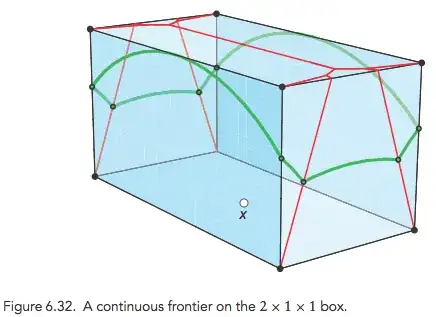
If you will excuse me substituting a polyhedron for the Riemannian manifold (imagine rounding the vertices), this figure shows how the cut locus (red) from source $x$ is a tree. (The green arcs are equidistant from $x$.)
     2x1x1Box
     (Figure from Discrete and Computational Geometry)

Concerning, "What are the edges?": They are geodesics, such that there are two distinct shortest paths from $x$ to every interior point of an edge of the cut locus. Points of the cut locus of degree $k$ have $k$ distinct shortest paths from $x$.

Joseph O'Rourke
  • 149,182
  • 34
  • 342
  • 933