6

If $X$ and $Y$ are two Beta random variables, I am interested in the distribution of their ratio $X/Y$. More specifically, I am interested in the moment generating function of this ratio. There is a paper of Pham-Gia that apparently computes the distribution but I don't have access to it and I don't know how helpful it will be for determining the moment generating function. What is known about these?

Edit (copied from comment added Nov 7 '13): I've located the paper, so now the only question is: what is known about the moments of this ratio?

YCor
  • 60,149
  • I've located the paper, so now the only question is: what is known about the moments of this ratio? – Aryeh Kontorovich Nov 07 '13 at 10:05

  • Sorry - it might be a stupid observation, but I struggle to see how the above expression is correct. If we have $a=c$ and $b=d$, The first raw moment of the ratio should be 1. And the above formula does not satisfy this. For example, for $a=b=c=d=2$ and $k=1$, I get: $$ \dfrac{B(2+1,2)B(2-1,2)}{B(2,2)B(2,2)} = 1.5 $$ What am I doing wrong? For the Euler Beta function I am using this in the scipy implementation – user143306 Jul 19 '19 at 15:39
  • @user14330 says; "The first raw moment of the ratio should be 1." ... It appears that your hypothesis is that if $X$ and $Y$ are iid random variables, then $E[X/Y] = 1$. Unfortunately, your hypothesis is wrong. – wolfies Jul 19 '19 at 17:29

1 Answers1

8

OP wrote:

what is known about the moments of this ratio?

I have not seen the paper ... but one does not even need to derive the distribution of the ratio in order to derive the moments of the ratio. In particular:

If $X$ ~ $Beta(a,b)$ and $Y$ ~ $Beta(c,d)$ are independent, then the joint pdf of $(X,Y)$ is, say, $f(x,y)$:

(source)

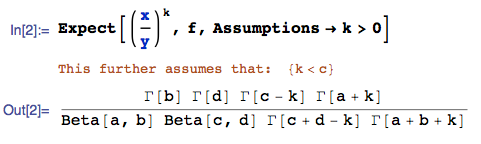
Then, the $k$-th raw moment of the ratio $\frac{X}{Y}$ can be derived immediately as:

(source)

where I am using the Expect function from the mathStatica add-on to Mathematica to automate the nitty-gritties for me (I am one of the developers of the former). If desired, one can express the solution slightly more neatly as:

$$\frac{B(a+k,b) B(c-k,d)}{B(a,b) B(c,d)}$$

where $B$ denote the Euler beta function.

jeq
  • 1,228
  • 5
  • 16
  • 21
wolfies
  • 469
  • I like this answer. Small followup Q. Presumably the (imposed) assumption about k<c is about higher moments not existing when the denominator has substantial weight on/near 0? i.e. If both distributions were the jeffrey's prior of Beta(0.5,0.5), the ratio wouldn't have a mean that exists. – user5957401 Nov 10 '20 at 22:32