16

I have $n$ unit-length vectors $v_i$ in $\mathbb{R}^3$, whose sum is zero: $$ v_1 + v_2 + \cdots + v_n = 0 \; .$$ Now I form the closed polygon $P$ in space by placing them head to tail. So the vertices of $P$ are $$ 0, v_1, (v_1+v_2), \ldots, (v_1+\cdots +v_{n-1}), 0 \; .$$ My question is:

What is the minimum excursion from the origin achievable by shuffling the vectors by a permutation of $(1,2,\ldots,n)$?

For example, the $12$ red vectors below wander $\sqrt{10}$ from the (purple) origin, but the light blue vectors—the same in a different order—stay within $\sqrt{3}$.
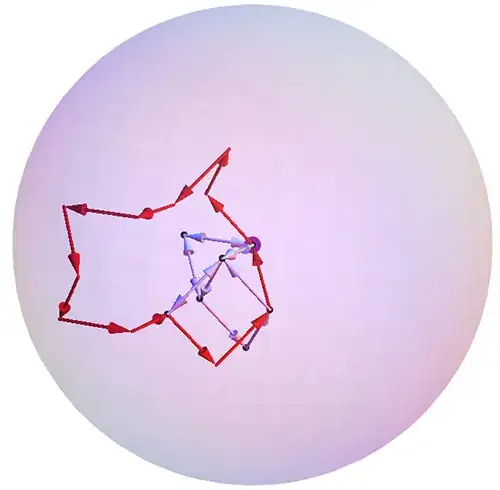
           Vector Sum
(These particular vectors derive from the vertices of a cuboctahedron, so some are negations of others.)

Is there some constant $r_{\min}$ independent of $n$ such that the sum can always be arranged to be at most $r_{\min}$, i.e., lie within an origin-centered ball of that radius? Or must $r_{\min}$ depend on $n$? Is there some natural algorithm for minimizing the excursion, or must I (in the worst case) try all $n!$ permutations?

Of course the same question can be asked in any dimension $\mathbb{R}^d$, but my focus is $\mathbb{R}^3$. Thanks for ideas and/or pointers!

Update1. The suggestion (in the comments) that $r_{\min} = \sqrt{d}$ in $\mathbb{R}^d$, based on an answer to the previous MO question, "Bounding a signed sum of complex numbers," is intriguing, and may be true. But I do not see that it is proved by that answer.

Update2. With key phrases suggested by Nik Weaver, I found a 1981 paper by Imre Bárány, "A Vector-Sum Theorem and its Application to Improving Flow Shop Guarantees" (Math. Oper. Res. link), which shows that $r_{\min} < \frac{3}{2} d$.

Michael Hardy
  • 11,922
  • 11
  • 81
  • 119
Joseph O'Rourke
  • 149,182
  • 34
  • 342
  • 933
  • I think the version in the plane has appeared as an olympiad problem, and that the number sqrt(2) appears in the answer. (Or I could be remembering something else.) It might have appeared on MathOverflow too. Gerhard "Ask Me About System Design" Paseman, 2012.08.19 – Gerhard Paseman Aug 20 '12 at 01:33
  • @Gerhard: If you are correct, then perhaps the appearance of $\sqrt{3}$ in my example is not a coincidence... – Joseph O'Rourke Aug 20 '12 at 01:40
  • 2
    @Gerhard is correct. This was a MO question a few months ago; the proof generalizes to $d$ dimensions, $\sqrt{d}$ is the magic constant, but I am having trouble finding the right keyword to search on. – Igor Rivin Aug 20 '12 at 02:24
  • This MO question is close in spirit, but not identical: "vector balancing problem" http://mathoverflow.net/questions/96782/ – Joseph O'Rourke Aug 20 '12 at 10:04
  • @Joseph: that is not the question I was thinking about... – Igor Rivin Aug 20 '12 at 14:37
  • 1
    I think Igor is thinking about this: http://mathoverflow.net/questions/98288/bounding-a-signed-sum-of-complex-numbers . Either that or one of the linked questions in the answer. Gerhard "Ask Me About System Design" Paseman, 2012.08.20 – Gerhard Paseman Aug 20 '12 at 16:42
  • The previous link is a result of a general search on "Gerhard Paseman Igor Rivin vector" . Gerhard "In Alphabetical Order, Of Course" Paseman, 2012.08.20 – Gerhard Paseman Aug 20 '12 at 16:56
  • 1
    @Gerhard:

    There once was a fellow named Henschel Whose limericks were self-referential My limericks, said he Refer NOT to me But to themselves, THAT's essential!

    – Igor Rivin Aug 20 '12 at 17:59
  • Ha! :-) It may take some investigation before I see that js's answer to "Bounding a signed sum of complex numbers" somehow solves my question as well. In any case, thanks to you both for remembering and identifying this earlier question. – Joseph O'Rourke Aug 20 '12 at 20:06
  • It's not clear from the earlier question that the value for that question is $\sqrt{d},$ much less this one. – Douglas Zare Aug 21 '12 at 00:30
  • I remember that the same question was asked about two years ago on MO, but am not able to find the reference. Perhaps it was restricted to the plane ($d=2$). – Denis Serre Sep 12 '12 at 07:11

1 Answers1

12

This is a famous open problem, $r_{\min}\le d$ is known as the Steinitz-lemma. It is conjectured that $r_{\min}= O(\sqrt d)$ but even $r_{\min}= o(d)$ is open. See also http://www.renyi.hu/~barany/cikkek/steinitz.pdf , section 3.

Michael Hardy
  • 11,922
  • 11
  • 81
  • 119
domotorp
  • 18,332
  • 3
  • 54
  • 121