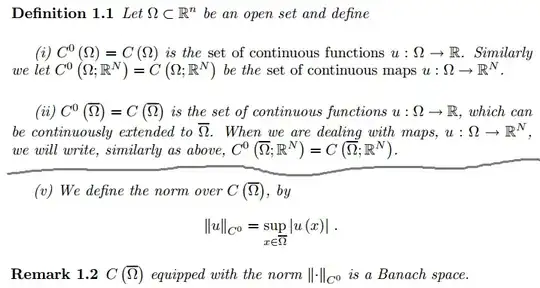
I am reading the book "Introduction to Calculus of Variations" by Bernard Dacorogna (Could not find a link in google books) where he defines $C(\bar{\Omega})$ to be the space of continuous functions $u : \Omega \to \mathbb{R}$ which can be continuously extended to $\bar{\Omega}$ (here $\Omega$ is an open set in $\mathbb{R}^n$).
After this, he defines the norm over $C(\bar{\Omega})$ by $\|u\|_0 = \sup_{x \in \bar{\Omega}} |u(x)|$ and then $C(\bar{\Omega})$ with this norm is a Banach Space.
I am confused about two things:-
1) Does $C(\bar{\Omega})$ consist of functions $u : \Omega \to \mathbb{R}$ which can be continuously extended or functions $u : \bar{\Omega} \to \mathbb{R}$
2)The "norm" $\|.\|_0$ is not a norm as $\bar{\Omega}$ need not be bounded and hence it can take an infinite value
Can someone please let me know if I am right and if so, this notation is OK in some texts.