2

Having solved the eigenvalue problem $$y''+ λ y=0, 0 \leq x \leq L$$ $$y(0)=y(L)=0$$ which solution is: $$\text{The eigenvalues are: } λ_n=(\frac{n \pi}{L})^2$$ $$\text{ and the eigenfuctions are: }y_n=\sin (\frac{n \pi x}{L})$$

I am asked to expand the function $f(x)=2$ to the eigenfunctions of the problem.

At an other exercise in my notes there is the following: $$\text{Since the problem is Sturm-Liouville, each function } f(x), 0 \leq x \leq L \text{ with } f(0)=f(L)=0, \text{ can be written as a sum of the eigenfunctions, so}$$ $$f(x)=\sum_{n=1}^{\infty}{c_n \sin(\frac{n \pi x}{L})}$$

But in this case $f(x)=2$ and it does not stand that $f(0)=f(L)=0$. What can I do? Can I use the sentence above though?

Mary Star
  • 13,956

1 Answers1

2

Think of all $v_n=\sin(\frac{n \pi x}{L})$ with $n\in \mathbb Z$ as vectors.

The set $B=\{v_n\}$ forms a basis for the space of functions defined over $0<x<L$, a space of infinite dimension (the dimension of a space is given by the number of elements necessary to form a basis). For a given set of vectors to form a basis, the requirements are that they are linearly independent, and that, by a linear combination of them, you can represent any other vector in the vector space.

If you define the inner product $<f,g>=\int_{0}^{L}fg dx$, you can say it's an orthogonal basis for the space of functions, since $<v_i,v_j>=0$ if $i\neq j$, and $<v_i,v_i>=L/2$.

If you define the inner product $<f,g>=\frac{2}{L}\int_{0}^{L}fg dx$, you can say it's an orthonormal basis for the space of functions, since $<v_i,v_j>=0$ if $i\neq j$, and $<v_i,v_i>=1$. Let's take this definition for the inner product.

Note that the definitions of inner product above, posses the usual properties of the dot-product: Positive-definiteness,symmetry and linearity (asociativity, distributivity), which is a requirement for this reasoning to work.

What you now want to know is what are all the components of $f(x)=2$ in each of the 'directions' forming the basis, the $c_n$. Let's compute them:

$$c_n=<f,v_n>=\frac{2}{L}\int_{0}^{L}2 \sin(\frac{n \pi x}{L}) dx=\frac{4 ((-1)^{n+1}+1)}{\pi n}$$

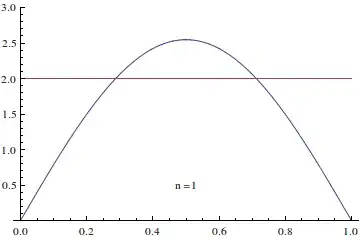
Here is what you get:

enter image description here

  • Great!!! Thank you very much for your answer!!!! :-) – Mary Star Apr 12 '14 at 13:04
  • If the function was $f(x)=x(L-x)$, would it be as followed? $$c_n=\frac{4 L^2 [(-1)^n-1]}{n^3 \pi^3}$$ So $$x(L-x)=\sum_{n=1}^{\infty}{\frac{4 L^2 [(-1)^n-1]}{n^3 \pi^3} \sin(\frac{n \pi x}{L})}$$ – Mary Star Apr 12 '14 at 13:10
  • 1
    you just forgot a minus sign in front of $c_n$, $c_n=-\frac{4 L^2 [(-1)^n-1]}{n^3 \pi^3}$ – Matias Morant Apr 12 '14 at 23:38
  • Oh yes..right!!! So it is $$x(L-x)=\sum_{n=1}^{\infty}{\frac{4L^2[(-1)^{n+1}+1]}{n^3 \pi^3} \sin{(\frac{n \pi x}{L})}}$$ Thanks a lot!!! – Mary Star Apr 12 '14 at 23:44
  • In my notes there is the sentence: $$\text{Since the problem is Sturm-Liouville, each function } f(x), 0 \leq x \leq L \text{ with } f(0)=f(L)=0, \text{ can be written as a sum of the eigenfunctions, so}$$ $$f(x)=\sum_{n=1}^{\infty}{c_n \sin(\frac{n \pi x}{L})}$$

    But in this case $f(x)=2$ and it does not stand that $f(0)=f(L)=0$. Why can we although expand $f(x)$ in this way? I haven't understood it.. :/

    – Mary Star Apr 15 '14 at 15:38
  • 1
    $f(0)=f(L)=0$ isn't a requirement if you will only express the function in $0<x<L$. The series expansion we found for $f(x)=2$ is only valid in this domain, as you can see in the animation I posted, and it still holds for the series expansion that $f(0)=f(L)=0$. Of course that will happen, how could it be otherwise if the sine functions are all $0$ at $x=0$ and $x=L$? – Matias Morant Apr 16 '14 at 02:23
  • Ok!!! Thanks a lot!!! :-) – Mary Star Apr 16 '14 at 09:48