4

Given triangles ABC and DEF, find the center O and radius k of the circle of inversion such that the inverses A', B', C' of A, B, C form a triangle congruent to $\Delta DEF.$ (This is problem 5.3.6 from Geometry Revisited, by Coxeter and Greitzer).

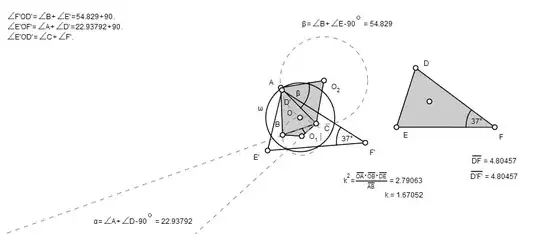
The diagram below illustrates the construction given in the back, but I don't understand how to prove that it holds true.

Here is the description of the construction from the book:

Construct an isosceles triangle $BO_1C$ with equal angles $A + D - 90^\circ$ at B and C, and an isosceles triangle $CO_2A$ with equal angles $B + E - 90^\circ$ at C and A. Circles through C with centers $O_1, O_2$ meet again at the desired center O. The radius k is given by $$k^2 = \frac{OA \cdot OB \cdot DE}{AB}.$$

enter image description here

  • Just to clarify the problem, is $ABC$ given to be similar to $DEF$? Otherwise, why should there be such an inversion, which is always conformal? – ronno Dec 18 '13 at 16:27
  • @ronno No, $\Delta ABC, \Delta DEF$ are arbitrary. The diagram is a bit busy, but if you zoom in you can see that $\Delta ABC, \Delta DEF$ are not alike (I drew them arbitrarily and then followed the construction as described to form $\Delta D'E'F'$ which is congruent to $\Delta DEF$). –  Dec 18 '13 at 16:33
  • OK, I misunderstood. I thought the image of the triangle $\triangle ABC$ was supposed to be congruent to $\triangle DEF$, instead of the triangle formed by the images of the vertices. – ronno Dec 18 '13 at 16:35

1 Answers1

2

A little angle-chasing shows that the construction with isosceles triangles and circles through $C$ create a point $O$ such that $$\angle BOC = A+D \qquad \angle COA = B+E \qquad \angle AOB = C+F$$ Because these values are symmetric in $(A,D)$, $(B,E)$, $(C,F)$, there's a corresponding point, $P$ for $\triangle DEF$ such that $$\angle EPF = A+D \qquad \angle FPD = B+E \qquad \angle DPE = C+F$$ To save myself from typing a bunch of \primes, I'm going to move $\triangle DEF$ to coincide with $\triangle D^\prime E^\prime F^\prime$; that is, I take $P$ to coincide with $O$, and points $D$, $E$, $F$ lie on rays $\overrightarrow{OA}$, $\overrightarrow{OB}$, $\overrightarrow{OC}$.

Now, assuming inversion in the circle about $O$ with radius $k$ inverts $\triangle ABC$ to $\triangle DEF$, we have $$k^2 = ad = be = cf$$ where $a := |OA|$, $d := |OD|$, etc. Because $\angle AOB = \angle DOE = C+F$, the Law of Cosines implies $$ \frac{a^2+b^2-|AB|^2}{2ab} = \cos(C+F) = \frac{d^2+e^2-|DE|^2}{2de}$$ so that $$\begin{align} de\left(\;a^2+b^2-|AB|^2 \;\right) &= ab\left(\;d^2+e^2-|DE|^2\;\right) \\ ad\cdot ae+ be\cdot bd - de|AB|^2 &= ad\cdot bd + be\cdot ae - ab |DE|^2 \\[4pt] k^2 ae + k^2 bd - de |AB|^2 &= k^2 bd + k^2 ae - ab |DE|^2 \\[4pt] ab|DE|^2 &= de|AB|^2 \end{align}$$ Multiplying through by $ab$, we get $$a^2 b^2 |DE|^2 = ad\cdot be \cdot|AB|^2 \quad\to\quad a^2b^2|DE|^2 = k^4|AB|^2 \quad\to\quad k^2 = \frac{|OA||OB||DE|}{|AB|}$$


By the way, (I think) this is the "symmetric" formula for $k$:

$$k^2 = \frac{|AB|\;|BC|\;|CA|\;|DE|\;|EF|\;|FD|}{4\;\left(\; |\triangle PQR|^2 - (\; |\triangle ABC| - |\triangle DEF| \;)^2 \;\right)}$$

Here, $\triangle PQR$ is such that $$|PQ|^2 = |AB|^2 + |DE|^2 \qquad |QR|^2 = |BC|^2 + |EF|^2 \qquad |RP|^2 = |CA|^2 + |FD|^2$$

The formula follows from this fact ... $$|OA|^2 = \frac{|EF|^2\;|CA|^2\;|AB|^2}{4\;\left(\; |\triangle PQR|^2 - (\; |\triangle ABC| - |\triangle DEF| \;)^2 \;\right)}$$ ... whose verification is left as an exercise to the reader.
Blue
  • 75,673
  • I think I follow most of the steps, but I do have some q's: 1) justification for moving $\Delta DEF$ to coincide with $\Delta D'E'F'$. Is this related to the symmetric formula (which I don't understand); 2) The step $a^2b^2|DE|^2 = ad \cdot be |AB|^2$ ... I get a rhs there of $ad \cdot be |BC|^2$? I'm also not certain I follow the last step on that line, passing to $k^2 = \frac{|OA||OB||DE|}{|AB|}$ but that might clarify if my other q on that line is settled. Not trying to be difficult ... just a little confused! –  Jul 21 '14 at 14:04
  • I just want to pretend that $\triangle DEF$ itself is conveniently in position for the inversion, because its vertices have names that are easier to type than in $\triangle D^\prime E^\prime F^\prime$. If you like, you can just imagine \primes on most of the $D$s, $E$s, and $F$s. Speaking of typing ... 2) Typos! (Math-o-s?) My $BC$s throughout that derivation should be $AB$s. I'd worked with different edges in my notes, and wasn't vigilant in converting everything over here. Sorry.
  • – Blue Jul 21 '14 at 15:04
  • Symmetric formula: The value of $k^2$ doesn't depend upon the choice of edges used to derive its formula, but the formula given looks dependent. It's not at all obvious that $\frac{|OB|;|OC|;|EF|}{|BC|}$ and $\frac{|OC|;|OA|;|FD|}{|CA|}$ give the same value for $k^2$, even though they must ... as must $\frac{|OD|;|OE|;|AB|}{|DE|}$, $\frac{|OE|;|OF|;|BC|}{|EF|}$, and $\frac{|OF|;|OD|;|CA|}{|FD|}$, for that matter. I wondered what formula for $k^2$ treats all edges (and both triangles) equally; eventually, I found it. :) BTW, I use "$|\triangle XYZ|$" to represent area. – Blue Jul 21 '14 at 15:32
  • ok ... ! I'll need to mull over some of the more difficult parts a little more (symmetricity and repositioning of original triangle) , but I'm convinced that the main part is correct. Appreciate the answer... –  Jul 21 '14 at 17:05