1

enter image description here

This is another grade school problem that's giving me trouble (posting on someone else's behalf).

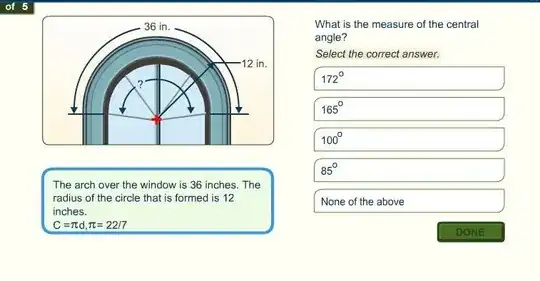
I can see that a 36 inch semi-circumference yields a radius of 36/Pi or about 11.46 inches.

However, I can't see how to use this information to calculate the angle. Given the width of the arch, I may be able to do this, but don't see an easy solution otherwise.

Given that this is a grade school problem, I'm obviously missing something basic.

Using the "eyeball theorem" (ha ha), it seems like that angle is 172 degrees (it's clearly not 85 or 100 obviously).

  • get a protractor – EpicGuy Nov 15 '13 at 03:55
  • Eyeball is pretty good. A semicircle of radius $12$ has length $\approx (12)(22/7)\approx 37.714$, overhang of $\approx 0.857$ on both sides. So the little angle (difference between horizontal and one of the red (?) lines has sine about $0.857/12$. This angle is about $4$ degrees, more like $4.09$. Thus $172$ is real close. The correct value of $\pi$ gives $4.06$ degrees rather than $4.09$. Still $172^\circ$ for all practical purposes. – André Nicolas Nov 15 '13 at 04:03

2 Answers2

1

The formula is $r a = s$ where $r$ is the radius, $s$ is the arc length, and $a$ is the central angle in radians.

So the angle is $36/12 = 3$ radians, which is about $172$ degrees (multiply by $\pi/180$).

John
  • 26,319
0

The length of an arc of angle $\theta$ radians and radius $r$ is $r\theta$. And $\pi \neq 22/7$

Ross Millikan
  • 374,822