Elements giving a general methodology.
A fundamental observation is the connection of your autocorrelation issue with arclengths. Have a look at the following picture :
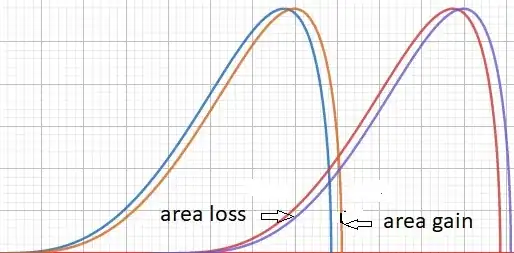
When moving from $a$ to $a+da$, the way the common area evolves is by considering gain minus loss, which amounts to lengths times $da$ (Cavalieri's principle), that you want to be equal to $da \cos(a)^2.$
$$da\left(\int_0^{a}\underbrace{\sqrt{1+\varphi'(x)^2}}_{L(x)}dx - \int_{\pi/2-a}^{\pi}\sqrt{1+\varphi'(x)^2}dx\right)= k da \cos(a)^2\tag{1}$$
where $k$ is a proportionnality factor (the formula for arc length computation can be found here).
Suppressing the common $da$ and differentiating with respect to $a$ gives :
$$L(a)-L(\tfrac{\pi}{2}-a)=-k \underbrace{2\sin(a)\cos(a)}_{\sin(2a)}\tag{2}$$
(Recall : derivation of $\int_0^{F(a)}f(x) \ dx$ with respect to $a$ is $f(F(a))F'(a)$)
Is it possible to find such a function $L$ ? By applying Laplace Transform to (2) which does not give an exact answer as far as I have attempted with Wolfram Alpha.
Let us assume that a function $L$ has been obtained (at least an approximation of it, see Edit below), what remains to be done ? Connecting functions $L$ and $\varphi$, i.e., obtain $\varphi$ by integration :
$$1+\varphi'(x)^2=L(x)^2 \iff \varphi(a)=\int_0^{a}\sqrt{L(x)^2-1} \ dx$$
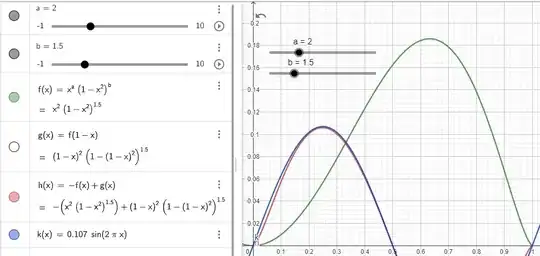
Edit : In order to be convinced that it is possible to find a function $L$ verifying (2), have a look at the case given on the following figure (beware, the normalization is on interval $[0,1]$ instead of $[0, \pi/2]$) using a "Beta-like" function : there is an almost perfect agreement on the two thirds of interval $[0,1/2]$ of red and blue curves (see color meaning on the left).