I'm going to refer to content from this book: Tilings and Patterns
by Branko Grunbaum, Geoffrey C. Shephard (borrow for free with this link)
My answer will use the "kites and darts" Penrose tiling.
The Penrose tiles can be marked with lines that form infinite straight lines through the entire tiling. These lines are called Ammann bars. There are 5 sets of Ammann bars for a tiling, angled at multiples of 72 degrees to each other. There are only two possible distances between consecutive Ammann bars, and the ratio of those distances is Φ (the golden ratio, 1.618...). A sequence of distances between consecutive Ammann bars can be written as LSLLS (e.g.), for (L)ong and (S)hort.
Two very similar tilings
In this section I'll construct two Penrose tilings that differ only within a narrow strip that's infinitely long. So I think the answers the first 3 questions is "no", if I get to pick the infinite set.
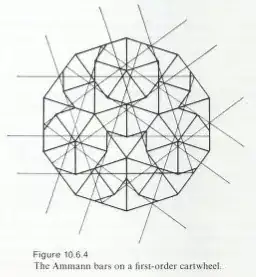
The book shows the above diagram

and describes how a valid set of Ammann bars can be constructed. (In this construction the sequence is palindromic, except for the S and L in the center). (Note that the "cartwheel" above has an S and L in all 5 directions, and the sequence will be extended as shown in 10.6.6.)

Here is the "cartwheel" rotated 90 degrees, with Ammann bars shown. The central L and S Amman intervals are shaded darker. Outside of these central intervals, the Ammann bars are symmetric, and therefore this tiling has 10-fold rotational symmetric, if you ignore the shaded portion.

In fact, you can rotate this tiling 108 degrees counterclockwise, and only one Ammann bar is affected, so only a single strip of tiles is affected. It seems this is a Conway worm that's being flipped.
Is my example a special case?
I think my example here might be a special case. I think there is only one sequence of Ls and Ss where single Ammann bar can be moved. In my example, all 5 sets of Ammann bars have this single bar pass through the same region.
I imagine there are other value Penrose tilings, but I'm not sure.
Pentagrid
from http://www.ams.org/publicoutreach/feature-column/fcarc-ribbons :
The result is that a pentagrid, determined by the 5-tuple $
> (\gamma_0,\gamma_1,\ldots,\gamma_4) $ , defines a Penrose tiling of
the plane.
Perhaps more remarkably, de Bruijn has proven that every Penrose
tiling results from a pentagrid.
So, a Penrose tiling can be defined by 5 real numbers.
Infinite strip
If we have an infinite strip of tiles (i.e. the tiles obtained by
crossing over opposite edges of successive rhombs), does that uniquely
determine the tiling?
You can pick an infinite strip parallel to the one in my GIF, and then the answer is no.
But how much of the tiling is forced?
For the Ammann bars parallel to the strip, only one Ammann bar forced. But the other 4 sets of Ammann bars are completely determined.

This forces a lot of tiles. For example, notice how there are only a handful of unique patterns that the Ammann bars make. Also, note that the small triangle always exactly determines the exact position of a "kite". I'm not sure of the exact region that is forced though.


