0

Recently I have been reading into Nuclear Fusion and the use of spherical tokamaks. My knowledge of maths and physics is quite limited, only a second year undergraduate level. I was wondering how I might obtain equations for the magnetic field around a simplified tokamak, namely a perfect torus.

I have derived the equation of a torus from the circle $$x^2+y^2=c^2$$ $$x(u)=c\cos(u), \ y(u)=c\sin(u), \ \ \ u \in [0,2\pi]$$ and another radial parameter $v$ by considering two circles of radius $a$ centred at $\pm c$ from the origin $$z(v)=a\sin(v), \ \ \ v\in[0,2\pi]$$ Shifting the $x$ and $y$ positions by: $a\cos(v)$ gives parametric equations of the form $$\begin{cases} x(u,v)=(c+a\cos(v))\cos(u)\\y(u,v)=(c+a\cos(v))\sin(u)\\z(u,v)=a\sin(v) \end{cases}$$ I know how to derive the formula for a magnetic field line in $\mathbb{R}^2$ and I assume it is fairly straightforward to do for $\mathbb{R}^3$. However, once I have the expression how can I deduce that the field lines should look like this?

$\hspace{4cm}$enter image description here
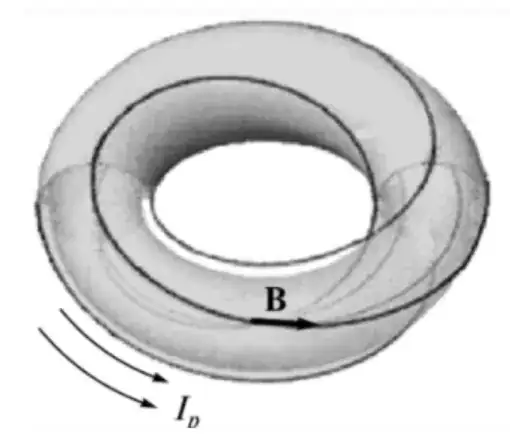
I have realised that it may be better to show that the magnetic field of a slice of the torus of infinitesimal thickness has a circular magnetic field, then revolve the circular magnetic field around the $\hat z$ axis to see it is a sort of helical spiral. If someone could advise on this I would greatly appreciate it.

  • The magnetic field depends on the current distribution. Do you have that information? – Andrei Nov 09 '21 at 14:56
  • I have not studied current distribution, however I have no problem with reading up on it provided I have a high enough level of mathematics to do so. Would you be able to recommend a resource where I could do so? – benmcgloin Nov 09 '21 at 14:59
  • https://en.wikipedia.org/wiki/Tokamak#Design You have a field along the axis of the torus, created by external magnets, then you have a field created by the plasma (a current along the torus) – Andrei Nov 09 '21 at 15:13
  • Can I show this mathematically though? That is what I am interested to know – benmcgloin Nov 09 '21 at 15:14
  • 1
    Yes. Magnetic fields are additive vectors. For an accurate calculation, the issue is to find the magnetic field of the external coils. The magnetic field at the center is easy to find. If the radius to the center of the tube is large compared to the radius of the tube, you can approximate a field that is constant along the tube. Add at any point the field due to a current along the tube. The field line would look like a curved helix – Andrei Nov 09 '21 at 15:35
  • I will outline the method I am considering. Find the magnetic field equation for a circle in the $xy$-plane, then find the magnetic field equation for a circle at a distance $c$ from the $z-axis$ in the $xz$-plane and add them together due to additivity. Would this describe the circular helix? – benmcgloin Nov 09 '21 at 16:24
  • 1
    Yes, that sounds right – Andrei Nov 09 '21 at 16:30

0 Answers0