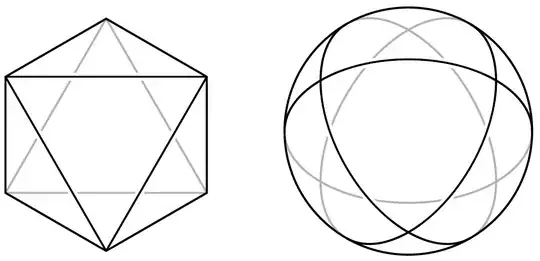
The answer is negative: not every spherical polyhedron comes from a convex one.
The argument is basically the same I gave over here: the spherical polyhedron can have more degrees of freedom than the convex polyhedron.
The following is a copy of a part of the answer behind the link:
[...] given the combinatorial type of a spherical polyedron, the realization space of that type (i.e. the space of all spherical polyhedra with this combinatorial type) has a local dimension of $2n$, where $n$ is the number of vertices.
What do I mean by that: you can describe your spherical polyhedron basically by drawing some points on the sphere, and stating between which points there should be a line. The line is then uniquely determined as the great circle arc between these points (yes, there is a choice which arc to take, but lets ignore this for now).
So if we placed our points carefully, then none of these arcs intersect, and what we have is a spherical polyhedron.
But note that we can move each point slighly, and the arcs move accordingly. And if we moved the points slightly enough, then the arcs stay disjoint, and the construct stays a spherical polyhedron.
Since each vertex moves on the surface of the 2-sphere, each vertex has two degrees of freedom, and the whole construct has $2n$ degrees of freedom.
Now consider the $7$-sided prism (the argument can certainly be improved, but as presented here, we need an $n$-prism with $n\ge 7$).
This prism has $14$ vertices, and by the argument presented above, the spherical 7-prism has $2\times 14=28$ degrees of freedom.
However, a convex polyhedron has as many degrees of freedom as its dual (because they determine each other uniquely). The dual of the 7-prism is the 7-sided bipyramid, which has $9$ vertices. And the position of these vertices determine the bipyramid uniquely. Each vertex has three dregrees of freedom, and so the 7-prism has at most $3\times 9=27$ degrees of freedom.
In other words, the projection of the convex prism to the spherical one (which is continuous) cannot be surjective, given the larger dimension of the realization space of the image.