2

Let $\alpha $, $\beta $ are the roots of $3x^2+x+5=0$ then find a quadratic equation with roots as $\dfrac {\alpha +1}{\alpha -3}$ and $\dfrac {\beta +1}{\beta -3}$.
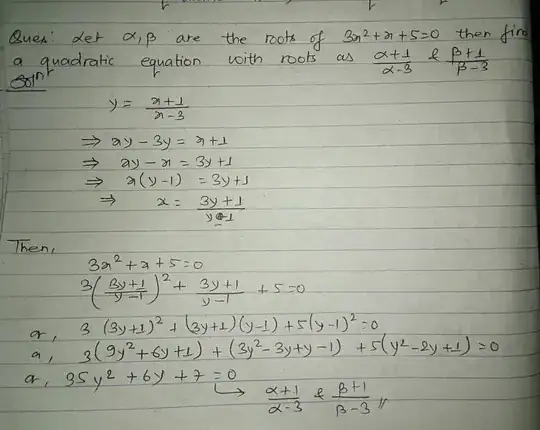
enter image description here

I got this solution but didn't understand what procedure is used, what concepts are used and how's it working?

pi-π
  • 7,416
  • 1
    Do you know Vieta's formulas? https://en.wikipedia.org/wiki/Vieta%27s_formulas – Student Oct 24 '17 at 15:47
  • 1
    Transformation of equation. See https://math.stackexchange.com/questions/2209034/finding-sum-k-0n-1-dfrac-alpha-k2-alpha-k-where-alpha-k-is-prim – lab bhattacharjee Oct 24 '17 at 15:48
  • Let $S=\alpha +\beta$ and $P=\alpha \beta$ then it is easily shown that equation $x^2-Sx+P=0$ has $\alpha$ and $\beta$ as its roots. – schneiderlog Feb 04 '24 at 14:34

4 Answers4

5

I think it's better to use the Viete theorem $$\alpha+\beta=-\frac{1}{3}$$ and $$\alpha\beta=\frac{5}{3}.$$ Thus, $$\frac{\alpha+1}{\alpha-3}+\frac{\beta+1}{\beta-3}=\frac{2\alpha\beta-2(\alpha+\beta)-6}{\alpha\beta-3(\alpha+\beta)+9}=...$$ and $$\frac{\alpha+1}{\alpha-3}\cdot\frac{\beta+1}{\beta-3}=\frac{\alpha\beta+\alpha+\beta+1}{\alpha\beta-3(\alpha+\beta)+9}=...$$

3

Hint: you can compute $\frac{\alpha+1}{\alpha-3}+\frac{\beta+1}{\beta-3}$ and $\frac{\alpha+1}{\alpha-3}\frac{\beta+1}{\beta-3}$ by $\alpha +\beta = -\frac{1}{3}$ and $\alpha\beta=\frac{5}{3}$.

GAVD
  • 7,296
  • 1
  • 16
  • 30
3

For a different route, try this.

Let $a=\dfrac {\alpha +1}{\alpha -3}$ and $b=\dfrac {\beta +1}{\beta -3}$.

An equation with roots $a$ and $b$ is $(x-a)(x-b)=0$, or $x^2-(a+b)+ab=0$.

Now $$ a+b=\frac{2 (\alpha \beta - \alpha - \beta - 3)}{\alpha \beta - 3 \alpha - 3 \beta + 9}, \quad ab = \frac{\alpha \beta + \alpha + \beta + 1}{\alpha \beta - 3 \alpha - 3 \beta + 9} $$ Finally, $$ \alpha + \beta = -\frac{1}{3}, \quad \alpha \beta = \frac{5}{3} $$

lhf
  • 216,483
1

$p(x)=3x^2+x+5$ is an irreducible polynomial over $\mathbb{Q}$ since it is an irreducible polynomial over $\mathbb{F}_2$. In particular its roots are algebraic conjugates over $\mathbb{Q}$ and any polynomial in $\mathbb{Q}[x]$ vanishing at $\frac{\alpha+1}{\alpha-3}$ vanishes at $\frac{\beta+1}{\beta-3}$ too. So the problem boils down to finding a polynomial vanishing at $A=\frac{\alpha+1}{\alpha-3}$. We may notice that $p(\alpha)=0$ implies $\alpha^2 = -\frac{1}{3}\alpha-\frac{5}{3}$ and $$\begin{array}{rcl}3(\alpha-3)^2 A^0 &=& 22-19\alpha \\ 3(\alpha-3)^2 A^1&=&-14-7\alpha\\ 3(\alpha-3)^2 A^2&=&-2+5\alpha,\end{array}$$ so by Gaussian elimination we have $35A^2+6A+7=0$.
In particular $q(x)=35x^2+6x+7$ is a polynomial vanishing at $\frac{\alpha+1}{\alpha-3}$ and $\frac{\beta+1}{\beta-3}$ as wanted.

Jack D'Aurizio
  • 353,855