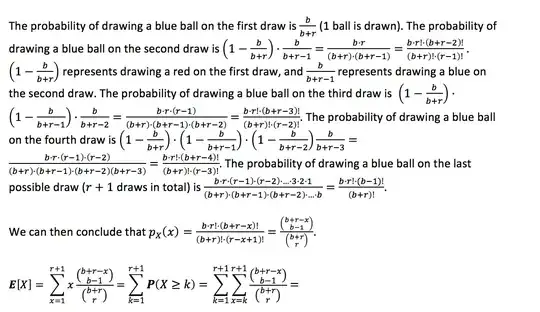
You are on the right path in solving the problem, however, there is a nice technique for evading the calculations, which is finding the expected value using indicator functions.
First, number the red balls from $1$ to $r$ and define $X_i$ to be the function indicating whether ball number $i$ is drawn before the first blue ball or not.
So $X_i$ is $1$ if the i'th ball is drawn before the first blue ball and zero otherwise.
Now, it is easy to see that $X$ is the sum of indicators, i.e.
$$X = 1 + \sum_{i=1}^r X_i $$
so the expected value of both sides are equal, and using the expected of the sum property and the symmetry between $\mathbb{E}[X_i]'s$, we get:
$$\mathbb{E}[X] = 1 + \sum_{i=1}^r \mathbb{E} [X_i] = 1 + r\mathbb{E}[X_1] = 1 + r\mathbb{P}[X_1] $$
the problem now boils down to finding the probability that the first red ball is drawn before the first blue ball,
which is just $\frac{1}{b+1}$, since out of b+1 different ways of putting 1 red ball and b blue balls next to each other, only the one which the first red ball comes first is valid. you can then arrange other red balls where ever you want.
Finally, the expected value is given by:
$$\mathbb{E}[X] = 1 + \frac{r}{b+1} $$