4

I recently ate in a restaurant where you could see part of the kitchen, and they had a plastic bin full of chicken eggs. This prompted me to wonder about the close packing properties of egg-shaped solids, analogously to the close packing of spheres. In particular, I'd like to know the optimal packing of these solids (assuming it's periodic) and the average density of that packing.

In general, define an egg to be two hemi-spheroids connected at their "equators". A spheroid is an ellipsoid with two equal semi-diameters, so let those two be of length one for each hemi-spheroid. We can then define the third semi-diameter of each hemi-spheroid to be $b$ and $c$; a reasonable choice to approximate a chicken egg is $b=1$ and $c=2$.

That much seems reasonable, but I have no idea how'd I'd even approach the close packing of these solids. I'm not expecting a full solution, unless it's a citation of existing work, but failing that I would like to know what techniques one could try to find the optimal packing.

mgold
  • 293

1 Answers1

2

We can start from dense sphere packings to find dense egg packings. In particular, this was what I thought immediately after reading the question:

  • Start with a layer of eggs, pointed ends all up, arranged as a triangular lattice in the xy plane.
  • Above and below this layer stack identical triangular lattices of eggs, but with their pointed ends down.
  • Continue stacking layers of eggs in this manner, alternating the direction in which the eggs' pointed ends point.

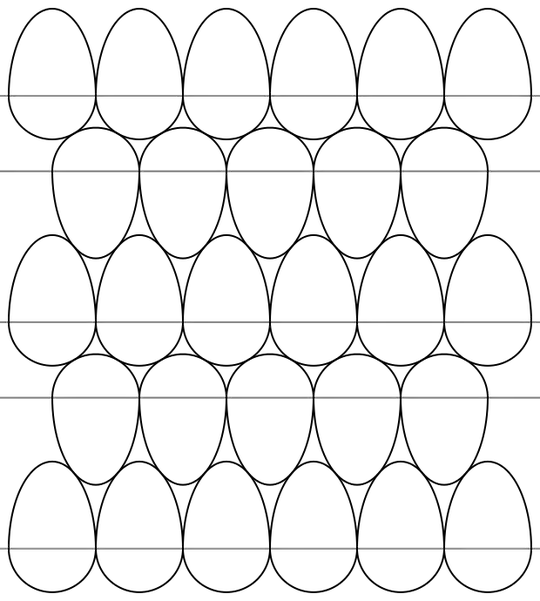
This is akin to the construction of the hcp and fcc lattices as stacks of spheres in triangular lattices. The diagram below shows a cross-section in the xz plane of the hcp-like egg packing.

Stacks of eggs: up, down, up, down, etc.

The grey lines show an alternate manner of constructing this egg packing: start with a hcp or fcc lattice and stretch alternate pairs of half-layers of spheres (a narrow gap between lines to a wide gap). Because such a transformation does not alter density, I conclude that this egg packing has the same density as the densest possible sphere packing: $\frac\pi{3\sqrt2}\approx0.74$.

I do not believe a denser packing of eggs exists; even if there was one, finding it would be a task on the same scale as the formal proof of the Kepler conjecture.

Parcly Taxel
  • 103,344