According to my book, the dimensions of a HCP unit cell is $2r$,$2r$, $2.83r$. How in the world is the height $2.83r$? The length and width are obviously $2r$ because there the base is a rhombus and the atoms at each corner of the rhombus are touching. However, the height has to to account for the extra atom in between the top and bottom layers of the rhombus. Check diagram:
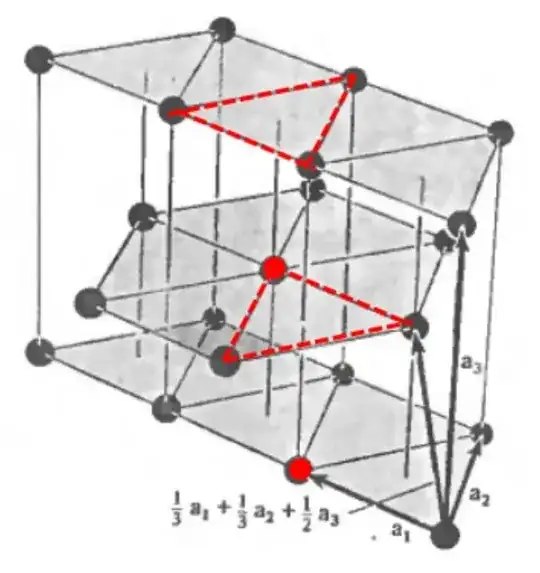
I was able to calculate (what I thought to be the answer) of the height of this unit by finding the height of a tetrahedron of length $2r$: $2\frac{\sqrt{6}}{3}$. In other words, the height from the base of the cell (the plane that cuts the $4$ atoms of the lower layer in half) to the plane through the midpoint of the middle atom is approximately $1.6r$. Therefore, from the middle atom to the top plane (cuts $4$ atoms of top layer in half), it should be be double the original calculation: approximately $3.2r$.
But my book says height is $2.83$...
Wikipedia seems to corroborate my answer for the height (z-axis).
What did I do wrong/conceptualize incorrectly?
P.S. I think Wikipedia is wrong for the $y$ component of the first row of the second layer. It should be $(r, r+ r\frac{\sqrt{3}}{2}, r + 2\frac{\sqrt{6}}{3})$ because it is in between row 1 and 2 of layer 1, which have a $y$ difference of $r\sqrt{3}$, so between them would be $r\frac{\sqrt{3}}{2}$. Could someone confirm my suspicions?


