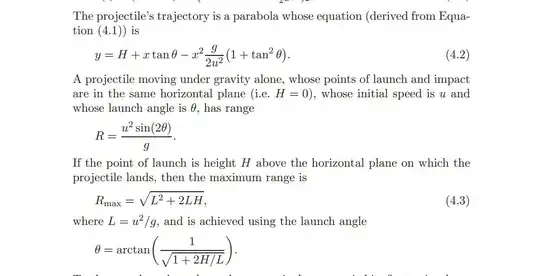
If a projectile is launched at a speed $u$ from a height $H$ above the horizontal axis, $g$ is the acceleration due to gravity, and air resistance is ignored, its trajectory is $$y=H+x \tan θ-x^2\frac g{2u^2}\left(1+\tan ^2\theta\right),$$ and its maximum range is $$R_{\max }=\frac ug\sqrt{u^2+2gH}.$$
I would like to derive the above $R_{\max},$ and here's what I've done:
- substitute $(x,y)=(R,0)$ into the trajectory equation;
- differentiate the result with respect to $\theta;$
- substitute $\left(R,\frac {\mathrm dR}{\mathrm d\theta}\right)=\left(R_{\max},0\right).$
However, this eliminates $H$ and fails to lead to the desired expression for $R_{\max }.$ How to actually derive the above $R_{\max }?$
P.S. This is the context; in the above, I've replaced all occurrences of $L$ below with $\frac{u^2}g$.