6

enter image description here

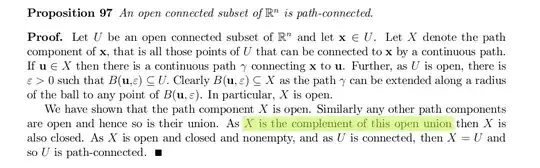
In the above proof the following equivalence is used at the last step:

A space $M$ is connected if and only if the only open and closed subsets of $M$ are $\emptyset$ and $M$ (ie. there are no proper open and closed subsets).

However I do not understand the claim that $X$ is the completment of the open union and feel like it is non-trivial. Can someone please elaborate?

suarko
  • 274

1 Answers1

4

The argument shows that that every path-connected component of your space is open. Since the space is the disjoint union of its path connected components, this implies that the complement of each path-connected component is a union of path-connected components —as each of these is open, the union is also open.

  • Is the statement that the space is the disjoint union of its path-connected components deemed trivial? I see this intuitively but this is essentially the question I'm trying to address. – suarko Jan 02 '15 at 17:28
  • Every point is in some path-connected component: namely, its own path connected component. – Mariano Suárez-Álvarez Jan 02 '15 at 17:29
  • On the other hand, two path connected components which share a point are equal: this is a trivial exercise. – Mariano Suárez-Álvarez Jan 02 '15 at 17:30
  • This clears it up, thank you. – suarko Jan 02 '15 at 17:31
  • 1
    (A sensible way to put this is to define a relation $R$ between points on your space, so that $xRy$ iff there is a path joining $x$ to $y$. Then you can easily show that $R$ is an equivalence relation and that the equivalent classes of $R$ are precisely the path-connected components of the space) – Mariano Suárez-Álvarez Jan 02 '15 at 17:31