3

I seek knowledge in regard Mead, this is my first attempt at making some mulberry mead, the recipe I used was: 19 liter Carboy 6kg Honey 1kg Raisins 2teaspoons of Wyeast Nutrient 1 little pack of the yeast 5kg Mulberries, soaked in 10 cups water and 2 cups brown sugar over night, mashed it all up into a goo, strained it with some pantyhose and squeezed all the juice out of it, maybe had umm 6-7 liters of mulberry juice.

So couple things if you could please help me;

  • when I first strained the mulberries, before I put them in the pantyhose all the little seeds got through, so I ended up with a little blanket of floaty seeds, I thought since I’m adding raisins some little seeds can go into the brew to, have I made an error with adding the seeds?

  • while I’m on the mulberries again with the first strain I didn’t have a sieve so I used, what I think it was a pasta strainer it had holes the width of a pencil, again I thought I’m adding raisins some pulp can go into it also, was this wrong also?

  • now because of the pulp, seeds, raisins I’m looking at the brew and I’ve maybe lost mmm 2-3 liters of liquid for mass volume, So my big question is:

  • can I add more liquid now (Honey) to top-up the carboy.

  • I was told to ferment it for around 2 months then strain it and put it into a fresh Carboy for the remaining time, this was when I thought I could also add the top-up liquid.
  • or don’t top-up just leave it be as is

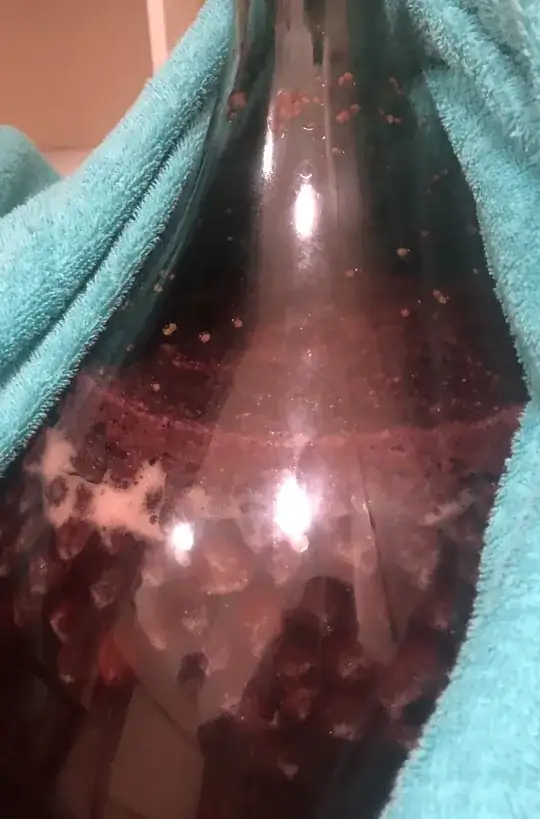
I made 2 x 19 litres, so I thought mmm that’s maybe 5-6 good mead litres I could have drunk, so do I top-up or not please? enter image description here
  • 1
    You can certainly top it off now if you want, but I've got a couple of questions. Are you able to take gravity readings from time-to-time? When you transfer it out of the carboy, what is it going to be going into, another carboy (same size?) or back into this one? Don't worry about the seeds, you'll eventually leave them behind. Two month fermentation is overkill unless you're fermenting very cold; let your gravity measurements tell you when you're done fermenting. – Dave Oct 28 '18 at 13:40
  • 1
    Every time you rack to a new vessel, you leave some liquid behind. Some people top off with water each time they do. Some don't like to dilute their wine/mead every time they rack, so they top off with wine or mead. Some people don't worry about racking too much because each time you do, you introduce oxygen; others rack a lot because they want brilliantly crystal-clear wine/mead, and some split the difference and rack a few times but use fining agents such as Sparkolloid or gelatin. There's tons of info on podcasts (search on Ken Schramm, for example) that cover all sorts of philosophies. – Dave Oct 28 '18 at 13:48
  • @Dave: your comment answered the question, why don't you post it as an answer. – rondonctba Oct 30 '18 at 01:59
  • @rondonctba: took your advice, thanks. It started as a quick comment then I just kept talking . . . :) – Dave Oct 30 '18 at 15:11

1 Answers1

1

You can certainly top it off now if you want, but I've got a couple of questions. Are you able to take gravity readings from time-to-time? When you transfer it out of the carboy, what is it going to be going into, another carboy (same size?) or back into this one? Don't worry about the seeds, you'll eventually leave them behind. Two month fermentation is overkill unless you're fermenting very cold; let your gravity measurements tell you when you're done fermenting (on the other hand, it isn't going to hurt you either if you don't want to fuss with checking on it).

Every time you rack to a new vessel, you leave some liquid behind. Some people top off with water each time they rack. Some don't like to dilute their wine/mead every time they rack, so they top off with wine or mead, and for people who don't like topping off, some add sanitized marbles to replace the volume lost to racking. The idea in all these cases is to have the liquid come as far up the neck of the carboy to minimize the surface area that can be exposed to oxygen. Some people don't worry about racking too much because each time you do, you introduce oxygen; others rack a lot because they want brilliantly crystal-clear wine/mead, and some split the difference and rack a few times but use fining agents such as Sparkolloid or gelatin. There's tons of info on podcasts (search on Ken Schramm, for example) that cover all sorts of philosophies.

Dave
  • 608
  • 3
  • 6
  • The gravity reading is something I don’t know, that’s the long floating thing yeah? I don’t have one but I’ll get one today. When I transfer - I have 2x19lr and one big one 50lr I was going to put both into the big one and let it sit till when ever it was ready ( that also I don’t know) how do I know when it’s all done? – The Human Child Oct 31 '18 at 02:50
  • the temperature here at the moment is between 18-25 atm I have some old jumpers and couple towels wrapped around them in a bathroom I don’t use. So the gravity probe will let me know when it’s all over a ready to drink for the first fermentation do you know what it should read? Yes I like your thinking on racking it all the time with the oxygen thing, makes sense, – The Human Child Oct 31 '18 at 02:51
  • I was only going to do it once just to strain all the pulp stuff out and it was then I was going to re-fill it with possibly honey or honey and water, if I do that will it start fermenting again ? Thank you for the pods I’ll look that dude up, I intend to start making the mead on a regular basis, been a bit busy and such so in that I rushed the whole process without reading a great deal into it, I have no equipment other then the carboys as I just thought it was a Viking sorta brew and one just put it all in and waited, quite incorrect I was. – The Human Child Oct 31 '18 at 02:52
  • The long glass thing is the hydrometer, which is what you use to take measurements. You need enough liquid to float it, so if you can't float it (and read the value) in your vessel, you need to pull liquid into a tube (I use a graduated cylinder); if you keep everything clean and sanitized, you can pour the liquid back, but that freaks out a lot of people, the fear of contaminating your batch. If you don't pour it back, and you just drink it (highly recommended), you lose that much liquid each time you take a reading. – Dave Oct 31 '18 at 20:42
  • Another option is to use a refractometer, which only needs a drop or two of liquid each time you make a measurement. However, once you start fermenting and making alcohol, the refractometer value you read isn't correct because you have to correct the reading due to the amount of alcohol is in your sample. There are online calculators for that (I recommend one by Sean Terrill) which were made for beer, but it should be good for wine/mead as well. – Dave Oct 31 '18 at 20:45
  • You know you're done fermenting when your gravity hasn't changed over a long time. What that final value is depends upon your yeast strain, how much sugar was in there at the start, etc. If you started out with a very high gravity, namely lots of sugar/honey, the yeast will only chew through so much of that before they peter out, leaving you with a sweet mead and high finishing gravity (say, 1.020). If you started with a low amount of sugar/honey, you would end up with a dry mead (low gravity, say, 1.002). – Dave Oct 31 '18 at 20:51
  • When you transfer it and you leave the yeast and berries behind, if you add more water and sugar to it t, it will start a new fermentation. It would take a little bit of work to separate the yeast from the berries (look up yeast washing or rinsing), if you didn't want the berries in the next batch, but it would be a lot more effort than it would be to just get some new yeast, if that is an option for you. If you are going to regularly make mead, you could easily get into a process where you use the yeast from batch to batch. – Dave Oct 31 '18 at 20:58