An obvious example is the fountains at the Palace of Versailles, which were made in the 17th century - which I'd have thought was long before anyone in Europe, even royalty, had running water on tap in the house (well, after the Romans!), but maybe they did.
In this answer I look specifically at the plumbing in Château de Versailles, so it is not necessarily generalizable to all the cases.
French kings did have indoor plumbing
Running water for drinking, cooking and bathing was available in Versailles, as well as in other royal residences:
Fait peu connu, le château de Versailles disposait de l'eau courante. En effet, dès 1664, Louis XIV voulut que sa résidence et toute la future ville soient approvisionnées en eau potable. Colbert, alors surintendant des Bâtiments, Arts et Manufactures2, fut chargé de réaliser un réseau d'adduction d'eau de source, comme il en existait déjà aux châteaux du Louvre, de Vincennes ou de Saint-Germain-en-Laye.
Little known fact, the Palace of Versailles had running water. Indeed, from 1664, Louis XIV wanted his residence and the entire future city to be supplied with drinking water. Colbert, then superintendent of Buildings, Arts and Manufactures, was responsible for creating a spring water supply network, as already existed at the Louvre, Vincennes and Saint-Germain-en-Laye castles.
(emphasis is mine)
It is also worth noting that the distinction was made between potable water and the rest, which required somewhat different technology:
Versailles disposait aussi d’un réseau spécial d’approvisionnement en eau potable : le réseau des « eaux bonnes à boire », construit de 1676 à 1682. En effet, au nord du Château, les cinq aqueducs de Rocquencourt, Bailly, Bel-Air et Glatigny collectaient les eaux de source en contrebas pour alimenter le palais, les Écuries du Roi et de la Reine, ainsi que les fontaines publiques. L’eau circule de préférence dans des « tuyaux de grès », en terre cuite, spécialement destinés au transport de l’eau potable, à la différence des tuyaux de fonte ou de plomb qui servent pour les fontaines. Il faut savoir que ce réseau des « eaux bonnes à boire » a fonctionné durant deux siècles, jusqu’à la guerre de 1914-1918, où il fournissait encore 120 mètres cubes par jour à la ville de Versailles.
Versailles also had a special drinking water supply network: the network of “waters good for drinking”, built from 1676 to 1682. Indeed, to the north of the Château, the five aqueducts of Rocquencourt, Bailly, Bel-Air and Glatigny collected spring waters below to supply the palace, the King's and Queen's Stables, as well as the public fountains. The water preferably circulates in “sandstone pipes”, made of terracotta, specially intended for the transport of drinking water, unlike the cast iron or lead pipes which are used for fountains. You should know that this network of “waters good for drinking” operated for two centuries, until the war of 1914-1918, when it still supplied 120 cubic meters per day to the city of Versailles.
(emphasis is mine)
Understanding of hygiene in Middle ages
However, having access to water was not considered as much of a necessity a sit is today. While bathing has continued uninterrupted since the Roman times, it was greatly diminished due to Christian understanding of modesty - it could be even viewed as an erotic activity. Bathing was also more associated with cleanness (not looking dirty) than with hygiene (preserving one's health). Thus, the common practice was toilette sèche (dry toilet) - at least for those who could afford it:
Les épidémies de peste et la rigueur religieuse (catholique et protestante) ont contribué à fermer les étuves, dont certaines s’étaient ouvertes à la prostitution, et à rendre l’eau suspecte. Les ablutions se font rares, et l’hygiène se déplace de la peau vers le vêtement : la propreté, c’est d’en changer souvent dans le cours de la journée, ce qui a pour conséquence de la rendre plus coûteuse et d’avoir recours aux parfums pour couvrir les émanations corporelles.
Plague epidemics and religious rigor (Catholic and Protestant) contributed to closing the bathhouses, some of which had opened up to prostitution, and making the water suspect. Ablutions are becoming rare, and hygiene is moving from the skin to clothing: cleanliness means changing it often during the day, which has the consequence of making it more expensive and use perfumes to cover bodily emanations.
It is only under Louis XV that the French adopt lieux à l'anbglaise ("places in English style")
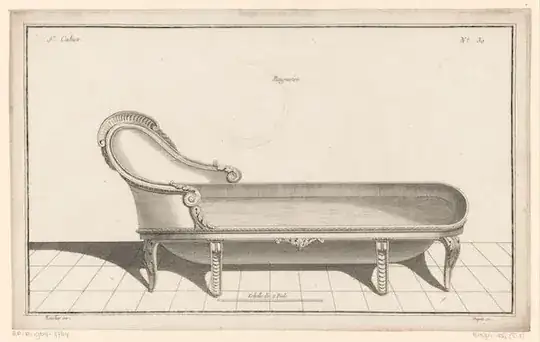
En France, les idées évoluent enfin sur le rôle de l’eau vis-à-vis du corps. Ce n’est pas encore la fin de la toilette sèche, mais l’Angleterre exerce sur le sujet une influence réelle, tant sur les principes que sur les installations. A Versailles, Louis XV donne l’exemple en faisant installer des « cabinets de bains », exemple qui sera suivi par son successeur. Louis XVI, très ouvert à la modernité, fera réaliser des « lieux à l’anglaise » [sic] qui comportaient une cuvette, un siège avec abattant, une soupape et deux arrivées d’eau libérant un jet nettoyant puis un second, dit « de propreté ».
In France, ideas are finally evolving on the role of water in relation to the body. It is not yet the end of dry toilets, but England has a real influence on the subject, both on the principles and on the installations. At Versailles, Louis XV set an example by having “bathrooms” installed, an example that would be followed by his successor. Louis XVI, very open to modernity, had “English places” [sic] created which included a bowl, a seat with a flap, a valve and two water inlets releasing a cleaning jet then a second, called “ of cleanliness.”
Technological challenges
Bringing water to Versailles was an important technological challenge, requiring finding appropriate materials for pipes, finding the appropriate water supply, creating the water distribution net, building pumps, etc.
L’eau pose un grand problème à Versailles puisqu’il s’agit d’une zone marécageuse. L’enjeu était donc de canaliser l’eau, d’assécher certaines parties et d’acheminer l’eau vers les fontaines. Tout un système de drainage de l’eau fut conçu pour qu’elle soit évacuée vers des aqueducs et des canaux. Il s’agissait ensuite de trouver des sources et des réserves d’eau suffisantes pour les fontaines mais aussi de construire des voies d’acheminement et d’évacuation des eaux. En 1664, la pompe de Claude Denis fut remplacée par une tour d’eau construite par Le Vau. Au rez-de-chaussée, la pompe de Denis Jolly permettait de tirer l’eau et de l’acheminer vers le réservoir situé au 1er étage. Comme cela ne suffisait pas à alimenter toutes les fontaines, furent créés cinq réservoirs principaux qui continuent encore aujourd’hui à alimenter les fontaines : sur les deux collines surplombant le château, les réservoirs de Montbauron et de Gobert (45 000m3) ; sous l’orangerie du château, les trois réservoirs Sous-Terre alimentent la perspective et les bosquets au sud (67x16m de côté construits en 1672, 1,6 m de profondeur).
Water poses a big problem in Versailles since it is a marshy area. The challenge was therefore to channel the water, dry certain parts and transport the water to the fountains. An entire water drainage system was designed so that it was evacuated towards aqueducts and canals. It was then a matter of finding sources and sufficient water reserves for the fountains but also of building water transport and evacuation routes. In 1664, Claude Denis' pump was replaced by a water tower built by Le Vau. On the ground floor, Denis Jolly's pump was used to draw water and transport it to the tank located on the 1st floor. As this was not enough to supply all the fountains, five main reservoirs were created which continue to supply the fountains today: on the two hills overlooking the castle, the Montbauron and Gobert reservoirs (45,000m3); under the castle's orangery, the three Sous-Terre reservoirs supply the perspective and the groves to the south (67x16m side built in 1672, 1.6m depth).

(image source)


