49

There is lots to see in Bruegel's famous painting representing life in June/July ('Haymaking'). (cf, https://insidebruegel.net for a great online collection of his work).

There is this activity he depicts in the background... It looks like shooting arrows at a pole - but that doesn't seem to make much sense.

The men appear to be holding bows, but maybe it's wooden swords, or rusty scythes - and we see streaks going up to the top of the pole (hence arrows or maybe it's rope). Our first thought was that it was some sort of maypole dance. Maybe they are raising a maypole - but then why are they all waving things at it?!

Mysterious Peasant Activity (click for bigger version here, or zoom in on InsideBruegel.net)

So - the question. What are they doing, and why is it relevant for the months that he has chosen?

Konchog
  • 513
  • 3
  • 7

1 Answers1

60

The question is:

Q: What mysterious Flemish peasant activity is depicted in this painting?

and one guess was:

Q: There is this activity he depicts in the background... It looks like shooting arrows at a pole - but that doesn't seem to make much sense.

And curiously, this is exactly it.

The group is playing a game: shooting at a popinjay:

Popinjay or Papingo (signifying a painted bird), also called pole archery, is a shooting sport that can be performed with either rifles or archery equipment. The object of popinjay is to knock artificial birds off their perches. […] The archery form, called staande wip[circular reference] in Flemish language, is popular in Belgium […]

With Wikipedia bringing us two pictures as examples, first Tir à l'arc au papegai:

[https://upload.wikimedia.org/wikipedia/commons/8/84/Tir_à_l%27arc_au_papegai.jpg2

and the following picture 'Popinjay mast for archery in Havré Belgium' as an example:

Popinjay mast for archery in Havré Belgium

This example in turn matches the echo master Bruegel himself presents us with, this time unused for sports and fun, just standing there in the background, in the painting "Hunters in the Snow" (empty field, vertically centred, extreme right):
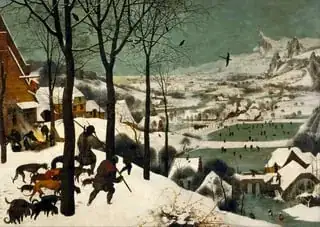
enter image description here

zoomed in:

enter image description here

Two more Wikimedia commons pictures with a more matching configuration of shooters compared to the painting:

Popinjay depiction Another Popinjay depiction

and how it evolved:

Popinjay with crossbow

This solution is confirmed by:

It is the calendar’s festivity of carnival in Gloomy Day that balances out the prudent tasks of early spring: at the right, the little carnival king in his printed paper crown watches the adults happily eating waffles, while in the opposite corner of the scene, down in the village, another family dances in the street outside an inn. In the next remaining scene of the series, Hay Harvest (June/July […]), the festive moment is very distant and yet, characteristically, fairly central on the panel: on a village green, people have gathered for a competition involving shooting at a popinjay on a pole. This pole also stood in an empty, snow-covered village green beyond the frozen ponds in Hunters, one of the echoes in the series that gives a sense not that we see the same place, but that every place we see is somehow archetypal, universal. In Hay Harvest Bruegel gestures to the universality of the view by structuring his composition as a clear echo of the ‘world landscapes’ of Joachim Patinir, some forty years earlier, with the colour scheme moving carefully from foreground brown to green to distant blue, the rather choppy sense of space where roads fail to connect individual features, and the great inhabited rock formations jutting suddenly upward from pleasant farmland.

— Elizabeth Alice Honig: "Pieter Bruegel and the Idea of Human Nature", Renaissance Lives, Reaktion Books: London, 2019. (gBooks)

clabacchio
  • 111
  • 1
  • 4
LаngLаngС
  • 80,978
  • 9
  • 282
  • 356
  • 19
    Yikes, looks slightly less safe than jarts! – shoover Oct 03 '22 at 03:37
  • 5
    It's being practiced even today, as a cultural activity. – Jos Oct 03 '22 at 06:52
  • 4
    Dutch Wikipedia seems to use staande wip, schuttersfeest and papegaaischieten – Henry Oct 03 '22 at 13:34
  • 1
    It is also common in Asiatic Horse Archery.... – MCW Oct 03 '22 at 13:35
  • 8
    @shoover Otherwise known as "circular firing squad". It'd be one thing if everybody was on the same side of the pole, but somebody needs to explain "what goes up must come down" to these people... – Darrel Hoffman Oct 03 '22 at 18:19
  • 7
    Blunt arrowheads exist, as do fletchings that will slow an arrow significantly after a short distance. And for crossbows the issue is not nearly as serious as for longbows. – DevSolar Oct 03 '22 at 21:50
  • 4
    Also popular in parts of the Netherlands and Germany, mainly in rural communities. Many villages have one (or more) "schutterij" (Dutch) or "schutzenverein" (German), which are clubs that organize competitions. Several variants in rules and shape/size of target(s) exist. Today usually performed with hand-bow or crossbow and, for obvious safety reasons, with the shooters and spectators on one side of the target pole(s) and an empty field on the other side. – Tonny Oct 04 '22 at 12:27
  • 2
    @Tonny You are using present tense. A 'schutzenverein' [sic] is much more likely to promote shooting assault rifles at targets far away and close to the ground than bows at targets nearby but high up in the air. – Nobody Oct 04 '22 at 19:37
  • 4
    Just in case anyone's wondering: popinjay is an archaic term for parrot. Hence being equivalent to the Dutch term papegaaischieten (parrot shooting) as mentioned above. So the object on top of the pole is probably not just any bird, but represents a parrot. I wonder if some medieval European explorers somehow go this idea from contact with certain far off rainforest inhabiting tribes or some such... – Will Oct 05 '22 at 07:27
  • 2
    @Will - London is currently infested with ring-necked green parakeets, which went feral in the 20th century and have been breeding rapidly since. Perhaps something similar happened earlier in Flanders – Henry Oct 05 '22 at 14:40
  • @Henry I can't really speak for Flanders, but a lot of major Dutch cities have them as well, but they're a 20th century phenomenon there as well. – SQB Oct 06 '22 at 10:30