19

The Old Testament is awfully big on foreskins (e.g. Genesis 34 and 1 Samuel 18:27). In particular, the Israelites are fond of collecting the foreskins of their enemies, usually after they have been slain, but occasionally beforehand.

It's such a bizarre-seeming detail that it got me wondering. Are there any non-Biblical historical references to this practice? Does it have any overlap with the historical origins of circumcision (it would seem it must, but I can't quite imagine what the backstory would be)?

Any insights would be much appreciated.

MCW
  • 33,640
  • 12
  • 105
  • 158
David
  • 465
  • 3
  • 6
  • 1
    It looks like there is a potentially relevant chapter ("Gezer and Circumcision") in this book, but the google preview is limited: https://books.google.com/books?id=oYearm8YobQC – Brian Z Aug 06 '17 at 21:59
  • 3
  • Thanks. The "Gezer and Circumcision" looks like a good resource. It relies heavily on the Bible as a source, and what I'm really wondering is whether other ancient texts also mention the same practice of gathering up the foreskins of slain enemies? As far as I can tell, the mention is limited to the Bible. – David Aug 06 '17 at 23:06
  • 2
    I'm not sure that a single attestation = "inordinate". You want to provide some sources for this having happened multiple times? – Shimon bM Aug 06 '17 at 23:08
  • Shimon bM: Genesis 34:25 and 1 Samuel 18:27. Not sure if there are others, so maybe 'inordinate' was overstating things. Still, it's hard to read these passages and not be struck by how peculiar it all seems. – David Aug 06 '17 at 23:58
  • 4
    Comment was to @david; please edit the citations into the question. Questions should stand alone without reference to comments; comments get deleted. If you're going to assert that the Torah is big on foreskins, then you need to support that assertion; you've done so in response to Shimon bM, but the information needs to be in the question, not in a comment. – MCW Aug 07 '17 at 00:08
  • 2
    In many fairy tales the writers have bowdlerised the text over the centuries. In Grimms Fairy Tales the prince kisses the Sleeping Beauty. In the original he went further, and she was woken by the result 9 months later... Soldiers are in a pretty primitive mood while fighting, and slicing off the genitals of a defeated enemy is common in ancient literature. See also the Bayeux Tapestry - the soldier cutting off "part of King Harold's thigh"? Quite. Why go to the trouble of the rather delicate task of circumcision when you can just hack? They were not collecting foreskins. – RedSonja Aug 07 '17 at 11:20

2 Answers2

16

The practice of Circumcision was by no means unknown in ancient Egypt, although I'm not sure how widely it was used.

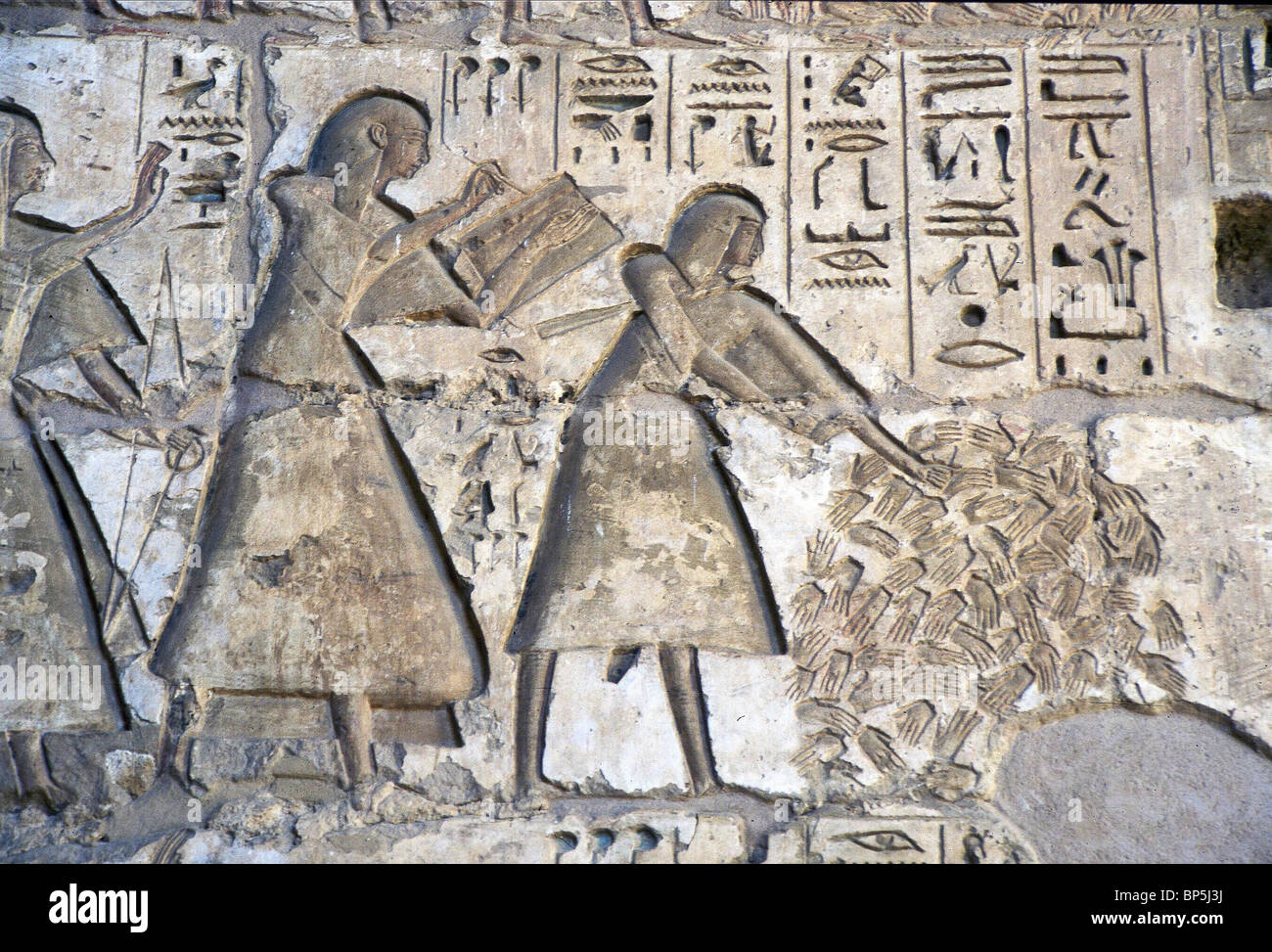
A parallel to the Israelite practice of collecting the foreskins of slain enemies was the ancient Egyptian practice of collecting hands and/or genitals from the dead. Soldiers were rewarded for each "trophy" they brought back. The practice is recorded in a number of tombs, for example in the Biography of Ahmose, son of Abana.

The Israelites were probably collecting foreskins for the same reason (e.g. 1 Samuel 18:27). An additional benefit of counting the foreskins would be that, since the Israelite army was presumably already circumcised before the battle, they could be sure that any foreskins collected actually belonged to the enemy.

sempaiscuba
  • 77,519
  • 15
  • 303
  • 356
  • 4
    Yes, and unlike the collection of scalps by North American indigenous peoples (which is easily done on a live victim with only baldness as a permanent side effect), it is likely that a foreskin is only collected from a dead victim. – Pieter Geerkens Aug 06 '17 at 22:52
  • Thanks, guys. Is there more detail on the Egyptian practice vis a vis foreskins (or genitalia) and rewards? – David Aug 06 '17 at 23:09
  • 2
    The earliest depiction of the practice of removing hands and/or genitals that I'm aware of is on the Narmer Palette. The practice is recorded in a number of texts and in tombs and a cache of severed hands was found back in 2012. I don't think they've found a similar cache of penises yet though. – sempaiscuba Aug 06 '17 at 23:34
  • 2
    Can you actually tell a severed foreskin from another bit of skin? –  Aug 07 '17 at 00:46
  • 4
    @fredsbend Me personally? Probably not. But I'm quite sure there are specialists who can. – sempaiscuba Aug 07 '17 at 00:49
  • A strange specialty... proving you've done your part in battle has had all kinds of variants. This is the first I've heard of foreskins. If true, I'd expect some discussion on determining the cheaters from the real thing. –  Aug 07 '17 at 00:53
  • 4
    @PieterGeerkens I am not a medic, but I think losing such a large mass of skin, without proper, high tech and quick medical assistance, would likely result wound infection and a painful death in some days. Today the medics would get skin from other parts of the body and transplant them to the place of the missing part. It would be a life-saving operation, not an aesthetical one. – Gray Sheep Aug 07 '17 at 03:26
  • 5
    @MorningStar : I've read about survivors of scalping, so it was survivable. With what chances, I don't know. – vsz Aug 07 '17 at 04:13
7

I don't think they were collecting foreskins, and I believe this mistaken assumption is due to a mistranslation.

This goes back to the meaning of the word "ערלה" ("Orla") in Hebrew also meaning specifically foreskin, but also "uncut", or "un-refined". This isn't a new interpretation, this is just knowing the source language, as a brief survey of the use of the root of the word "ערל" ("Arel") in the bible confirms:

  • Genesis 6, Moses refers to his own mouth as "Arel", meaning his mouth is blocked / closed. In other words, he is a stutterer.
  • Ezekiel 46, refers in the same passage to both the "Arel" of the flesh (i.e. uncircumcised) as well as the "Arel" of the heart - presumably those who have not opened their hearts to God.
  • Leviticus 19 refers to the fruit of young trees "Arelim".

Thus, it is more likely that the story describes collection of genitals in the Egyptian custom, with the biblical author terming them "Orlot" or "the uncut(s)", which they were, and is not describing collection of the actual foreskin alone.

Nathaniel Bubis
  • 539
  • 5
  • 12
  • Citation to a source making this claim would improve this answer. – Aaron Brick Oct 01 '18 at 14:53
  • @AaronBrick A source that the Hebrew word means what I said it does? I can add references to the relevant passages. As to what the intent of the passage is, it's a question of likelihood: Do we assume they engaged in a common local practice? Or assume based on no evidence but a mistaken translation that they engaged in a surgical operation in the battlefield? – Nathaniel Bubis Oct 01 '18 at 14:58
  • I think you're saying that established English language Bible translations may be in error. If so this would be of major scholarly interest and has perhaps already been the subject of research. I read a few dozen versions of 1 Samuel 18:27 and there was not much hint of any disagreement among them (one said "pieces of flesh"). Do Torah scholars or Bible translations in other languages support your claim? I like the idea, in part because cutting a foreskin off a dead enemy sounds so much trickier than hacking the whole appendage off. – Aaron Brick Oct 01 '18 at 16:20
  • @AaronBrick - I added in some sources, I really don't think this is innovative, rather it's a understanding of how the word is used in the rest of the bible, and use of common sense to determine the specific meaning used in this passage. – Nathaniel Bubis Oct 01 '18 at 18:22
  • Another commenter above agrees with you, and if you're right, it overturns the premise of the question. – Aaron Brick Oct 02 '18 at 01:45