What language(s) were considered the primary language for the Holy Roman Empire? Were there many different languages spoken due to the many different regions?
Asked
Active
Viewed 2.1k times
36


-
1The full name was The Holy Roman Empire of the German Nations... – txwikinger Oct 25 '11 at 20:39
-
12But as we know it wasn't Holy it wasn't roman and it wasn't an empire SNL – Napoleonothecake Oct 26 '11 at 06:38
-
2@Napoleonothecake is empire not but a title? – Dominykas Mostauskis Oct 15 '14 at 08:15
-
5To quote Emperor Charles V: "I speak Spanish to God, Italian to women, French to men, and German to my horse." – Pieter Geerkens Dec 15 '22 at 02:30
7 Answers
53
The Holy Roman Empire (of the German Nation) was a multi-ethnic, multi-cultural, and multi-lingual coalition from its (unofficial) founding by Charlemagne in the 9th century AD. The German Empire would be a better term in fact, as it was founded and typically ruled by Germanic peoples. (Charlemagne himself was a Frank.) As Voltaire once perceptively quipped, the Holy Roman Empire was "neither holy, nor Roman, nor an empire". (Essai sur l'histoire générale et sur les mœurs et l'esprit des nations, Chapter 70)
Given that the boundaries of the empire were constantly changing over its almost thousand-year history (and were rarely if ever officially defined), the cultures and languages subsumed were constantly in flux too. Undoubtedly, German (or the predominant dialect thereof) was the de-facto official language. Latin was also for official matters of state/ceremonies, especially during the Medieval period, given this more modern empire's desire to ape the glory of Ancient Rome, not to mention the ubiquity of the Church in Medieval life.
A map of the Holy Roman territories circa 1600 hints well at what languages were commonly spoken by the populace in various regions.
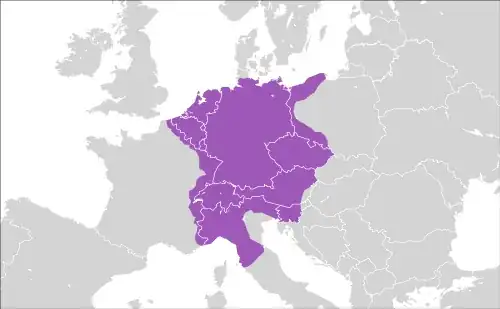
These would have included the following:
Standard German and regional West Germanic languages – in modern Germany and adjacent regions
Note that "Lower German" dialects (e.g. Low Saxon/Low Franconian) were commonly spoken in Northern Germany whereas "Upper German" dialects (e.g. Bavarian) were commonly spoken in Southern Germany/Austria/far north of Italy.
Dutch / Flemish – in modern Netherlands/Belgium
French (and other Gallic languages/Langues d'oil) – in modern France, Belgium, Switzerland, and the oft-disputed regions of Alsace and Lorraine
Italian (and its northern regional dialects) (e.g. Venetian, Genoese) – in Italy and elsewhere as a language of culture
Czech – in modern day Czech Republic (ancient Bohemia and Moravia)
Polish – in modern day Poland and surrounding areas
Undoubtedly I have missed out a few, but the above list should cover the predominant languages within the (stable) boundaries of the Holy Roman Empire, noting where appropiate the diversity of dialects of some languages that was extremely prevalent during the medieval and early modern periods of history.
Medieval Latin (an evolution of the Classical Latin of Ancient Rome) was indeed the official language of the Holy Roman Empire for most of its history. It was in fact only changed to Standard German during the reign of Joseph II (late 18th century.) What is interesting to note, especially in the High Medieval period where the Holy Roman Empire encompassed much land and many cultures, is that Medieval Latin was the only common language between the educated (especially ecclesiastical) folk in all of its member states. It was perhaps the second great period in which Latin was the "Lingua Franca" of its day, supplanted by Standard German (even in regions such as Slavic Bohemia) by the Early Modern period.
References
Please feel free to add/improve on references, especially secondary ones. Some of the information in this post is admittedly from old history lessons of mine/sources I have forgotten.

Noldorin
- 5,142
- 3
- 33
- 35
-
-
-
1Updated... included a few references, but feel free to add/expand/correct! – Noldorin Oct 11 '11 at 23:20
-
9@Noldorin This is a perfect example of the standard of quality that should be applied to all answers on this site. Thank you! – Sorcerer Blob Oct 12 '11 at 05:19
-
-
2@GPiece, noocyte I'm glad to hear that... thank you. Putting the effort into answers should hopefully encourage others to do the same! Would like to see this site become a lively community for history buffs and aficionados. – Noldorin Oct 12 '11 at 14:57
-
-
Since when Genoa would have been a part of the Holy Roman Empire? In 1600? – o0'. Feb 20 '12 at 13:34
-
1@Lohoris: Certainly in the High Medieval period. Frederick I and/or Frederick II would have at least possessed nominal control over Genoa, as well probably earlier Holy Roman Empires. The control was never firm though, and Genoa was governed by a largely independent Bishop, with the real power being held by pseudo-Roman elected consuls. As far as I know, at least. :-) – Noldorin Feb 20 '12 at 14:30
-
Wow. An excellent answer. To be slightly pedantic, there would have been little Polish in the area on the map (which was broadly Germanised until after WW2, and Poland-Lithuania was its own powerful state to the east of the Empire.) There were (and, to a lesser extent still are) a handful of West Slavic languages in what is now eastern Germany and western Poland. Whilst Switzerland was only nominally within the Empire by 1600, Romansh probably counts too. – Owen Blacker Feb 21 '12 at 13:21
-
@OwenBlacker: Yeah, you make fair points. It's so hard to cover the subtleties of the Empire's languages and the every-changing boundaries and degrees of controls over various regions (throughout a millennium history). During the early Empire -- until the late Middle Ages I believe -- territory encompassed significant Polish speaking areas. Not on the area in the above map (the year ~1600) though, I agree with that. – Noldorin Feb 21 '12 at 16:10
-
@Noldorin: Yes, that's a fair point, though the cities within areas of the Empire we now consider Slavic but founded during the Ostsiedlung tended to be quite Germanised, even if their hinterlands were still Slavic. But yes, I think I'm being more pedantic than is helpful :o) – Owen Blacker Feb 22 '12 at 00:15
-
1@OwenBlacker: Yeah, well we're both getting into fine details here, for sure. Northern Europe east of roughly modern Brandenburg was settled by ethnically and linguistically Slavic (and Baltic) peoples before Germanic folk established a presence there. You're right in saying that the Germans came along later, founded cities, and spread the German language such that it was even dominant in some areas, but for the most part the Slavic character of the region remained. Bohemia had a similar story as far as I know. – Noldorin Feb 22 '12 at 01:35
-
-
Ah yes, good call @knut. Although weren't all Oïl languages probably mutually intelligible at that time? – Noldorin Oct 15 '14 at 23:10
-
Note that the courtly language of the late Medieval to early Modern era was French - replacing Latin as the lingua Franca during that period for diverse speakers seeking a common language of intercourse. – Pieter Geerkens Aug 28 '16 at 13:29
-
1The name often used in later times translates as Holy Roman Empire of (the) German Nation (singular, not "Nations"). – Torsten Schoeneberg Jan 11 '23 at 07:03
-
@TorstenSchoeneberg Yes indeed. Apparently it was adopted in 1512 (Diet of Cologne). The name had already evolved a fair bit before that point, but "Holy Roman Empire" is the canonical (English) name for historians, at least. – Noldorin Jan 12 '23 at 01:52
-
@TorstenSchoeneberg Ah yes. Fixed now; thanks for highlighting it. (I think I must have copied the comment here with the same little mistake… That’s my excuse at least!) – Noldorin Jan 13 '23 at 04:29
-
1@TorstenSchoeneberg That’s alright. I probably should have checked the change went though. – Noldorin Jan 17 '23 at 03:47
20
In a decree called the Golden Bull of 1356, which set the election system of the Holy Roman Emperor, it was specified that the elector's sons should speak the three imperial languages - German, Italian and Czech.

T.E.D.
- 118,977
- 15
- 300
- 471

astalavista
- 201
- 2
- 2
20
Mainly German, but a lot of literature wasn't vernacular (in your language) until after the printing press, so Latin was used to read books (if you were educated). Italian was also used in the southern part of the HRE.
(Pulled from A History of Western Society by John McKay)


6
Given the southward spread, Slovenian was likely spoken within the Empire as well. Also Romansch, the fourth language of Switzerland. Not sure how much Polish was spoken; though the Empire overlaps modern Poland, remember that Poland was forcibly moved 300 miles to the west by the Soviets. The northern overlap is Brandenburg/Prussia, which would have been mostly German speaking at the time; the southern overlap is Silesia, with probably did have Polish speakers. And, of course, speakers of Yiddish and Romany would have existed throughout the region.

Greg Costikyan
- 61
- 1
- 1
4
I'm unable to find a reference to an official language of the empire, but according to Wikipedia, the languages that would have been spoken within its borders were numerous, and would include the following:
Latin
German
Italian
various West Germanic languages
Romance languages
Slavic languages
Taken from Holy Roman Empire (Wikipedia)
As for which one would have been the language of business, I would say Latin during its inception and pre-Renaissance existence, the Germanic languages as the independent states of the era came into their own during the latter half of the empire time, and Italian as well during that time, but fading as Italian influence waned during the last two hundred or so years.

Ken Graham
- 1,910
- 1
- 12
- 33

canadiancreed
- 3,677
- 4
- 27
- 40
1
The primary language that united all the principalities, provinces and larger states within the Holy Roman Emperor was Latin. The widespread use of Latin was within the Ecclesiastical communities of Roman Catholic Western and Northern Europe. From the local Parish Priest, to the Pope himself, Latin, was the central language of the European Middle Ages.
However, Latin was still an academically and theologically oriented language within the Holy Roman Empire and was not necessarily the conversational or everyday language of villagers and townsfolk. If, for example, someone was walking through a town square in France, Germany or Belgium 1000 years ago, one would not have bought and sold products by using Latin, but instead, he or she would have used the indigenous languages of the various countries that were part of the larger Holy Roman Empire.
Here is a list of SOME of the more widely spoken conversational languages within the Holy Roman Empire:
- German
- French
- Dutch
- Possibly Hungarian
- Flemish
- Italian-(though during the later years of the Holy Roman Empire)
- Czech
- Slovenian
- Yiddish 10.Polish 11.Possibly Croatian 12.The original language of Switzerland
The majority of the listed languages are Germanic languages-(that is to say, languages which originated in Germany, as well as greater Germany), though some are Romance, as well as Slavic-(specifically, North Slavic languages, though not including Russian).
The combination of the Latin theological and academic language,coupled with the everyday conversational use of various indigenous languages throughout much of Northern and Western Europe would have been the linguistic map and history of this part of the world 600-1200 years ago.
0
The HRE (Holy Roman Empire) was a multi-cultural and multi-lingual but German was the official language. Other languages that were spoken would be Latin, Italian, Czech, Polish, Dutch, French, Frisian, Slovene, Sorbian and others. Latin was used in books if you were educated and Italian also used in the southern part of the HRE.

-
+1 for mentioning one (of several?) Slavic language spoken between the Elbe and Oder/Neisse rivers – Jan Jan 17 '23 at 06:28