51

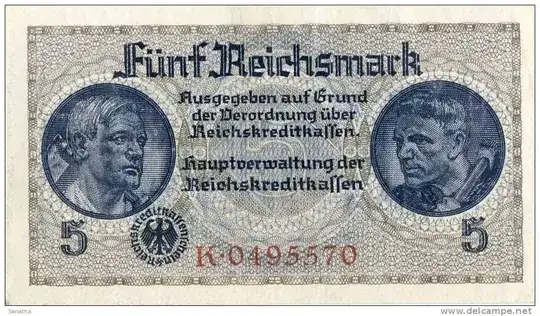
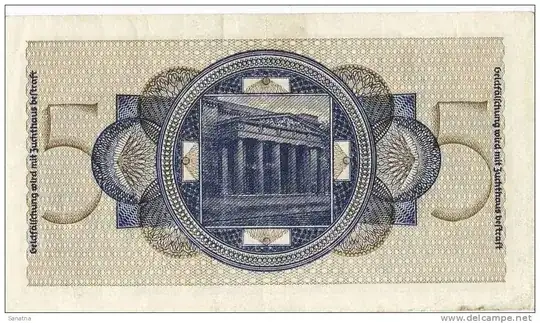
I have a 5-mark German banknote (I think from 1941 or 1942), looking exactly like this:enter image description hereenter image description here

I am curious why the banknote not only does not bear a portrait of Hitler, but doesn't include any German state symbols. The only swastika on the banknote is in the stamp of the Reichsbank (which is not a part of the banknote design).

Given the known Nazi interest in symbolism this is quite surprising.

Joe
  • 10,454
  • 5
  • 52
  • 120
Anixx
  • 32,728
  • 13
  • 90
  • 183
  • 14
    Interesting question given the propensity to brand everything. Today the symbol is banned in Germany so even a display of old timetables at the airport to mark some Lufthansa anniversary recently had little black stickers over the offending logo. – none Mar 13 '12 at 17:28
  • @Anixx I edited for clarity and removed the supplemental question about the colors because it may distract from the main question, in addition to leading the question in more than one direction. Re-edit if you think anything important was lost. – stevvve Mar 13 '12 at 17:39
  • 3
    You could search for a banknote from before nazi taking power, and see if it features the same design. – o0'. Mar 13 '12 at 18:44
  • 12
    @Lohoris: That would be pointless - it is an Occupation Reichsmark, those were printed specifically for occupied territories and never circulated within Germany. They are entirely different from the "regular" Reichsmark. – Wladimir Palant Mar 14 '12 at 11:26
  • Btw, it is easily explained why you don't see Hitler on Nazi money: the head of state was still the president, not the chancellor. Hitler merely decided to leave the post of the president vacant after Hindenburg's death. Nevertheless, Nazi coins show Paul von Hindenburg, not Hitler. But that doesn't explain the lack of swastikas of course. – Wladimir Palant Mar 14 '12 at 12:10
  • 10
    First, you are wrong, he conbined the post of president with that of chancellor. He was undoubtly head of state. But anyway it is not necessary print exactly to heads of state on the banknotes. Very often revolutionary leaders got printed as Lenin in the USSR even after his death. If you look at the Soviet money at the time, btw, you will see portraits of Lenin and multiple instances of state symbols including the state emblem, symbols of Communism such as hammer and sickle and five-pointed stars in various combinations. US dollars also included the president and the seal. – Anixx Mar 14 '12 at 14:39
  • Yes, I should have checked - I remembered that incorrectly. Then I don't really understand why they printed Hindenburg on the coins, even after his death - that is unusual, coins traditionally show the current head of state if any. On the other hand, it is quite common to have famous dead people on banknotes (George Washington on US $1, Carl Friedrich Gauß on 10 DM). This banknote however presents Germans as a nation of hard workers instead. I couldn't find the process of thought that went into it anywhere. – Wladimir Palant Mar 15 '12 at 07:55
  • @WladimirPalant I guess it was part of the Nazi "we're worker-friendly" propaganda spiel. – quant_dev Mar 17 '12 at 16:04
  • It is quite normal that they printed workers. What is surprising is that there is no coat of arms, emblem, eagle, swastika or any other state symbol. – Anixx Mar 17 '12 at 16:35
  • 1
    Interestingly, this 5Pf coin, coined by the Reichskreditkasse in 1940, does show a swastika. – sbi Mar 17 '12 at 22:17
  • 3
    So maybe the use of state symbols was prohibited on occupation marks? Or on banknotes? – Anixx Mar 17 '12 at 22:20
  • @Anixx: I really don't know (though I doubt it), and googling brought up lots of historical info on the Reichskreditkassen, and detailed description on the coins, but nothing on the design curiosity you noted. Sorry, but I have to give up on this. – sbi Mar 17 '12 at 22:38
  • 1
    @quant_dev: That's not really surprising - they were the national-socialist party after all. – Wladimir Palant Mar 18 '12 at 11:59
  • Depicting workers is normal for any country, not only for socialist ones. Look for example at this banknote from US state Georgia: http://propagandahistory.ru/pics/2012/01/1326350165_3011.jpg – Anixx Mar 18 '12 at 17:51
  • Most of the note designs was from before the Nazi government. Exceptions are apparently the 20 RM note seen in Davids' answer, which has a swastika, and more curiously, the 5RM note in your picture, which does not. – Lennart Regebro Sep 30 '13 at 12:55
  • There is a misspelling, "dernung" should be der ordnung. It's probably counterfeit. –  Jul 22 '14 at 02:03
  • 1
    Where is the misspelling? It says Verordnung. – fdb Jul 22 '14 at 10:12
  • I have some notes from the late 30s that have a swastika in filigram. Maybe it is the case. – Yves Jul 22 '14 at 15:04
  • What do you mean with "the stamp of the Reichsbank (which is not a part of the banknote design)"? It is not added later, after printing. In my understanding it is printed on the note as is, identical in position and orientation on all of these and therefore part of the design? – LаngLаngС Jun 18 '18 at 00:36
  • @LangLangC it is added later. I had a similar banknote, and the stamp was definitely that, a stamp. – Anixx Jun 18 '18 at 03:30
  • About Hitler's face: AH got paid for his image being used in postal stamps. This was an important source of personal income for him. An interesting legal question: IF his face had been on bank notes, would him have been paid? IF the answer is NO, then they would have one less reason to push for it. – Luiz Feb 05 '24 at 13:42

2 Answers2

26

The currency you posted is from an occupied territory, see the related wikipedia link.

If you read carefully, it says: Reichskreditkassen on the bottom, Nazi Germany issued these notes in occupied territories which weren't considered to the Reich's territory.

Note that these notes had completely different rules than real Reichsmarks, for example they were legal tender only in occupied territories, and couldn't be subject of a negotiation inside the Reich. Also the fact that it was independent from Reichsmarks, it added a layer of protection of real Reichsmarks. For example it could have been inflated separately from real Reichmarks. Take a note: 5 Reichmarks in German territories were minted on silver coins (I have one), not notes, an important difference!

Read more interesting facts of your banknote here.

I have only a subjective opinion on why didn't they have Swastika, since the webpages only give clues, not definite answers: The occupied territories had their own currency in this form, maybe this was easier to accept as legal tender than Reichsmarks. It was printed very differently to make it easier to separate from real Reichsmarks. Real Reichsmarks were printed approximately 3:4 ratio while occupation Marks were printed on the whole surface.

But if you check out other - in-Reich - notes, for some strange reason swastika doesn't seem to be overly used on banknotes unlike on coins.
CsBalazsHungary
  • 6,594
  • 4
  • 31
  • 64
19

Fascinating question.

Thank you for your comment on my first guess/answer, @Lohoris, it caused me to keep digging.

Revised answer:

I found pictures of German bank notes from the 1940s that do include the Nazi swastika and the swastika/eagle. For example, the "XX RARE CRISP UNCIRC WW2 NAZI BILL w SWASTIKAS 1 HUGE" has a large faint black swastika in the background and the "NAZI GERMANY CURRENCY RARE 20 REICHSMARK LARGE SWASTIKA IN MIDDLE OF NOTE" has both symbols. Here's a large image of the latter I found on a different site

20 Mark Banknote, 1939 - Crisp Uncirculated - RARE.

David Pointer
  • 1,083
  • 1
  • 9
  • 19