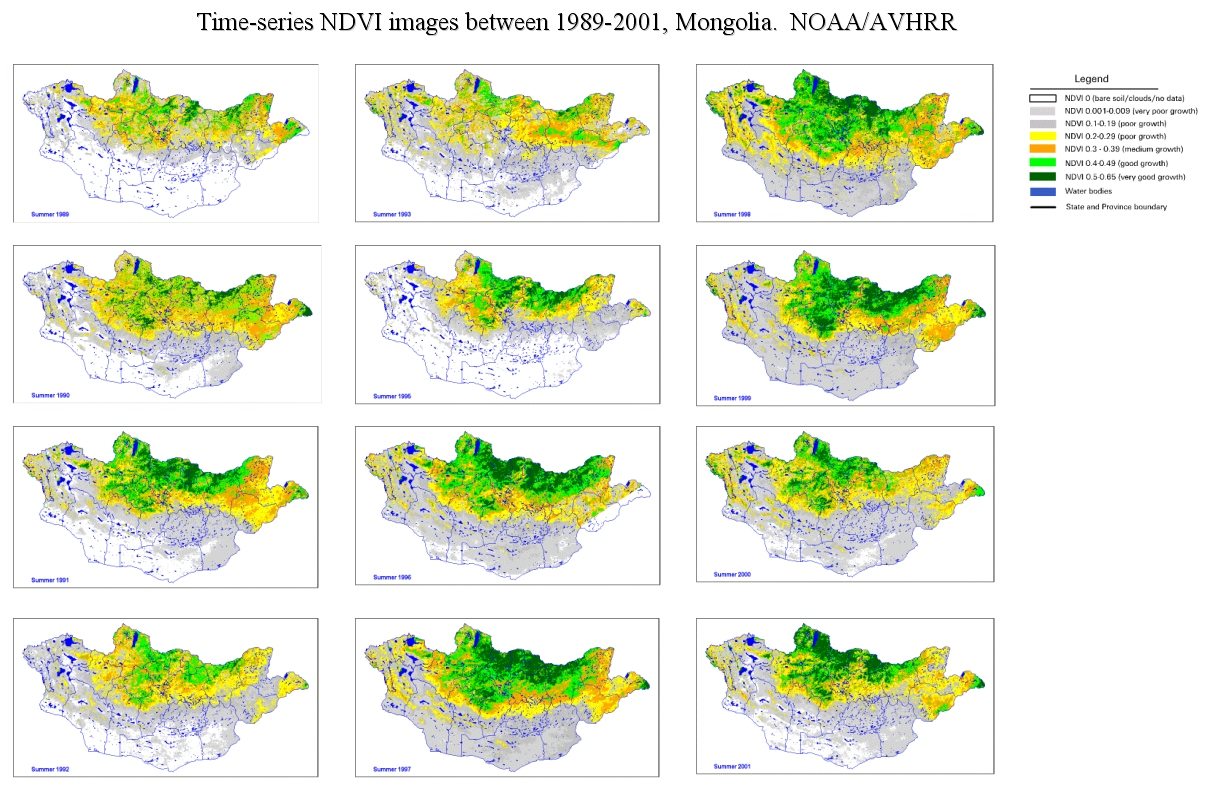
From a remote sensing point of view, what you usually want in a time series is a consistent profile in time. Due to the presence of clouds, atmospheric degradation and BRDF effect (different illumination due to sun-object-sensor geometry), using single images will often result in noisy profiles. RS time series are therefore most of the time based on composite images : a combination of several images to reduce the noise and fill the gaps due to the clouds. For instance, maximum value compositing is used for MODIS and Mean Compositing is used for SPOT VGT. Those are simple method compared with BRDF correction methods, but Mean Compositing is very robust. You can have a look here for a weekly NDVI time series from SPOT VGT in Europe (using Mean Compositing).
From the GIS point of view, it depends on what you want to analysis/display. Yearly composite (all images from one single year) are useful for trend anlaysis. On the other hand, multi-year monthly composite (all images for the same month) are useful to assess the seasonality of the different land covers. Finally, one composite per month and per year gives you a full time series where you can observe changes in the seasonal patterns, but will probably be very noisy and with plenty of gaps if you are using ASTER data, so you will need temporal smoothing with plenty of issues. In your case, the example you show is more like a trend analysis (or multi-annual variability), so you should group summer images every year. If you have a large number of images each summer, I would try to make composite instead of picking just one image, because summer could start or end at different dates, so adding more images will bring more stability and remove the subjectivity of your choice for "the best". If you only have a few images, just picking the best one could be a solution (otherwise you will have some artefacts)
From the data processing point of view, it may help to create monthly composites then combine them into yearly composites (reduce the size in memory), but his is not necessary. However, if you do so with the mean compositing, you need to account for the number of valid observations each month and make a weighted average; otherwise your results will diverge.