To answer this another question ("How to identify front of land lot?"), we need also to separate "property boundary" of land lot from public boundary of lanes, sidewalks and other public parcels of a city block.
There are another concept, between "privately owned" and "public" (not privately owned): the condominium, where the lanes, sidewalks, gardens, etc. are a commonhold of many land lot owners, tipically at the same city block. Some areas of some city blocks have condominium characteristics, because are shared areas.
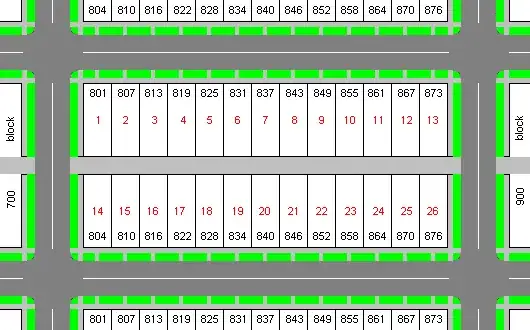
The city block illustration bellow show a case: a lane (light gray) in the block, that is not a "public" street (dark gray), but an access medium (like an alley) for land lot owners.
Translating this concepts to GIS:
There are many layers with this information: streets, lots (land-lots), blocks (city blocks), and others.
Some cadastral data have this information: the main source for Google Maps is the OpenStreetMap where (check its Wiki), many cadastral information (as low/high traffic) is provided. Many oficial data (from city municipalities) have list of names of public streets.
So, "how do I determine if a road is privately owned or not?", and not only at USA:
Use all informations. Start with the "oficial" or the "consensual" ones. Example: big (high traffic) roads, big streets, etc. that are always public, and oficial data (law) that express what are public.
Use parcels (blocks and lots) as reference about "inside/internal street": all that is internal of parcel polygon and is not at item-1, is suspected to be not public.
Example: a very low traffic alley, with no name, short length (block length), is a good candidate to non-public. An alley internal to a non-public land lot, in general (check USA/state/city rules), is a non-public street.
Important: all the "streets" contained into parcels officially declared as "closed horizontal condominium", are non-public.
(if you did it all yourself) Show and talk about with your pairs: refine and check information again, when your work is questioned.


