1

I'm in the process of creating a webpage to ease the process of visualizing NOTAM navigation warnings. Never done any geospatial software development before, so all the terms like geoid, reference ellipsoid, datums, different coordinate systems are new to me, though I've been doing a lot of reading up on the related material. I'm using the DotSpatial.Projections library to load the projection info either based on the EPSG code or the corresponding proj4 string. The target coordinate system is the one used by Google Maps API - (WGS84 / EPSG 3857).

I'm having trouble figuring out the proper conversion source coordinate system/projection. What I've come up with does not give the proper results: https://epsg.io/transform#s_srs=42310&t_srs=4326

The source coordinate system is described here: http://eaip.eans.ee/2018-02-01/html/eAIP/EE-GEN-2.1-en-GB.html#GEN-2.1-Geodetic

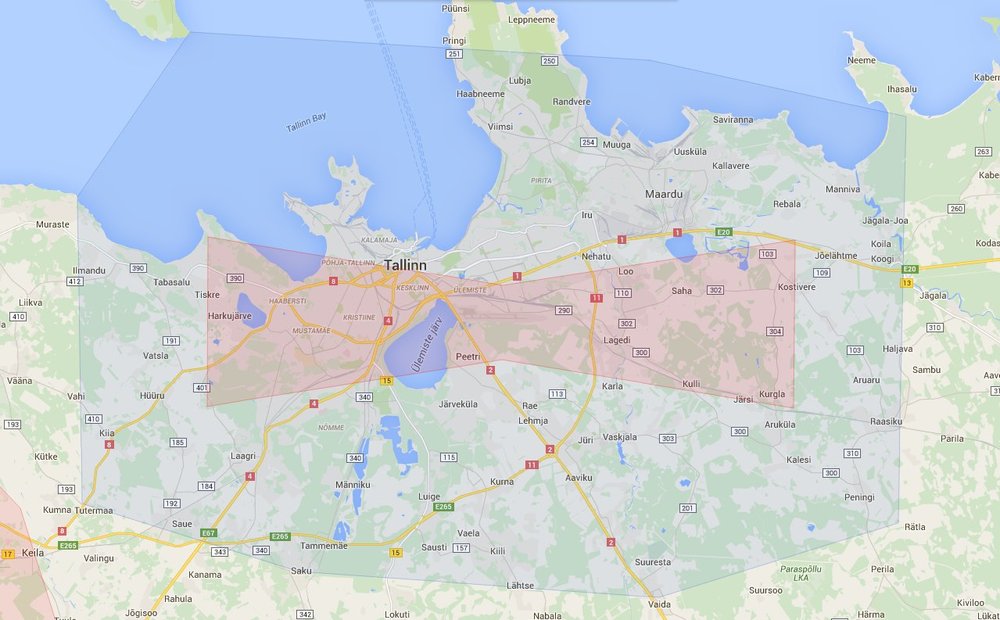
The converted nor the original coordinates don't align with the expected result. For example, the Zone 9 near north of Estonia surrounding Tallinn: Expected result, actual result on my website (large red/green polygon south of Tallinn)

Some proj4 strings I've come up with: NOTAM:

+proj=lcc +lon_0=24.0 +lat_0=57.51755393 +lat_1=58.0 +lat_2=59.3333333 +ellps=GRS80 +datum=WGS84 +units=degrees +no_defs

Google Maps:

+proj=longlat +ellps=WGS84 +datum=WGS84 +no_defs

The aforementioned two strings result in a very tiny projection near the reference point of the source coordinate system.

This application is initially for personal use as a drone pilot to visualize if there are any flight restriction zones active at a given time.

Mihkel
  • 111
  • 2
  • Given that navigation is the riskiest possible use of GIS data, it seems quite reckless to use data you don't understand. Just because libraries allow you to use the data doesn't mean doing so will be safe. I strongly recommend a semester or two of geography/GIS coursework before attempting a navigation application. – Vince Apr 08 '18 at 12:32
  • 42310 is using ellipsoidal Mercator rather than the spherical Mercator used by EPSG::3857. If it is, data will be offset north-south, often by kilometers. How about some actual coordinates for all these steps? – mkennedy Apr 08 '18 at 17:27
  • @Vince I get that and I completely grasp the seriousness of the issue at hand. Though, this application is initially for personal use as a drone pilot to visualize if there are any flight restriction zones active at a given time. – Mihkel Apr 08 '18 at 19:00
  • @mkennedy Here's a sample polygon: AIP (input): 593002N 0243035E 593227N 0243351E 593142N 0245804E 593012N 0251134E 591918N 0251110E 591718N 0245834E 591800N 0243934E 591908N 0243231E 592154N 0243044E 593002N 0243035E

    Reference Google maps (correct output): 593649N 0245122E 593188N 0245419E 592999N 0246594E 592883N 0249761E 593216N 0251861E 595033N 0251927E 595283N 0249677E 595408N 0245641E 595005N 0245097E 593649N 0245122E

    – Mihkel Apr 08 '18 at 19:01
  • Drone flights through do-not-fly could incur megafines and years in federal prison. This is not a safe thing you're proposing. Please [Edit] the question in response to requests for clarification. – Vince Apr 08 '18 at 20:27
  • @Vince I get that. But as of right now all I (and basically all the other drone pilots in Estonia) have to work with are NOTAM messages with a bunch of coordinates with no way to visualize them. I don't see any harm doing a map visualization for the given coordinates - which will be better than nothing (like it is right now). I have the input data, I have the expected output, I can write test confirming the conversion to the n-th decimal point precision - just need the correct conversion logic. – Mihkel Apr 08 '18 at 20:35
  • I feel like the Google values are decimal degrees but the AIP values are DDMMmm or DDMMSS (degrees decimal minutes or degrees minutes seconds) but I can't quite make them match. – mkennedy Apr 08 '18 at 21:43
  • @mkennedy Seems like that did the trick - converted original DMS values to DD values (no coordinate system conversion necessary). The initial visual verification is promising. Will do further testing. – Mihkel Apr 08 '18 at 22:39

0 Answers0