155

I am thinking of an alternative timing mechanism; I am building a trap and I wanted to try something different to set it off.

I want to drop a sheep from n blocks high so that I have a delay before the trap is triggered. The timing needs to be very exact, but I don't know how the falling mechanism works: whether there is acceleration, and how fast it is hit. (I understand this would be different for a chicken.)

Can someone give me some figures of the length of time it takes to reach the terminal velocity, and how many blocks per second a mob will fall at terminal velocity?

50 bonus points for the answer for chicken speeds as an extra: This will be applied after two days; the best answer in reference to chickens will get the bounty.


What do you mean, an African or European sheep? Alex

It is an Unladen European Sheep.

Now a Post on Physics SE

The winner is confirmed as he was the sole entry but thanks for all the comments which made the answer so brilliant, as soon as the system lets me i will be giving Caleb +100 bounty

Flaunting
  • 5,155
  • 10
  • 29
  • 60
  • 1
    Totally not going to post to Physics.SE.... Well, crap: http://physics.stackexchange.com/questions/129267/terminal-velocity-of-a-sheep – Kaz Wolfe Aug 03 '14 at 07:25

1 Answers1

147

Falling speed is explained in the "Transportation" page on the wiki:

Every tick (1/20 second), non-flying players and mobs have their vertical speed decremented (less upward motion, more downward motion) by 0.08 blocks per tick (1.6 m/s), then multiplied by 0.98. This would produce a terminal velocity of 3.92 blocks per tick, or 78.4 m/s.

Terminal Velocity

As stated above, terminal velocity in Minecraft is 78.4 m/s, but this speed cannot be reached in survival mode:

However, the sky isn't quite high enough for that: Falling from layer 256 to bedrock takes about 5.5 seconds, with impact at 3.5 blocks per tick (70 m/s).

In creative mode, you can fly higher, and could potentially reach terminal velocity falling from "above the sky".

Acceleration

Acceleration is not talked about on the wiki, however see the change in velocity over time in the following graph. The graph was created using the formula:

v(t) = (0.98t - 1) × 3.92
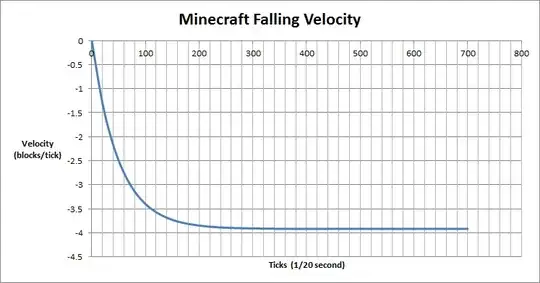
graph showing the change in velocity over time

You will notice that acceleration is not constant, and decreases over time.

How Long?

Using the velocity time graph, we can find how long it would take to reach terminal velocity.

10% Terminal Velocity (0.392 blocks/tick) : ≈ 5 ticks (0.4 seconds)

50% Terminal Velocity (1.96 blocks/tick) : ≈ 35 ticks (1.75 seconds)

75% Terminal Velocity (2.94 blocks/tick) : ≈ 69 ticks (3.45 seconds)

99% Terminal Velocity (3.8808 blocks/tick) : ≈ 228 ticks (11.4 seconds)

100% Terminal Velocity (3.92 blocks/tick) : ≈ 672 ticks (33.6 seconds)

Chicken Science!

I couldn't find anything on the falling speed of chickens, so I set my own apparatus to test. It involves a 10 block fall with a pressure plate at the bottom, turning on a redstone lamp. I start the timer at the same time that I press the button, and stop the timer when I see the lamp turn on:

My chicken-speed mechanism

I timed the fall of 3 different chickens to ensure accurate results:

Test 1: 5.0 seconds

Test 2: 4.9 seconds

Test 3: 5.1 seconds

This averages out at 5 seconds for a chicken to fall 10 blocks. Using the formula for speed we can calculate the speed of a falling chicken:

speed = distance / time

speed = 10 / 5

speed = 2 m/s

∴ The falling speed of a chicken is 2 m/s.

Higher?

As per the OP's request, I did the test again at a greater height, 50 blocks to be exact:

The top of my extended contraption, now 50 blocks tall

I timed the test the same as the others, and received another result:

Higher Test 1: 25.0 seconds

The first test I did came back with 25 seconds flat, I didn't feel a need to repeat any more tests:

speed = distance / time

speed = 50 / 25

speed = 2 m/s

Note: I was using unladen European chickens. I also noticed that chickens reach their maximum velocity as soon as they started falling.


No chicken were harmed in the making of this answer:

Chicken on the testing apparatus

Caleb
  • 9,225
  • 6
  • 35
  • 59
  • 23
    Where you using african or european chickens? ;) – Flaunting Jul 31 '14 at 09:38
  • if its a pain don't worry but could you do a second test to see if this is consistant with bigger heights. – Flaunting Jul 31 '14 at 09:39
  • 8
    No problem! Also, I am using unladen European chickens. – Caleb Jul 31 '14 at 09:55
  • Damn i stated earlier that is needed to be african chickens, i presumed u had due to the baron desert landscape sorry about this confusion – Flaunting Jul 31 '14 at 09:58
  • I gotta say that is damn impressive chicken science – Flaunting Jul 31 '14 at 10:00
  • 3
    The acceleration is d²y/dt² = -0.02/tick*dy/dt-0.0784blocks/tick² or -0.02/s*dy/dt-1.568m/s², from the formula in the answer. Feel free to solve the differential equation yourself to find the equation of vertical motion for minecraft sheep. – MrLemon Jul 31 '14 at 12:18
  • @user2357112 If I'm reading that sentence correctly, I interpret it as v = 0.981.6t, and thus d²y/dt² = dv/dt = 1.568, i.e. constant acceleration (and I have no idea how terminal velocity comes in). But then the wiki has a completely different formula for velocity right after that (which does have non-constant acceleration and a limit/terminal velocity of 3.92). It's a bad sentence. – Affine Jul 31 '14 at 14:30
  • I'm thinking it should read "decreased by 0.08 blocks per tick (1.6 m/s), then multiplied by 0.98 per tick", i.e. a = -0.08*0.98^t (which happens to be the derivative of the velocity formula on the wiki) – Affine Jul 31 '14 at 14:32
  • 2
    Up-voted this because it was thorough and entertaining. Generally though the answer is simple physics that can be found in any book, deciding on the constant for 'acceleration due to gravity' in whatever environment (Earth different from moon or some contrived place). There is no variation due to 'weight' but rather simple wind resistance. A ball of mass X will drop faster than a flat plate of the same mass because of its interaction with the wind (local space friction). – Darrell Teague Jul 31 '14 at 14:38
  • 2
    That may be true in real life but this is minecraft and i don't believe there is wind resistance but just straight raw coding deciding these factors. @DarrellTeague – Flaunting Jul 31 '14 at 15:43
  • 1
    @Flaunting Right. The purpose of the 0.98 is to simulate air resistance. Clearly this does not depend on the mass of an object. – Cruncher Jul 31 '14 at 16:56
  • @user2357112 Are you sure that is correct? The wiki states that it takes 5.5 seconds to reach 3.5 blocks/tick. It doesn't seem like it would take another 5.9 seconds to reach the terminal velocity of 3.92 blocks/tick. What formula did you use to get 11.4 seconds? Your correct in the fact that I calculated acceleration as a constant, but how would I do it differently? Personally I can't wrap my head around what formula you would use to do that. Finally, what gravity formula are you talking about? – Caleb Jul 31 '14 at 20:54
  • 13
    This is the best thing on the internet, today. – Wes Jul 31 '14 at 22:10
  • 1
    @Caleb: The gravity formula I'm referring to is the "subtract 0.08, multiply by 0.98" per-tick calculation. I didn't feel like solving the recurrence, so I just plugged the formula into Python and iterated to see how fast the sheep would be going at various times. In retrospect, I could've just asked Wolfram Alpha. – user2357112 Jul 31 '14 at 23:59
  • @user2357112 How would you calculate the average acceleration using that? – Caleb Aug 01 '14 at 00:08
  • You wouldn't. Average acceleration turns out not to be a useful measure. The average acceleration over any time period will be faster than the average acceleration over any later time period; you can't extrapolate from average acceleration to determine how fast something will be falling later. – user2357112 Aug 01 '14 at 00:15
  • @user2357112 Are my current calculations actually incorrect? Because all of the values make sense, and I don't think it is necessary to change anything unless it is actually wrong. – Caleb Aug 01 '14 at 00:29
  • Yes, your calculations are incorrect. – user2357112 Aug 01 '14 at 00:35
  • (The results for the chicken experiments suggest that if chickens require any time to reach maximum falling velocity, it's too short to accurately measure with humans timing single falls. A carefully-calibrated apparatus that sets up a chain reaction of falling chickens causing other chickens to fall might allow for higher-precision timing, but without more data or a more sophisticated test setup, I'd recommend leaving the chicken section as it is.) – user2357112 Aug 01 '14 at 00:42
  • @user2357112 From my observations, chickens are at maximum falling velocity as soon as they start falling. As for the acceleration, what would you do to fix it? – Caleb Aug 01 '14 at 00:50
  • 1
    I'd make a graph of velocity over time and point out when the sheep hits certain velocity milestones, like 50%, 90%, and 99% of terminal velocity. I think Excel should have the necessary capabilities. – user2357112 Aug 01 '14 at 00:57
  • @user2357112 I have have corrected all of the mistakes in my answer, please leave a comment if you have any more feedback. I really appreciate it! – Caleb Aug 01 '14 at 03:31
  • Looks good! Should I remove the earlier comment about incorrect acceleration calculations, as it's now obsolete? – user2357112 Aug 01 '14 at 03:37
  • @user2357112 Yes, I would delete it. Thanks for your help. – Caleb Aug 01 '14 at 04:09
  • I suggest inserting 0.08*0.98^t as the formula for acceleration as described in my earlier comments. This is ~ the derivative of your plotted velocity function, and sort of matches the quoted (unclear) description of acceleration. – Affine Aug 01 '14 at 04:19
  • 22
    Something tells me this got out of hand – Flaunting Aug 01 '14 at 06:44
  • 18
    Graphs! Chickens! Science! What's not to love? – Alex Aug 01 '14 at 08:55
  • Is there a formula i could use to determine the time it would take to fall from n blocks high @user2357112 – Flaunting Aug 01 '14 at 12:17
  • 1
    Mad proprs to the OP for the title and mad props to this answer for the totally awesome game science <3 - @DarrellTeague That's accurate but only for sufficiently small objects: physics.se post - check my comments in this question (and the answers) (couldn't resist posting this even if it's primarily because of my objection to the "weight doesn't matter" idea :P) – mechalynx Aug 02 '14 at 05:23
  • 1
    Based on the calculations in this answer and the maximum fall height, it sounds like the terminal velocity of a sheep is the velocity at which it hits the ground. – Mark Aug 02 '14 at 08:13
  • 2
    @Mark no, terminal velocity is the maximum speed that the sheep can reach while falling. – Caleb Aug 02 '14 at 08:22
  • @Caleb, Maybe Mark is right, after all, the sheep is going to die. – DatEpicCoderGuyWhoPrograms Aug 02 '14 at 19:33
  • I will call the American Society for Protection of the A... wait – Braiam Aug 03 '14 at 00:37
  • The ACTUAL APPROXIMATE terminal velocity is around 47 m/s. I LOVE the internet. – Kaz Wolfe Aug 03 '14 at 07:19
  • @Flaunting: There is, but it involves the Lambert W function, so it's not a very convenient formula. – user2357112 Aug 04 '14 at 05:57
  • @Mew: Really? What's the source of the discrepancy? – user2357112 Aug 04 '14 at 05:58
  • @user2357112, IRL sheep as reported on some wiki. – Kaz Wolfe Aug 04 '14 at 16:59
  • Why are there no references to basic physics here... which does apply to this game, which just has different factors for forces and units of measure... http://physics.info/falling/ – Darrell Teague Aug 05 '14 at 12:00
  • 2
    Update: With elytra, you can now reach terminal velocity in Survival as a player. But I think you can't take animals with you, because leashes break above y=256. Flying straight down with an activated elytra is even slightly faster than just falling. With TNT cannons, resistance and so on, you might have been able to get quite a bit higher than 256 before, too. – Fabian Röling Nov 20 '17 at 13:25
  • Note that this answer contains outdated information, the new minecraft worlds have an height limit of 4064 blocks, instead of the previous 256. This is big enough to reach terminal velocity while falling – Ferrybig Feb 19 '21 at 22:18