57

In StarCraft 1, I didn't halt worker production until I had 3 for every 2 mineral patches, and 3 for each vespene geyser. This was my own personal guideline, and I have no idea how efficient/wasteful it was.

What's an appropriate guideline for maximum income rate in StarCraft 2? Does it differ by race?

Mag Roader
  • 12,309
  • 19
  • 69
  • 115

4 Answers4

62

I know some people have answered this but I thought I could add a little data.

For gas, full saturation is 3, however the third isn't worth as much as the first two. As a result its worth getting a second geyser before putting a third worker on the first.

This is also true for minerals as shown by this graph: alt text
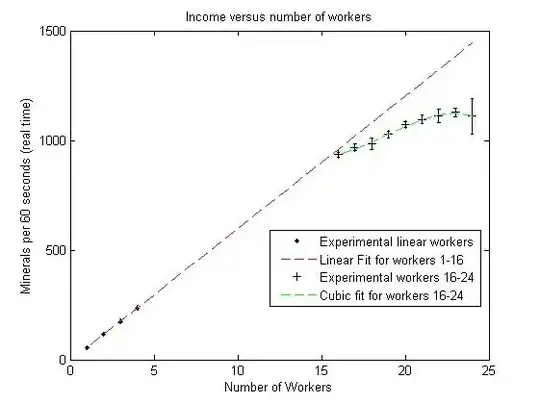
As you can see after your first 16 workers the gain per worker starts to decrease dramatically. As a result when you start an expansion you should shift any excess workers (over 16) to the new expansion.

The original research can be found in this paper: Worker Income Efficiency in Starcraft II By Chet 'Cheticus' V. The paper reports original data collection and methods, as well as the formula's uses for the 'least squares regression.'

tzenes
  • 44,685
  • 13
  • 151
  • 219
  • Can you cite the formula for that graph? – Joe Phillips Jul 23 '10 at 03:56
  • @Joe added to my answer – tzenes Jul 23 '10 at 15:46
  • Note, that the number of 16 workers is only valid if there are 8 mineral patches (as can be found in your source) – JochenJung Jul 27 '10 at 12:11
  • @JochenJung agreed. Since 8 mineral patches is the standard for maps, 16 is the "normal" number. However, we can abstract this to 2 per mineral until all patches have 2, and then 3 max. – tzenes Jul 27 '10 at 15:06
  • 1
    It does show that 24 works gathers faster than 16 though based on the graph. If you have 24 at all expansions you'd be gathering faster than just 16. – MetaGuru Sep 03 '10 at 17:06
  • @Shogun yes, but you have to consider the cost/benefit analysis of an additional 8*expansion supply that can't be used for your army. I'm not saying I don't build more than 16, but when I transfer I usually transfer everything in excess of 16. – tzenes Sep 03 '10 at 17:08
  • I've heard that 4 workers are required for full saturation of a far diagonal vespene geyser. Is this true? Whenever I've tried it, it always seems like one of them is just sitting outside the assimilator. – Lotus Notes Sep 08 '10 at 18:09
  • @Carl yes, but the gain on that fourth worker is in the 10-20 gas per minute range. – tzenes Sep 08 '10 at 19:01
  • @Shogun: 16 spread over 8 patches is faster than 18 spread over 6 patches. – alexanderpas Sep 19 '10 at 19:24
  • @tze, how can you easily transfer your excess in 16? Hotkeys? Clicking? – juan Oct 14 '10 at 15:48
  • 1
    @Juan box all my workers and preform the following calculation: Workers - 2*Extractor - 16 = number to transfer. Box accordingly and subtract (shift click) if I have extra. – tzenes Oct 14 '10 at 16:02
  • 1
    @Juan I demonstrate the technique in this video – tzenes Oct 15 '10 at 16:10
  • @JuanManuel: Note how each row is 8 units long. Two rows per base is optimal saturation. Three rows is maximal saturation. Simply count how much there are on the second page (if there is one), add 8 to that number and then select that amount of number to transfer them to your expansion... – Tamara Wijsman Nov 12 '11 at 14:43
4

Same values: 3 per gas, 3 per patch. I think that the in game tips also say that, but I got that info from looking at high-level replays.

Some players prefer less, though, for various reasons - less wasted supplies, for example.

Oak
  • 58,470
  • 68
  • 271
  • 424
3

3 is what is necessary to "saturate" a patch or geyser.

However, I like to play with about 5 for every two patches or so and 3 on each geyser.

This almost maxes out gathering speed, wastes fewer resources, and scales nicely when a patch is exhausted.

John Gietzen
  • 3,629
  • 26
  • 28
3

Since SC2 is much more economy based than SC:BW the golden rule is never stop producing workers!
If you get much more than 3 per patch: EXPAND and do a miner-slide (moving workers from main to expansion).

fschl
  • 5,463
  • 13
  • 40
  • 64