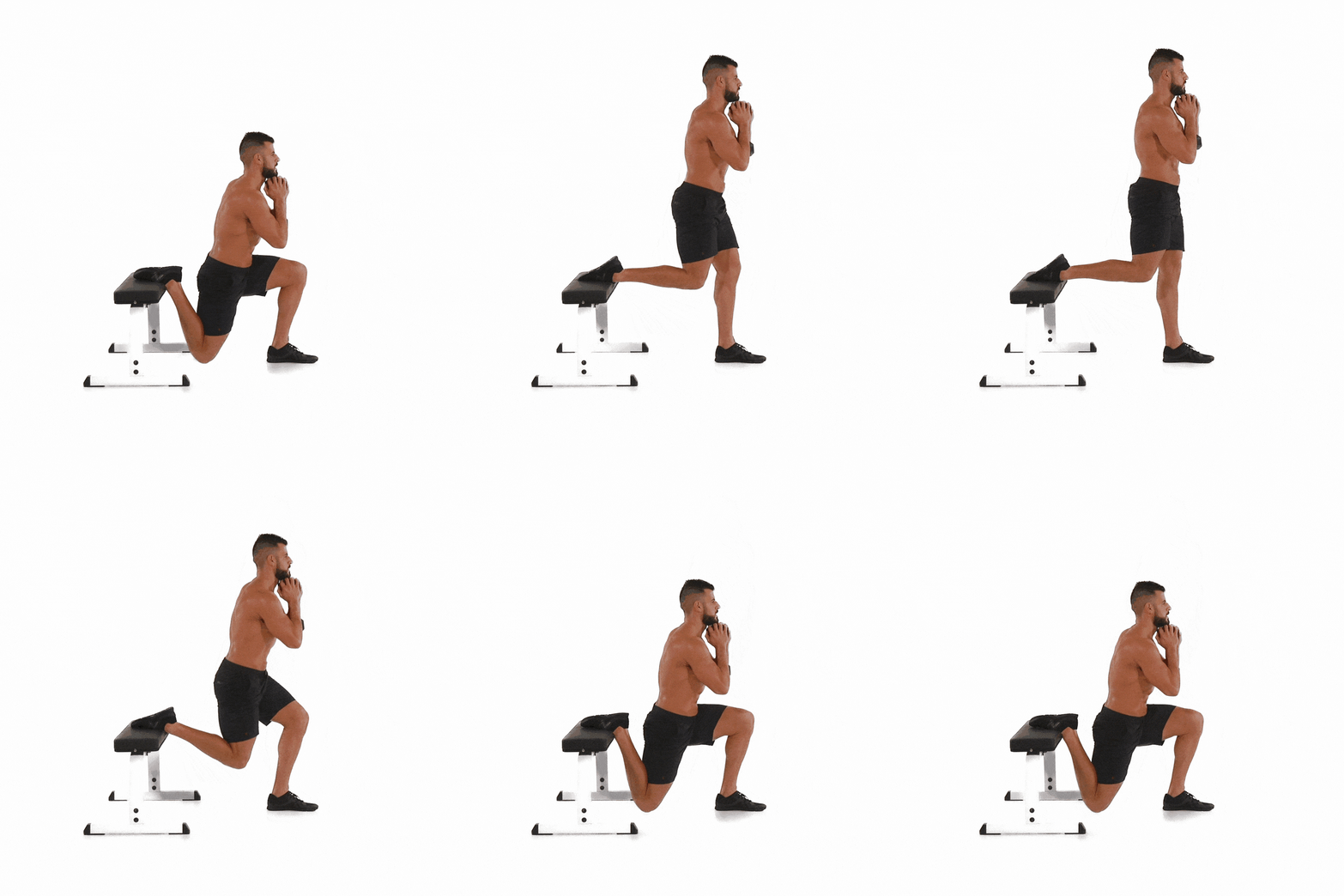
The legs don't have to work quite as hard as they would in a regular squat with the same weight, but it's very close, and they certainly have to work harder than in a bodyweight squat.
First of all, let's eliminate the idea that you aren't doing any work because you aren't moving the weight. Yes, you aren't imparting any mechanical work on the weight, but that's not necessary for the muscles to be working, where "muscular work" is defined as the rate at which energy is burned by the muscle to produce force. This is evident from isometric training, where the muscle exert against an immovable object, and in doing so consume energy and fatigue.
Now for how much additional resistance this would add over a regular (split) squat. Holding a dumbbell stationary during the exercise is identical to performing the exercise while pushing upwards on a fixed bar, with a force equal to the weight of the dumbbell. Both the arms are exerting upwards force when they normally wouldn't need to, and this force gets added to what is required of the legs.
As far as the legs are concerned, the big difference between this and a regular dumbbell split squat is that in this case the only additional loading provided by the dumbbell is a constant force equal to the dumbbell's weight, whereas in the regular split squat, the legs must both overcome the external load's weight, and additionally provide enough to accelerate it through the movement. This acceleration component is missing when the dumbbell is held stationary.
But how significant is the acceleration component? Let's model the squat as a vertical movement of 0.5m, with a complete rep following a sinusoidal pattern with period of 2 seconds. So x is the vertical position of the bar, v is its velocity, and a its acceleration.
x = 0.25cos(π*t)
v = -0.25π*sin(π*t)
a = -0.25π²*cos(π*t)
Peak acceleration occurs at the bottom of the movement, at t=1:
a = -0.25π²*cos(π)
  = 2.47m/s²
(Note that m in m/s² is metres, not mass.)
From this we can calculate force required to cause this acceleration, using F=ma, where F is force and m is the mass of the dumbbell:
F = ma
  = 2.47*m
Compare this to the force needed to overcome the weight of the dumbbell, which for any object on Earth is 9.81 times its mass. So with acceleration, peak force would be (9.81 + 2.47)*m, whereas without it, it's just 9.81*m, which is about a 20% reduction.
Also keep in mind that for the vast majority of people, the external load in a Bulgarian split squat is much less than their bodyweight. This means that most of the force they're producing is going towards holding the weight of and accelerating their own body, rather than the external load. So let's say they're a 75kg person using a 25kg dumbbell. The dumbbell only makes up 25% of the weight in that system, so the 20% reduction in peak force due to not needing to acceleration it decreases to a 5% reduction in peak force when bodyweight is accounted for.