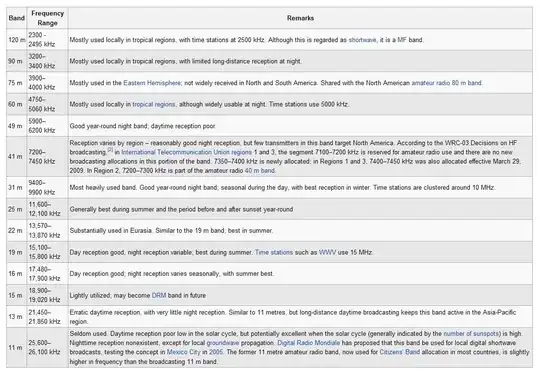
I have small Short wave receiver for the 7 broadcast bands. (49,41,31,22,19 and 16 meters) What Modulation do they use in this? The radio is a small grundig mini 300 world band reciever.
Asked
Active
Viewed 1,228 times
2

-
Your receiver booklet should tell you this. It possibly also depends on what country you are in. – Andy aka Jun 02 '13 at 13:31
-
It doesen't say anything. It only says the frequencies and the meters – skyler Jun 02 '13 at 13:37
-
Just about anything. The main consideration is bandwidth and quality. A BFO (beat frequency oscillator) is useful for picking up SSB etc. I would expect the receiver circuits to be aimed mainly at amplitude modulation. – JIm Dearden Jun 02 '13 at 13:37
2 Answers

2
All "short wave" public broadcast I have ever listened to were plain old AM.
You will find some SSB (single side band) and OOK (on/off keying) interspersed in various bands between the "short wave" stations. Those require different demodulation techniques to recover the signal. A regenerative receiver can demodulate AM and OOK easily, and SSB sortof if very carefully tuned. For most practical purposes, you need a receiver specifically intended for SSB to properly receive it.
In general, something called a "short wave radio" is little different from a AM radio except in the range of frequencies it can be tuned to.

Olin Lathrop
- 313,258
- 36
- 434
- 925
-
so on a certain freq. I hear morse, but the on for the morse not a beep, and just less fuzz. Is this morse transmited in single side band? – skyler Jun 02 '13 at 14:20
-
There are a few broadcasts in digital radio mondiale, which is a OFDM, QPSK modulation. – Phil Frost Jun 02 '13 at 14:20
-
@skyler that sounds like CW (the most common modulation for sending Morse code) through an AM receiver. CW is simply keying a simple carrier on and off. When this carrier is on, amplitude is constant, so you hear silence. When the carrier is off, the amplitude is random noise, so you hear noise. – Phil Frost Jun 02 '13 at 14:23
-
@skyler: That Morse is using OOK as I mentioned. That is a common way to send Morse signals. The transmitter is simply turned on for dits and dahs, and off in between. That will sound mostly like clicks with pure AM demodulation, sometimes with the fuzz you mention. You need a reciever with a beat frequency oscillator (BFO) or something like a regenerative receiver to make a tone when the transmitter is on. It sounds like you have a normal AM-only short wave radio. Most of them are like that. – Olin Lathrop Jun 02 '13 at 14:42