1

I have a driver module came with its differential input signal wires as shown below(red, black, green):

enter image description here

I provide the signal from DAC with diffential outputs.

My question is, since its not twisted shielded cable and the wire is made up of sig+, sig- and GND; how should I twist them as a good practice? Should I twist sig+ and sig- only and altogether or none?

GNZ
  • 1,729
  • 5
  • 28
  • 59

1 Answers1

-1

Yes. The best way is to twist the sig+ and sig- uniformly. Don't add any other signals to the twisted pair. This way, there will be no un-even noise on the pair. If you add any other wires in between, there will be a risk of injecting noise from that extra wire.
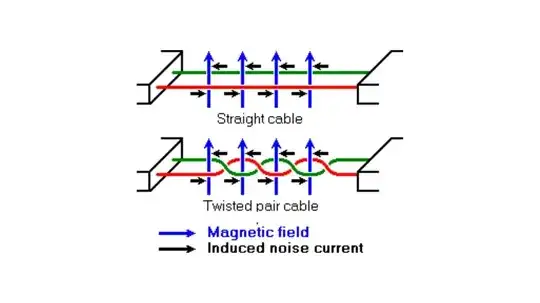
Twisted Pair Cables: How it Works and Benefits Explained

The twisted pair is used to create a cheaper solution to shielding. However, if a cable provides the shielding on top of the twisted pair, it is the better solution. The shield must be connected only on one side of the cable to the GND (No current should go through the shield itself).

For example for RS485, we can do this:
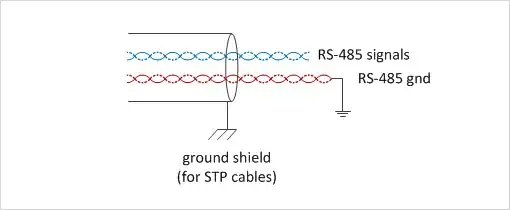
RS-485 Wiring Guide

In this picture, they probably used a pair for GND to gain a lower wire resistor. I don't think it makes a difference to use a single wire for GND.

If it's not possible in your project, the simple twisting of the pair of sig+ and sig- of your DAC should do the job.

Saadat
  • 1,621
  • 8
  • 14
  • sig+ and sig- in my case are inverted diff signals and there is also ground. what should be done to the gnd wire. see my photo green is gnd. red and black are sig+ and sig-. so thre are 3 wires not 2. – GNZ Sep 14 '23 at 10:39
  • Most of the time, it's ok to connect the GND of both systems. However, the pair signal usually can reject big common mode dc voltage. This is helpful in case we can not connect the GND signals of both ends. In case the signal output or input is isolated, then usually there is no GND to connect to. To be safe, you can measure the current going through the GND when you connect it to the other end. If there isn't any unusual current going through it (if it's just the signals and GND - no Vcc - it should be in a matter of a couple of 10 mA), then all is good. – Saadat Sep 14 '23 at 11:01
  • If the other end does not have GND, then just leave it. If you replace the wires with the shielded ones in future, you can connect the GND on one side to the shield. – Saadat Sep 14 '23 at 11:02
  • Both ends have gorund and i will use these wires. Please dont answer a question which I didnt ask bout. – GNZ Sep 14 '23 at 11:16