0

I have found myself in a situation where I need to test some components, among them some dimmer switches and wall outlets. But I have quickly been hampered by my complete lack of experience.

I am looking for a tool that will allow me to plug into a normal wall outlet, and get some installation cables out on the other side, preferably with some short-circuit protection in between just in case I mess up. I have seen test benches like that before but I have absolutely no idea what they are called or where to get them. I am hoping you can help with both.

Thank you

  • 1
    It is not at all clear what you want but I could suggest a multiple extension outlet with a build in circuit breaker and on/off switch. – Barry Dec 30 '22 at 23:13
  • Welcome to EE.SE but please note that direct shopping questions will result in fairly prompt closure of your question as per site rules. You can always edit it to remove the problem parts. – Transistor Dec 30 '22 at 23:21
  • Short circuit protection will be handled by the breaker. I very much suggest getting an in-line GFCI however. – vir Dec 30 '22 at 23:36

2 Answers2

2

Quicktest by CLIFF Electronic Components

CLIFF Quicktest power connection unit

(Manufacturer catalog photo)

You plug the unit into the wall, place wires into the clips, which are only energized once the lid is shut. A replaceable fuse limits current.

Searching finds several electronic distributors which carry it. I looked for other "mains test blocks" but I only found this brand.

user71659
  • 1,230
  • 7
  • 10
  • Be careful with these things. Often referred to as Safeblocks, they do not provide much, if any, safety. I've seen people assume that they provide isolation (like an isolation transformer) or earth leakage protection (like an RCD to prevent electrocution) but they do neither. You can see that they are just a dual pole switch. Handy for quickly connecting wire-ended products to, but it doesn't stop you leaving it closed, live, with wires dangerously hanging out. – Martin Dec 31 '22 at 13:10
2

Be aware that working with mains voltage is very dangerous. You may not have the experience necessary and should consider leaving this to someone else.

Some people build their own general purpose test setup. I built something similar to this a long, long time ago. I learned about the incandescent series trick after I built it.

It is very important to limit the risk of shock and fire. The isolation transformer will reduce the risk of shock. You want fuses with a much smaller current rating than your house breaker.

F2 must be sized to protect the Variac and isolation transformer. Large isolation transformers are very expensive, so you need to pick something that will meet your needs, but not cost too much.

If you want to power something with unknown status, open SW2 first. If your device under test is shorted, the worst that can happen is the lamp will light. Close SW2 once you are confident that your device isn't shorted.

The Variac autotransformer can be used to verify that your device will work with other than nominal input voltage. Many Variacs will allow you to boost the voltage slightly.
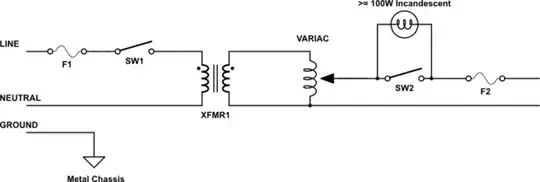
schematic

simulate this circuit – Schematic created using CircuitLab

Mattman944
  • 15,935
  • 1
  • 20
  • 47