The input poles of the input function decide the form of the forced response - step, etc.
If by "form" you mean whether it's constant or damped sinusoid or whatever -- yes. But the input function can have zeros, too, and those do shape the response. For instance, an input function of the form \$X(s) = \frac{a s + b}{s^2}\$ will have a step of amplitude \$a\$ plus a ramp with a slope of \$b\$.
The system poles decide the form of the natural response
Yes.
The amplitude of the forced and natural responses are dictated by ALL of the poles - both input and system.
Poles and zeros
if you consider a system that is completely underdamped, that will just continue to oscillate at the output when a step input.
You will see the input in the output, but a "forever" natural response could be there, too.
But note: if you're overly clever, the "forever" natural response won't be forever. Here's a "low pass" filter with zero damping, $$H = \frac{\omega_0^2}{s^2 + \omega_0^2}$$ where \$\omega_0 = 5(2\pi)\$. It's excited by a finite-duration pulse that someone just happened to arrange to be exactly five cycles of the filter's natural response.
It even has a Laplace transform -- $$X(s) = \frac{1 - e^{- s}}{s}$$
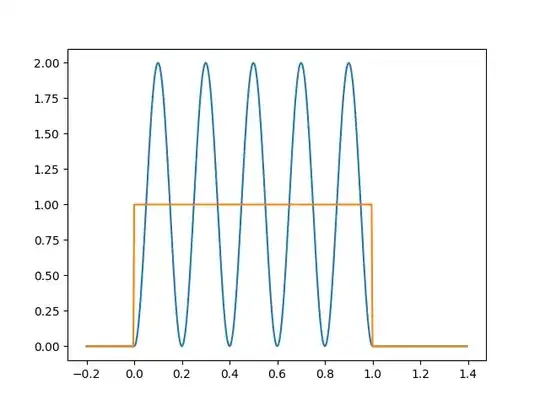
In time-domain terms, the reason that the natural response goes away is because the input signal acts like a step at \$t = 0\$, added to a negative step at \$t = 1\$. Because the "negative step" is an integer number of cycles after the initial step, it's response cancels out the natural response.
In frequency-domain terms, the reason that there's no persistent natural response is because \$X\$ has an infinite number of zeros on the imaginary axis at \$\omega = 2 \pi n\$. One of these falls at \$\omega = 0\$, which is why there's no persisting DC response to the input; another falls at \$\pm\omega_0\$, which is why there's no persisting natural response.


