1

I've been having trouble identifying the value of this resistor (see picture below) as the color codes in position does not make sense. It looks like a 5 band coded resistor. The 3rd band seems to be my cause of confusion as I can't make out the color. It looked like silver, or is it a gray?

But still, regardless of the reading direction (which I thought I got it wrong originally) and whether the 3rd band is silver or gray, the value produced is not in any of the standard/preferred resistor values.

Or maybe there's a band visibly missing (blackened or discolored or whatever)?

Or somehow I got it wrong, and it might not be a resistor but an inductor or others?

If possible could you let me know:

  1. What is the value of this resistor?
  2. What is this if its not a resistor?
  3. Is the 3rd band is a silver or gray?

I can't depend on my multimeter readings as its just a cheap one but is the only one I have at the moment.
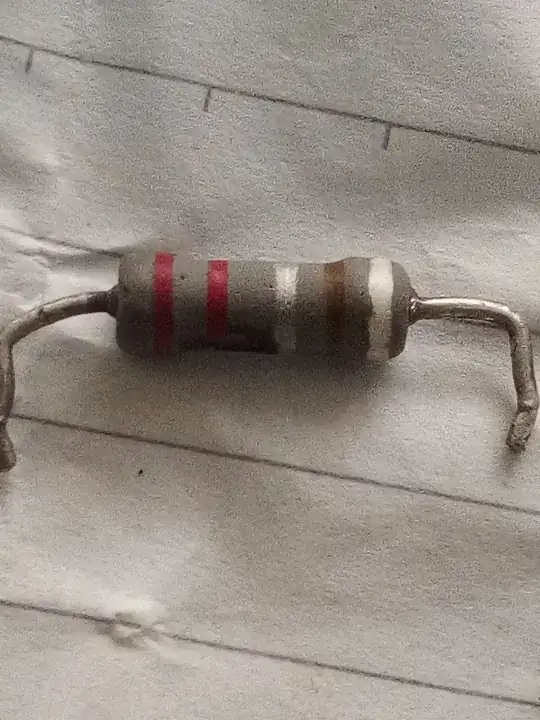
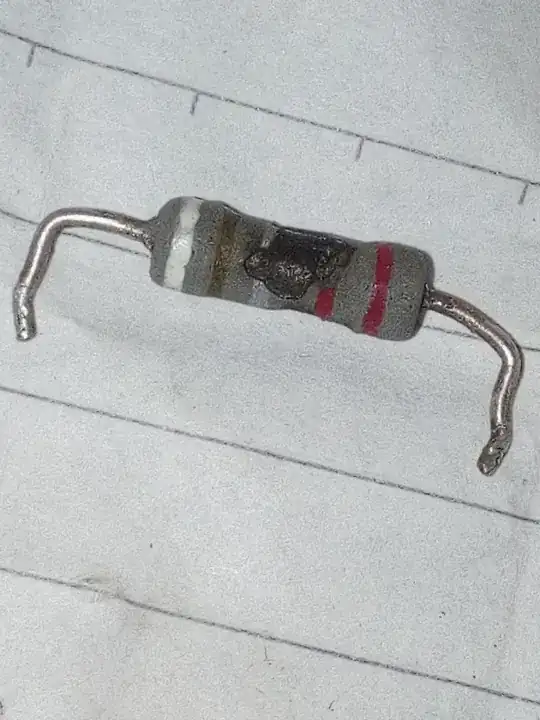
Resistor Color Bands The same resistor with blown side

colintd
  • 7,833
  • 1
  • 11
  • 34
  • You have it out of circuit !! Why don't you use a DMM to make some measurement of the ohms value of the thing?? – Michael Karas Feb 03 '20 at 14:25
  • 1
    Its blown, opened... DMM shown as OL (opened loop/circuit)... [Edited by a moderator] – user10176439 Feb 03 '20 at 14:28
  • brhans, thats the problem... The white strip/band at the end make it looks like a 5 bands ones! Confused me a lot! And its blown opened-circuit, the DMM report as OL (opened loop)... Avoiding any emoji(s), thou... Still, appreciate it all a lots. Thanks – user10176439 Feb 03 '20 at 14:32
  • Is there any more resistor on the same board with same colour coding? Also, it it is a 5 band resistor, the third one will signify the third digit.. in either direction it will be the same band.. and there is only definition for grey.. but not for silver .https://www.resistorguide.com/pictures/resistor_color_codes_chart.png – User323693 Feb 03 '20 at 14:50
  • Sorry for this may be stupid question... Assuming that it read 0.22ohms, the resistance is almost none and since i cant find (on my 1st look, and i hv stocks of used boards as my 1st too look for component replacement stocks) resistor of equiv value... Is it possible for me to use a simple wire jumper (low resistance, almost zero) as a replacement? I know its seems stupid but new components are hard to look for at my place (hv to travel return trip of 120km for the shops)... Is it possible or even advisable in such situation as mine? – user10176439 Feb 03 '20 at 15:05
  • @user323693, nope - this is the only resistor on that board (and/or any other stock boards that i hv) making the situation diff or else i can probably read from that or simply just take that similarly colored (assumed good) resistor from other board and plug it in; thanks thou, appreciate it; – user10176439 Feb 03 '20 at 15:22
  • IF you're still unsure about whether that extra band means enough to make this not a 0R22 resistor then you'll need to look at the circuit to get an idea of what function that resistor serves and what order of magnitude resistance you'd expect to see there. – brhans Feb 03 '20 at 17:11

1 Answers1

2

A white last band on a 5 band resistor, is commonly used to indicate a fusible resistor. This combines the function of a resistor (to limit current) and a fuse (to fail open circuit in the event of persistent overload).

Questions on these units most often come up after failure, when a resistance measure will show open circuit, and the questioner is struggling to decode using the normal 5 ring coding.

Ignoring the white band, the other 4 bands can be read as for a normal 4 band resistor. This particular unit looks like 0.22R 1% (RedRed=22 * Silver=0.01, Brown=1%). To match power you need to compare physical size with the possible replacements.

Replacement should be with another fusible resistor (to maintain circuit protection), but as with a fuse you will almost certainly need to locate and resolve the source of the overload first (else it will just blow again).

(Other last ring/body color combinations are also used to indicate fusible/non-flammable resistors, and more details can be found here Color Code for Fusible or Flame Retardant Resistors: Data Sheets, Standards?. However, this list is not exhaustive, and I have seen other similar combinations.)

colintd
  • 7,833
  • 1
  • 11
  • 34