3

Is there any quick and easy way to determine if a microwave oven is leaking radiation from the door edges? By quick and easy I mean without buying a dedicated meter.

And if there is an undetected leak, how far do microwaves generated by a domestic microwave travel in air?

John
  • 53
  • 5
  • 3
    How can it be quicker and easier than buying a dedicated meter? What you mean is "Is there a cheap way". – pipe Mar 08 '17 at 17:11
  • You can place a phone inside and call the phone. If phone rings, it means there is a leakage. But these are not microwaves. – user3219492 Mar 08 '17 at 17:21
  • 1
    One cheap way would be to test WiFi signal strength near a working microwave (assuming you have one running at 2.45GHz). – Dmitry Grigoryev Mar 08 '17 at 17:22
  • Replacing the microwave is the simplest way to prevent possible leaks. – skvery Mar 08 '17 at 17:37
  • 1
    how far do microwaves generated by a domestic microwave travel in air? Microwaves aren't magic, they are radio waves at about the same wavelength as WiFi. So the loss due to the atmosphere in dB will be roughly 20*log(distance in m) + 40. – Andrew Mar 08 '17 at 17:38
  • 1
    Weird, right before visiting this site, I put a Bluetooth speaker in my microwave to check if it blocks Bluetooth... (it doesn't) – sweber Mar 08 '17 at 17:52
  • 2
    This is going to sound wrong, but run hour hand along the edge of the door or seam with the oven turned on. If it's leaking.... you won't hold it there very long....... trust me. – Trevor_G Mar 08 '17 at 18:31
  • @user3219492 you'd be surprised how bad a test that is. Source: Been there, done that, live, with well-shielded microwave ovens. just read sweber's answer. Bluetooth even works on the same frequencies as microwave ovens, unlike phones (which typically use longer wavelengths) – Marcus Müller Mar 08 '17 at 21:11
  • Neon bulb will wirelessly light from Microwave energy. Scan for leaks. – Optionparty Mar 08 '17 at 21:42
  • @Optionparty Marcus and sweber; I need to try the neon inside the over first to see if that works and then may trust it enough to use as a simple leak detector. As for using bluetooth that also makes sense. Thanks. – John Mar 15 '17 at 15:17
  • @john neon bulb inside the oven will have the internal conductors receiving enough energy to arc and maybe break. Don't use an idea if you have doubts. – Optionparty Mar 15 '17 at 20:57

3 Answers3

5

What wattage/cm^2? Microwatts? Attowatts? All microwave seals leak. They may act more like a -60dB attenuator, rather than a perfect reflector.

If you're only worried about microwave heating (burns,) then any straight fluorescent tube-lamp will light up when held against a watts-scale door leak. Or, hold the terminals of an NE-2 neon lamp with fingers, and pass the glass lamp over the door seals, watching for orange flash. This is the same as tesla-coil lighting of a fluorescent tube. (Heh, actually a microwave oven chamber is a driven high-Q resonator. So in that sense the oven IS a 2.5GHz tesla coil.)

If instead you're looking for a high-milliwatts leak which might overload a receiver front-end, or perhaps hurt some sensitive electronics, then Tony_Stewart's trick with the red LED works fine. Simpler: two red LEDs soldered back to back in parallel, so both will light from AC. Add a 2" floating wire to to one side, hold the other with fingers as a ground, then pass the wire near the seal and watch for LEDs to glow.

I once took apart an active oven-leakage detector having a separate probe. The probe itself was a tiny pcb with a 1" ring trace, with six 1N4148 diodes soldered in a radial array, positive terminal pointing inwards to a central contact. The ring was ground, the pos terminal led to a resistor load and a 741 op amp. Obviously it was acting as a small loop, a nearfield probe-antenna with a diode detector. But they'd added five more in parallel, so the device would read roughly the same e-field regardless of probe orientation.

wbeaty
  • 10,925
  • 24
  • 39
  • This is great. The fluorescent, neon, and LED tests are well within my competence - for which read doable. And I will definitely try them. Would I burn out the neon or tube if I placed it inside the oven? Also can I use a nightlight neon for this sort of test? – John Mar 15 '17 at 15:20
2

Spread the leads of a 5mm LED with zener protection into a dipole and hold the lens with leads next to the seam. If there is any dim glow then you have leakage.

If you put inside oven and turn on it will explode the lens off with a big pop.

Tony Stewart EE75
  • 1
  • 3
  • 54
  • 185
-1

Put a cc of mixed water/fat on the external seam. It must remain cold.

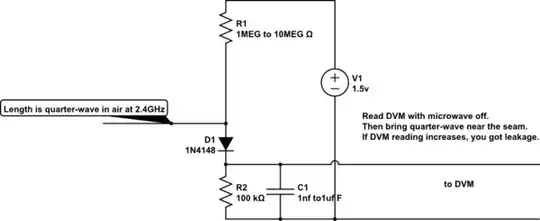
Or try this:

schematic

simulate this circuit – Schematic created using CircuitLab

analogsystemsrf
  • 34,253
  • 2
  • 19
  • 48
  • 2
    My doubts: The wire acts like an antenna? U have a diode so that both half (+ & -)waves don't result in NULL deflection. U have a LPF by that capacitor. V1 powers D1. Why is there a large resistor in series? BTW your water/fat answer is cool. – user3219492 Mar 08 '17 at 17:57
  • 3
    Can a 1N4148 deal with that high frequencies? – Oskar Skog Mar 08 '17 at 18:31
  • 1
    That circuit isn't going to work without a careful selection of components, a proper PCB layout, and an adequate board substrate. Don't use whatever through hole components you stumble upon when searching in your arduino breadbording bin. – Enric Blanco Mar 08 '17 at 19:16
  • We boost sensitivity by turning ON the 1n4148 with 1uA or .1uA of current. – analogsystemsrf Mar 09 '17 at 03:11
  • This is not quick and easy. I am an "enthusiast with attitude" not an electronics guru. To put this in perspective the question I posted came about because I followed instructions on how to carefully dismantle a microwave (to extract the magnets and motors mainly) and this set off a train of thought on the dangers of a leakage. – John Mar 15 '17 at 15:24