0

I broke open a dead LED night light before discarding it, and found this circuit:
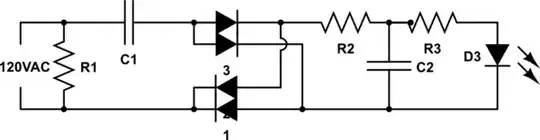
schematic

simulate this circuit – Schematic created using CircuitLab

I'm wondering how it works. The diode bridge (actually in one package) and the low pass filters for the DC power supply seem fairly clear, but I'm puzzling over the arrangement of the initial capacitor and resistor. My guess is that the capacitor and the rest of the circuit (bridge and right of it) forms some sort of voltage divider, sized to give the right voltage to the LED; I could imagine the need for a bleeder resistor, but I don't see how R1 does that, quite. Any insights?

Certainly a minimal AC-DC power supply!

Zeph
  • 269
  • 1
  • 8

2 Answers2

2

This is just a capacitor power supply .The reactance of C1 sets up the AC current for the bridge rectifier diodes.As Andrew Morton had commented this is much more efficient than a resistor .You could use an inductor here but the cap is smaller and cheaper .R2 limits surge currents at startup .C2 in conjunction with R3 filters the 100Hz current pulses from the bridge rectifier to stop led flickering .The resistance of R2 and R3 is chosen to be low compared to the reactance of C1 .The resistance of R1 is chosen to be high compared to the reactance of C1 .This means that efficiency can be good .If R1 were not present C1 could hold charge giving somebody a shock if they touched the bare mains plug prongs after power up and pulling the plug from the wall .I put R1 across C1 .If your cap exceeds 100nF then you must bleed it .The voltage rating of R1 must be understood .2 resistors in series is often seen as a way to address this .C1 must be a mains rated saftey cap .R2 must be rated for the surge currents that can occur at start up .

Autistic
  • 14,616
  • 2
  • 28
  • 65
  • I'd considered answering, but you covered all the bases I wanted -- including the command about charge held in $C_1$ that could present a shock risk at the plug ends (In the US, required to meet UL approvals.) – jonk Jan 28 '17 at 18:53
1

(not withstanding your schematic error)

If there was no LED , The secondary cap would charge up to the peak line voltage (1.414 x RMS)

The load of 2 R's for one LED is probably in the 300 ~ 500 Ohm range while the impedance of the primary C limits the average current. \$ Zc=\omega C , ~~I=V_{ac}/Zc~~~\$ , approx. (since most of the voltage drop is across it as you will see below.)

The 1st R provides a higher DC voltage with some filtering to reduce flicker and the 2nd R smoothens the current due to the fairly fixed low LED voltage.

This sim. will show you how it works with scope waveforms showing peak values at each stage (in slow motion) enter image description here

I assumed conservative values for 50Hz, for 120V the primary cap is 2x value.

Tony Stewart EE75
  • 1
  • 3
  • 54
  • 185