5

For our bar, I needed a refrigerator which could operate at 10°C in order to serve ale and dark beer at the ideal temperature. Being of the DIY bent, I bought an under-bench refrigerator second-hand and built a simple system to keep it at 10°C.

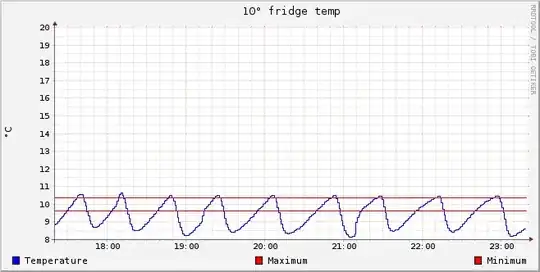
There is a one-wire temperature sensor in the refrigerator, and a microcontroller switches the fridge on at 10.375°C and off at 9.625°C (via a relay driven by a transistor and separate 12V supply).

This keeps the refrigerator acceptably close to 10°C, although I may experiment with turning it off sooner to try to reduce how low the temperature drops (although this will result in more on/off cycles). The temperature is graphed below (the red lines are the relay on and off points).
enter image description here

From this fine establishment

My question is: will treating the refrigerator like this shorten its life? Which components, if any, are being stressed by this setup, and how? If it is relevant, the fridge is relatively old and is unlikely to have digital control circuitry.

Russell McMahon
  • 150,303
  • 18
  • 213
  • 391
jbg
  • 152
  • 5
  • 1
    It shouldn't be a problem, because also the normal fridges are regulated to switch on and off in a similar way. – clabacchio Mar 04 '12 at 10:07
  • I concur. If anything, it is probably operating on a smaller duty cycle that it would normally. It might actually lengthen the service life. – drxzcl Mar 04 '12 at 12:49
  • 1
    Assuming the X axis is labeled in hours (not labeling graphs is bad), then this looks fine. It appears the fridge is on for 10 minutes out of every 40 or so. The important thing is to not turn the compressor on after having been on recently. Give it a few minutes, which you are doing, so I don't see a problem. – Olin Lathrop Mar 04 '12 at 14:37
  • X axis is hours. You’re right, not labeling graphs is bad. I’ll fix it… – jbg Mar 04 '12 at 21:34

1 Answers1

6

IF you have spare capacity then adding containers of water OR just ensuring there is as much Ale in the fridge as possible at all times will slow down the switching cycle.

A block of Gallium Indium Tin alloy would do very nicely. (Cost unknown.) Melting temperatures, degrees C. {From](http://en.wikipedia.org/wiki/Low-melting_alloy)

Ga 61 , In 25, Sn 13, Zn 1 8.5
Ga 62.5, In 21.5, Sn 16.0 10.7
Ga 69.8, In 17.6, Sn 12.5 10.8


Non expert comment:

If the x axis is hours I'd say it looks fine. If it's minutes (seems unlikey) I'd be nervous.

As you are in NZ the fridge is probably a Rankine Cycle compressor unit. If you had been in US then an absorption fridge would have been a significant possibility. Much rarer in NZ.

The compressor unit starts a small AC motor on each cycle start. Pressure in the system cycles and there is a degree of heat cycling but this is small due to low temperature differential. Really frequent starts (several per minute) would tend to place more mechanical stress on system than usual. Hourly or a few per hour starts are usual.

Russell McMahon
  • 150,303
  • 18
  • 213
  • 391