2

I am using a 4N25 opto-coupler for 5kHz to 10kHz application. In some datasheets the turn on and turn off times are mentioned to be 3us. I am wondering if this opto-coupler is suitable for my circuit's frequency. Doesn't it much distort the output which is supposed to turn on gate of a power Mosfet?

In a SE question, in the accepted answer, it is mentioned that connecting base to emitter via a resistor such as 220k or 470k can increase speed of switching. Does it mean that t_on and t_off decrease by connection via R_BE ? and how much can I expect to improve speed by that?

zahmati
  • 151
  • 6
  • Kelvin-Hertz is not a unit of anything meaningful to this question. – Olin Lathrop May 14 '15 at 11:55
  • @OlinLathrop Where is Kelvin-Hertz proposed? – zahmati May 14 '15 at 11:58
  • In the first sentence of your question - twice. Also, specifying resistors in units of degrees Kelvin makes no sense either. – Olin Lathrop May 14 '15 at 12:00
  • @OlinLathrop So how do you show Kilo Hertz? – zahmati May 14 '15 at 12:03
  • This is getting silly. This site is about electronics, not for teaching the basics of expressing units. We do engineering, and expect a certain minimum from anyone posting here. That includes expressing units properly. Surely there are many places that describe that. I'd start by looking around the NIST site if I needed to find one. – Olin Lathrop May 14 '15 at 12:06
  • 6
    @OlinLathrop I agree that this is getting silly. It was clearly a mistake, and the units were obvious, whether its KHZ, KHz or kHz. Correct the units, and move on, why berate him on units unless the understanding of the units was unclear, such a 5kF resistor. – efox29 May 14 '15 at 13:17
  • @efox: Because it's wrong. Use of proper units is important in engineering. We have standard abbreviations for a reason. I could have fixed it, but then the OP may have just thought "eh, who cares". This sort of thumbing of nose at our conventions and therefore at us has to be stomped on publicly, not just silently fixed. I didn't downvote since he fixed most of what I mentioned. Note though that he is still using dimensionless quantities like "220k" and "470k" as values of resistance. That's OK on a schematic, but wrong in text where Ohms can be easily specified. This stuff matters. – Olin Lathrop May 14 '15 at 16:54
  • 1
    @OlinLathrop You could have pointed this out to him politely and constructively, instead of with snark. It's not at all obvious what your first comment means unless you're already aware of the distinction, so I can only imagine it was an attempt to have a laugh at the OP's expense. – Nick Johnson May 14 '15 at 17:42
  • @Nick: This first comment was to get him to think about it and look for the error. Again, just correcting it or telling him outright could be too easily brushed off. It's useful to have the OP feel a little uncomfortable and to have others take notice. If you don't like being called on doing something stupid, don't do something stupid. – Olin Lathrop May 14 '15 at 21:15

2 Answers2

4

No it's rather unsuitable. The 2us given on the datasheet is with a load of 100\$\Omega\$- which is a totally unrealistic load when used in a simple circuit.

If you allow a CTR of 10% (half the minimum when brand new) and put 10mA through the LED, you'll have 1mA at the phototransistor. A load of 10K would be reasonable, so delays will be in the tens of microseconds. See this datasheet.
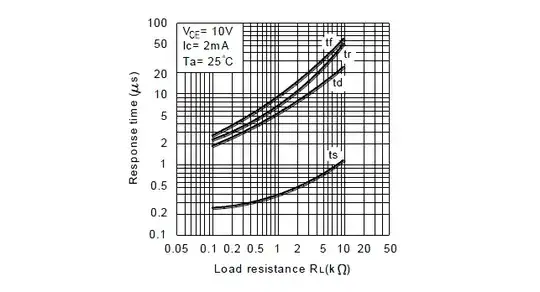
enter image description here

It's not quite as bad as being proportional to the load resistance, but well in that direction, so the 100 ohms condition on the datasheet could, at best, lead to a bad conclusion. You could put a complex circuit around the phototransistor and get down to the datasheet numbers (which are not ouright lies, just misleading) and the base resistor you suggest will further reduce the numbers somewhat (at the expense of CTR, so a simple circuit does not benefit).

I suggest you use a logic-output optoisolator such as the 6N137 or similar. They use a photodiode internally with a sensitive and fast circuit, which is a much more suitable method for high speed. Optoisolators with phototransistor (or photodarlington) output generally should be avoided where speed is of much importance.

Spehro Pefhany
  • 397,265
  • 22
  • 337
  • 893
  • So what opto-coupler do you think is suitable for this range of frequency? Any suggestion? – zahmati May 14 '15 at 11:59
  • @zahmati See above- it's easy to get guaranteed delays in the 100ns range, which should be quite acceptable unless you use a bad circuit where propagation delay has an effect on dead time (thus potentially causing shoot through in a bridge or half-bridge). – Spehro Pefhany May 14 '15 at 12:08
  • Thank you it helped much. Since I am using opto-couplers to turn on gate of Power Mosfet, does it mean that my R_L is very high which includes resistance of gate paralleled with a 10K resistor as pull down? Logic gate transistors seem to be good idea however I have 4 floating transistor with 8V voltage on them. which make usage of logic gate hard in this case. – zahmati May 14 '15 at 12:21
  • You need a MOSFET gate driver plus the optoisolator. If supplies are required- create them. This is outside the scope of the original question. – Spehro Pefhany May 14 '15 at 12:26
2

Your first question can be directly answered from the numbers you have provided. The fastest speed you want to pass is apparently 10 kHz, which has a period of 100 µs, and level times of 50 µs for a square wave. So is 3 µs susbtantially less than 50 µs? You really should have been able to see this yourself.

Note that the datasheet you link to only shows the typical delay to be 2 µs at 10 mA input current and 100 Ω load. You can only guess what the worst case is, but it seems likely to be a small fraction of 50 µs in any case.

Yes, you can speed up the turn off time by adding a resistor between base and emitter of the output transistor. This comes at the expense of the current transfer ratio.

Olin Lathrop
  • 313,258
  • 36
  • 434
  • 925